
How Apple collects before it pays (and 5 strategies for your cash flow)
Apple collects in 25 days. Pays suppliers in 100+. Result: 75 days of free cash. Here's the mechanism — and 5 strategies to apply it.
Nour Madani
CEO & Founder, Madani
Key Takeaways
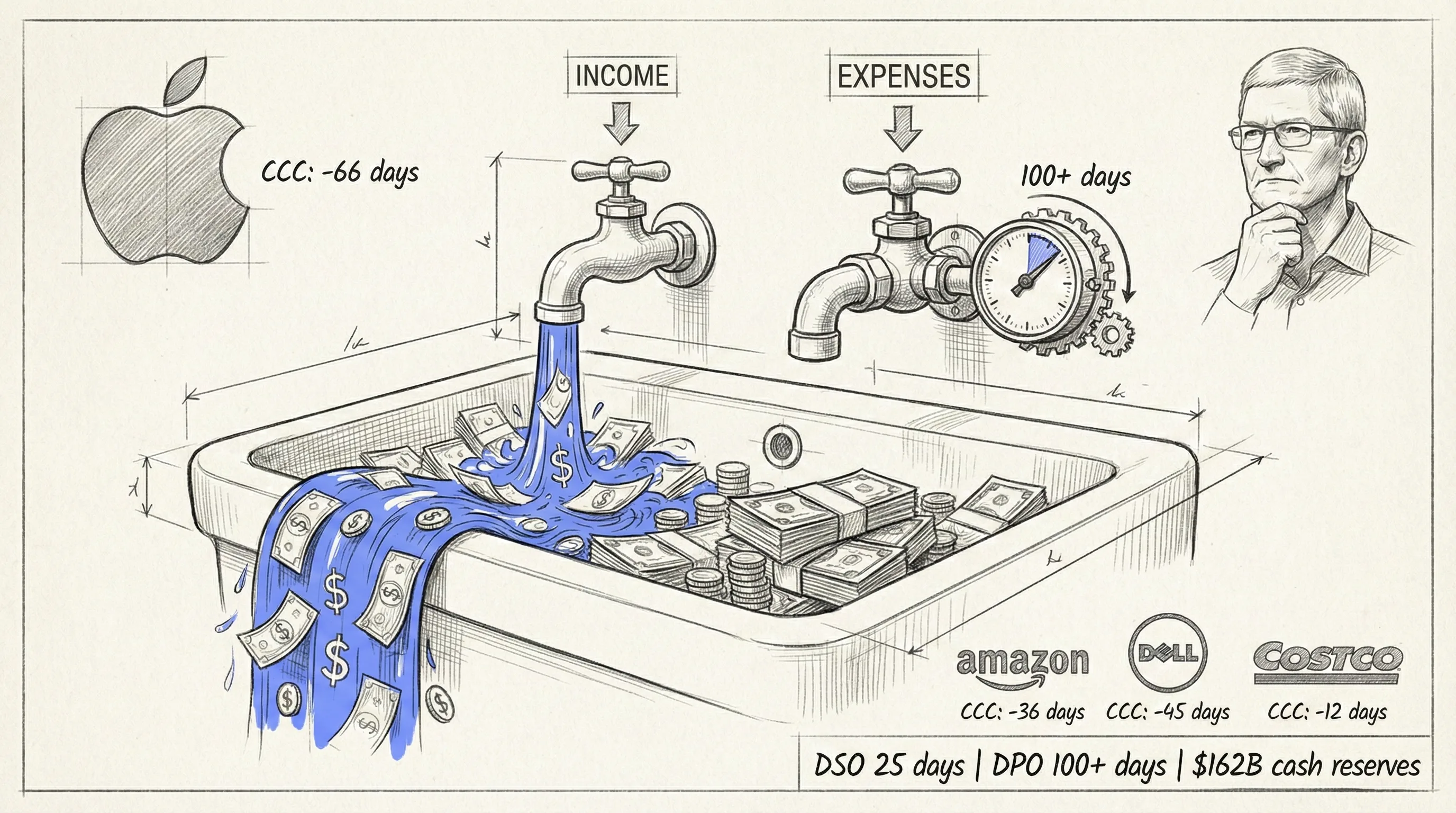
- →Apple has a negative Cash Conversion Cycle: it collects 75 days before paying suppliers.
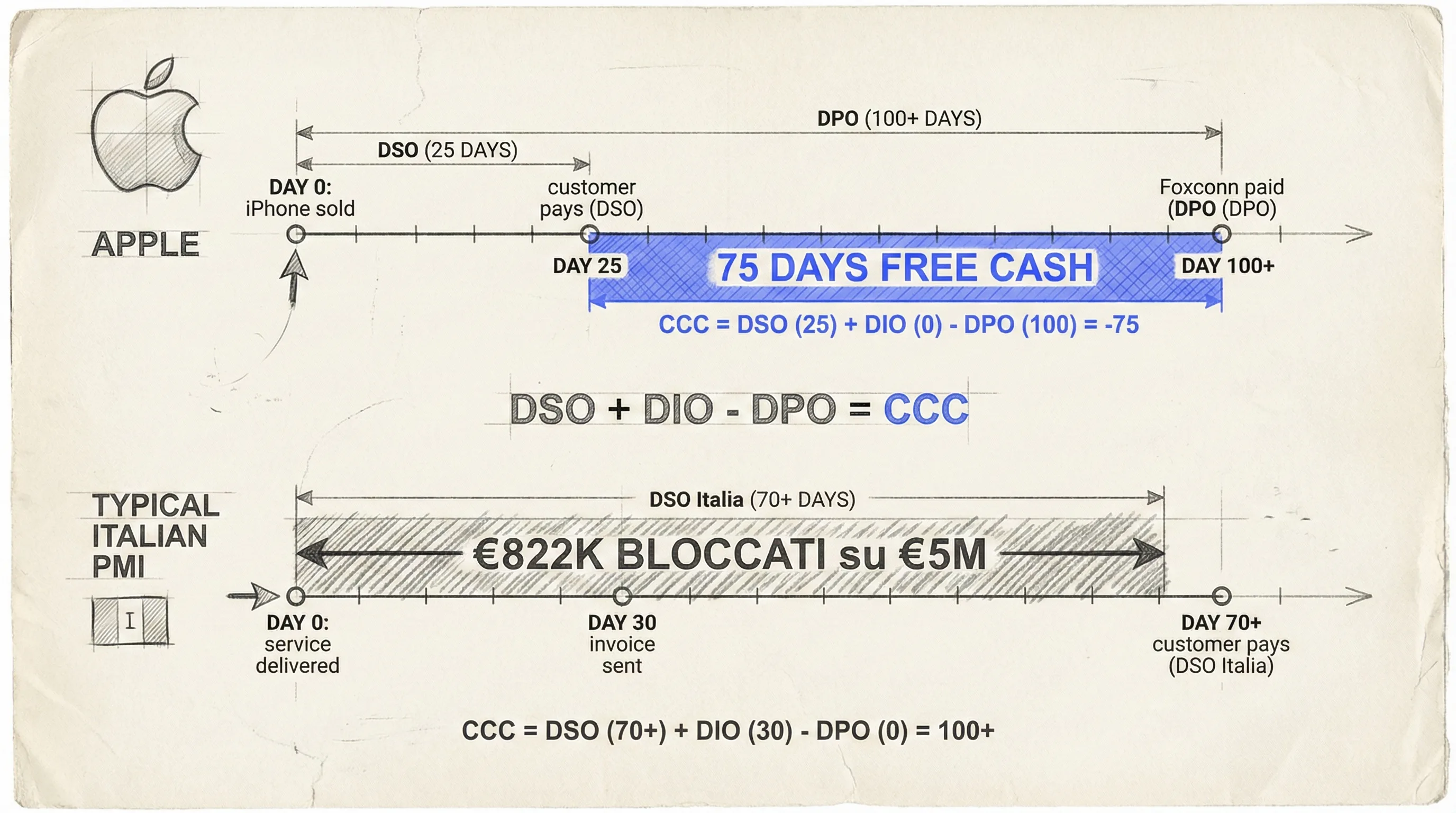
- →Italian SMEs have an average DSO of 70+ days. On €5M in revenue = €822K locked up.
- →Reducing DSO from 60 to 30 days frees €411K/year on €5M in revenue.
- →The 2/10 net 30 discount is equivalent to an annualized return of 36% — it always makes sense to offer it.
25 days vs 60+
Apple collects from customers in 25 days. Italian SMEs? 60+ days on average (Atradius, CRIBIS).
On €5M in annual revenue, a 60-day DSO means €822,000 locked up — money you've earned but can't use. You're financing your customers. For free.
The formula is simple: (Trade Receivables / Annual Revenue) x 365 = DSO. But the implications are enormous. A 60-day DSO means that at any given moment you have almost two months of revenue "frozen" — money that exists on paper but not in your bank account. For an SME with 15-20% margins, those €822K locked up represent the equivalent of 4-5 million in additional revenue in terms of cash impact.
Apple in 2023 generated $110 billion in operating cash flow. Not just because it sells a lot of iPhones — but because its financial system is designed to maximize cash velocity. Tim Cook, before becoming CEO, was the head of operations. He built the most efficient supply chain on the planet. The result: Apple sits on $162 billion in cash and short-term investments (Q4 2023, Apple 10-K). It's not luck — it's financial engineering.
Data
On €5M in revenue, a 60-day DSO = €822K locked up. Reducing it to 30 days frees €411K/year. — Based on standard DSO formula
The negative cycle
Apple's Cash Conversion Cycle (CCC) is negative.
- DSO (Days Sales Outstanding): ~25-30 days — Apple collects fast
- DPO (Days Payable Outstanding): 100+ days — pays suppliers very slowly
Result: 75 days of free cash. Foxconn assembles your iPhone and gets paid 3 months later. Amazon does the same.
The business self-finances. Growth without debt.
The third component of the CCC is DIO (Days Inventory Outstanding) — how many days inventory sits idle. Apple keeps DIO at about 9 days. That means products go from warehouse to customer in just over a week. The full formula: CCC = DSO + DIO - DPO. For Apple: 25 + 9 - 100 = -66 days. Every negative day is a day you're using someone else's cash to grow your business.
To understand the power of this mechanism: in 2023 Apple had a free cash flow of $99.6 billion. Enough to buy Netflix, Spotify, and Uber — simultaneously. And a large portion of that cash flow is fueled by the negative cycle, not just product margins.
Not just Apple: the trillion-dollar model
Apple isn't the only one. The largest companies on the planet share the same principle: collect before you pay.
Jeff Bezos wrote it clearly in the legendary 1997 shareholder letter: "We will optimize for long-term free cash flow generation over any other metric." Not profit. Not revenue. Cash flow. Amazon has maintained a negative CCC for over two decades — reinvesting every cent of cash "borrowed" from the cycle into growth, logistics, cloud infrastructure.
In 2023, Amazon's CCC was approximately -33 days. That means for every order, Amazon collects from the customer 33 days before paying the supplier. On $575 billion in annual revenue, those 33 days represent tens of billions of dollars in free cash flow.
But the real pioneer of the negative CCC is neither Apple nor Amazon. It's Dell.
In the 1990s, Michael Dell revolutionized the PC industry with the "build-to-order" model: the customer ordered and paid, then Dell assembled with components purchased from suppliers paid at 60+ days. The result: a CCC of -36 days in 2001. Dell grew in double digits without ever needing external financing. As Joan Magretta wrote in Harvard Business Review: "Dell turned its suppliers into its involuntary financiers."
The pattern is identical: Apple, Amazon, Dell, Costco, Walmart — all companies worth hundreds of billions or trillions of dollars. All with negative or near-zero CCC. It's not a coincidence. It's a structural principle: whoever controls cash flow controls growth. And whoever controls growth wins.
The question isn't "can I do what Apple does?" — it's "how can I shift my CCC by just 10-15 days?" Because on €3M in revenue, 15 fewer CCC days means approximately €123K more in available cash. No investors needed. No debt needed. Just the right principle — the same one that drives constraint removal.
Insight
Apple, Amazon, Dell, Costco: trillion-dollar companies share the same principle. It's not the product that makes the difference — it's the cash cycle.
The math of DSO
Let's take €5M in annual revenue:
- DSO 60 days → €822K locked up
- Reduce to 45 → you free €205K
- Reduce to 30 → you free €411K per year
€411K you can invest in growth, hire people, buy tools — instead of financing your customers. The same principle as finding the constraint: blocked cash flow could be the bottleneck holding everything back.
Italy vs Europe: the structural DSO crisis
Italy's DSO problem isn't an individual flaw. It's structural.
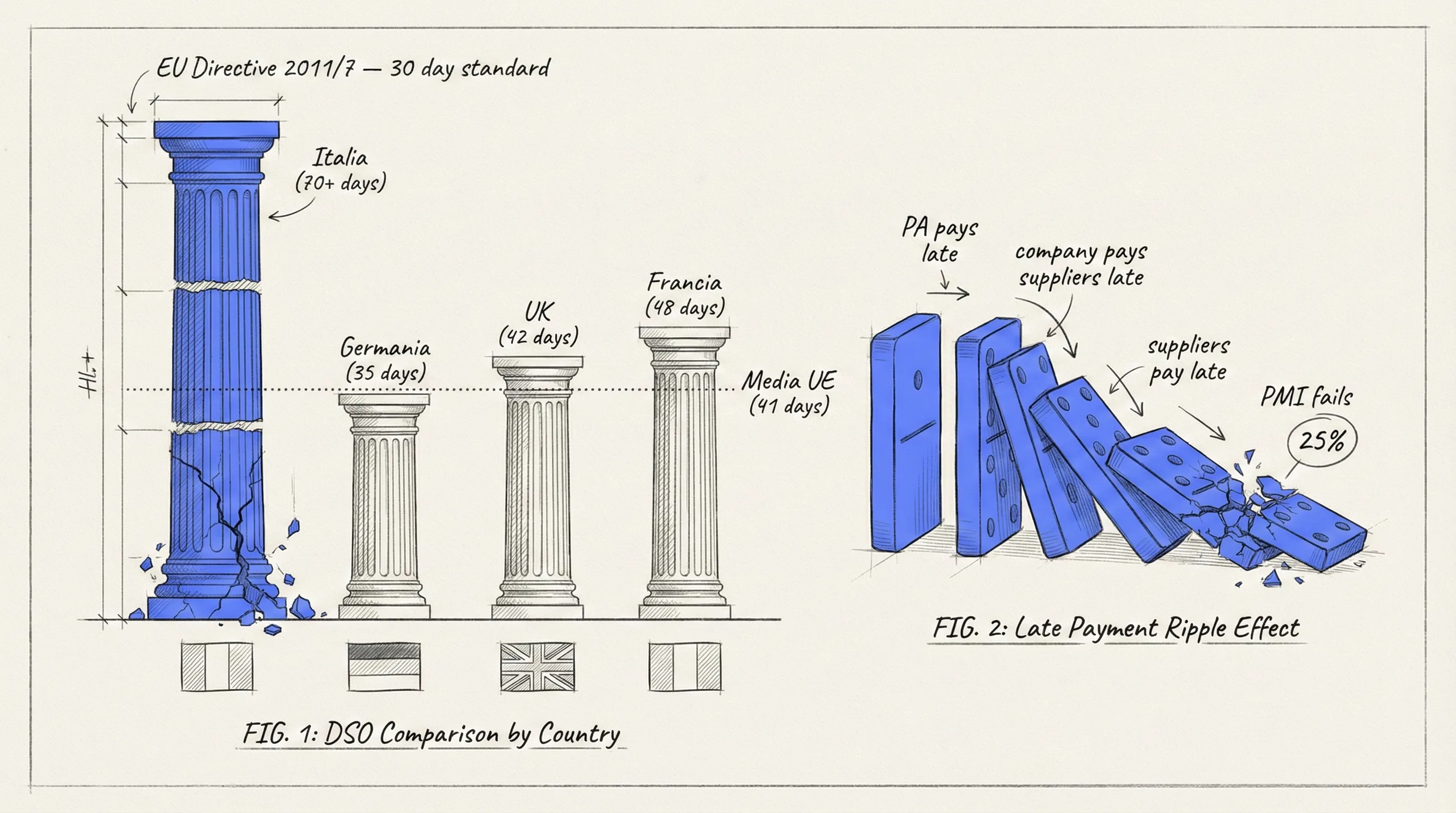
CRIBIS data (2023) speaks clearly:
- Italy: Average B2B DSO 70+ days
- Germany: 35 days
- United Kingdom: 42 days
- France: 48 days
- EU Average: 41 days
Italy pays at nearly double the European average. And it's not because Italian companies are less organized — it's a cultural and systemic issue rooted in the economic fabric. The "I'll pay you later" is practically an institution.
In 2011, the European Union issued the Late Payment Directive (EU 2011/7), establishing a 30-day standard for B2B transactions and 60 days for Public Administration. France implemented the directive with heavy penalties — fines up to €2 million for large companies. The result: French DSO dropped from 67 to 48 days in less than a decade.
Italy? It transposed the directive in Legislative Decree 231/2002 (updated in 2012), but enforcement remains weak. Italian Public Administration pays at an average of 100+ days, despite the legal limit of 60. And when the PA pays late, the effect cascades: the company waiting for PA payment delays payment to its own suppliers, who in turn delay. A chain of implicit debt that strangles SMEs.
According to an Euler Hermes study, 25% of business failures in Italy are directly linked to cash flow problems caused by late payments. Not low margins. Not the wrong product. Cash flow. Profitable companies that die because they can't collect in time to pay salaries, rent, suppliers.
The comparison with Germany is instructive. German companies systematically use Skonto — the early payment discount (equivalent to our 2/10 net 30). It's culturally accepted, almost expected. In Italy, asking for an early payment discount is seen as a "sign of financial weakness." It's exactly the opposite: it's a sign of sophistication in cash management.
For Italian SMEs, this means that improving DSO isn't just an optimization — it's survival. And it also means that whoever manages to break the cultural pattern has an enormous competitive advantage over competitors stuck in the 70+ day cycle.
Data
25% of business failures in Italy are linked to cash flow problems from late payments. Italy pays at 70+ days — nearly double the EU average (41 days). — Source: CRIBIS, Euler Hermes
5 DSO strategies
- Early payment discount (2/10 net 30) — 2% discount if they pay within 10 days. Seems small? Annualized, it's a 36% return. It always makes sense to offer it.
- Invoice immediately — not at month-end. The day you deliver, the invoice goes out. Every day of delay in invoicing is an extra day of DSO.
- Shorter terms for new customers — 15 days for new clients. 30 for those with a track record. Not the other way around.
- Automated reminders — day 7, 15, 25, 30. Automatic. Not "when I remember." The system reminds, you work.
- ABC customer analysis — 20% of customers generate 80% of delays. Identify them. Treat them differently.
Bonus: upfront payment. Ask for 50% at the start of the project. Many clients will agree — you've never asked because "it's not done." But Apple has always done it.
A note on the 2/10 net 30 discount: the math is counterintuitive. Are you "giving away" 2% of revenue? No. The 2% discount for 20 days of early payment (from 30 to 10) is equivalent to an annualized rate of 36.7% — calculated as (2/98) x (365/20). If your cost of capital is 6-8% (typical for Italian SMEs), you're paying "only" 2% to get cash that would otherwise cost much more in terms of missed opportunities, bank credit lines, or foregone growth.
For professional services, there's an unwritten sixth strategy: milestone billing. Instead of invoicing on project completion, invoice at milestones: 30% at kickoff, 30% at midpoint, 40% at delivery. On a €50K project over 3 months, you go from collecting €50K on day 90 to collecting €15K on day 0, €15K on day 45, €20K on day 90. The project's effective DSO drops from 90 to about 45 days.
Case study: from 72 to 35 days in 6 months
Theory is useful. Numbers convince. But nothing beats a real case.
A professional services firm in northern Italy. Revenue: €3M. Sector: engineering consultancy for manufacturing. 22 employees. DSO was steady at 72 days — in line with the Italian average, but devastating for growth.
72 days of DSO on €3M means approximately €592K permanently locked in receivables. Money earned, invoiced, but unavailable. The company had two open positions unfilled for 8 months — not for lack of work, but for lack of cash.
In 6 months they implemented three changes:
- Immediate invoicing. Previously they invoiced at month-end — regardless of when the project was delivered. A project delivered on the 3rd of the month was invoiced on the 30th. 27 days of DSO given away. They moved invoicing to the day of delivery. Impact: -15 days of DSO from this change alone.
- 2/10 net 30 discount. They offered 2% discount for payments within 10 days. 38% of clients accepted immediately. Cost of the discount: approximately €22K/year. Value of cash freed: over €180K. Discount ROI: 8:1.
- Automated reminders at day 7, 15, 25. They configured their management software (Fatture in Cloud + a Zapier workflow) to send polite but systematic reminders. The first at 7 days: "Confirming receipt of invoice — all good?". The second at 15: "Friendly reminder — due in 15 days.". The third at 25: "Invoice due in 5 days — can you confirm the payment date?". Before automating, reminders only came after the due date — when the delay was already underway.
Result after 6 months: DSO down from 72 to 35 days. Cash freed: over €300K on an annual basis.
With that cash they hired 2 senior engineers, took on 3 projects they previously couldn't handle, and closed the year with 28% revenue growth. No bank debt. No investors. Just optimized cash flow.
The key point: none of these three actions required significant investment. No expensive technology. No corporate reorganization. Just three operational decisions — and the discipline to apply them. Like in Toyota's Double Loop: you don't need new tools, you need to question the rules you took for granted.
“DSO from 72 to 35 days. €300K freed. 2 hires. +28% revenue. Zero debt. Three operational decisions.”
DSO is the faucet
Revenue isn't cash. Profit isn't cash. Only cash flow is cash.
And DSO is the faucet. Open it — reduce collection days — and cash starts flowing.
It's not sexy. It's not AI. It's not innovation. It's the most important thing you can do for your business this week. Like in the Salesforce system: the advantage is structural, not creative.
Peter Drucker wrote it in 1954: "Revenue is vanity, profit is sanity, cash is reality." Seventy years later, Italian SMEs continue to confuse revenue with financial health. A company with €10M in revenue and 90-day DSO is more fragile than one with €3M and 25-day DSO. The first is a ticking time bomb. The second is a machine.
This week, do one thing: calculate your real DSO. Not the theoretical one from your contract terms — the actual one, based on collection dates over the last 12 months. You might discover that your contractual DSO is 30 days, but your actual one is 55. That 25-day gap is your first intervention. And as we saw in the Gore Waterline Principle: this is an "above the line" decision — you don't need anyone's permission to start.
“Cash is not king. Cash FLOW is king. And DSO is the faucet.”
Frequently Asked Questions
What is the Cash Conversion Cycle?+
The Cash Conversion Cycle (CCC) measures how many days pass between paying suppliers and collecting from customers. A negative CCC (like Apple's) means you collect before you pay — the business self-finances.
What is DSO?+
Days Sales Outstanding — the average number of days to collect from customers. In Italy the average is 70+ days. The formula: (Receivables / Revenue) x 365.
How do I reduce DSO in my company?+
5 strategies: (1) Early payment discount (2/10 net 30). (2) Invoice immediately, not at month-end. (3) Shorter terms for new customers (15 days). (4) Automated reminders at day 7, 15, 25, 30. (5) ABC customer analysis — treat late payers differently.
Related Articles
Let's build the system for your business.
Let's discuss how to apply these principles to your specific situation.
Let's talk →