
How Salesforce built a $38 billion sales system (3 replicable pillars)
Salesforce generates $38B with 76,000 people. The secret isn't who sells — it's how the sales system is built. Three replicable pillars.
Nour Madani
CEO & Founder, Madani
Key Takeaways
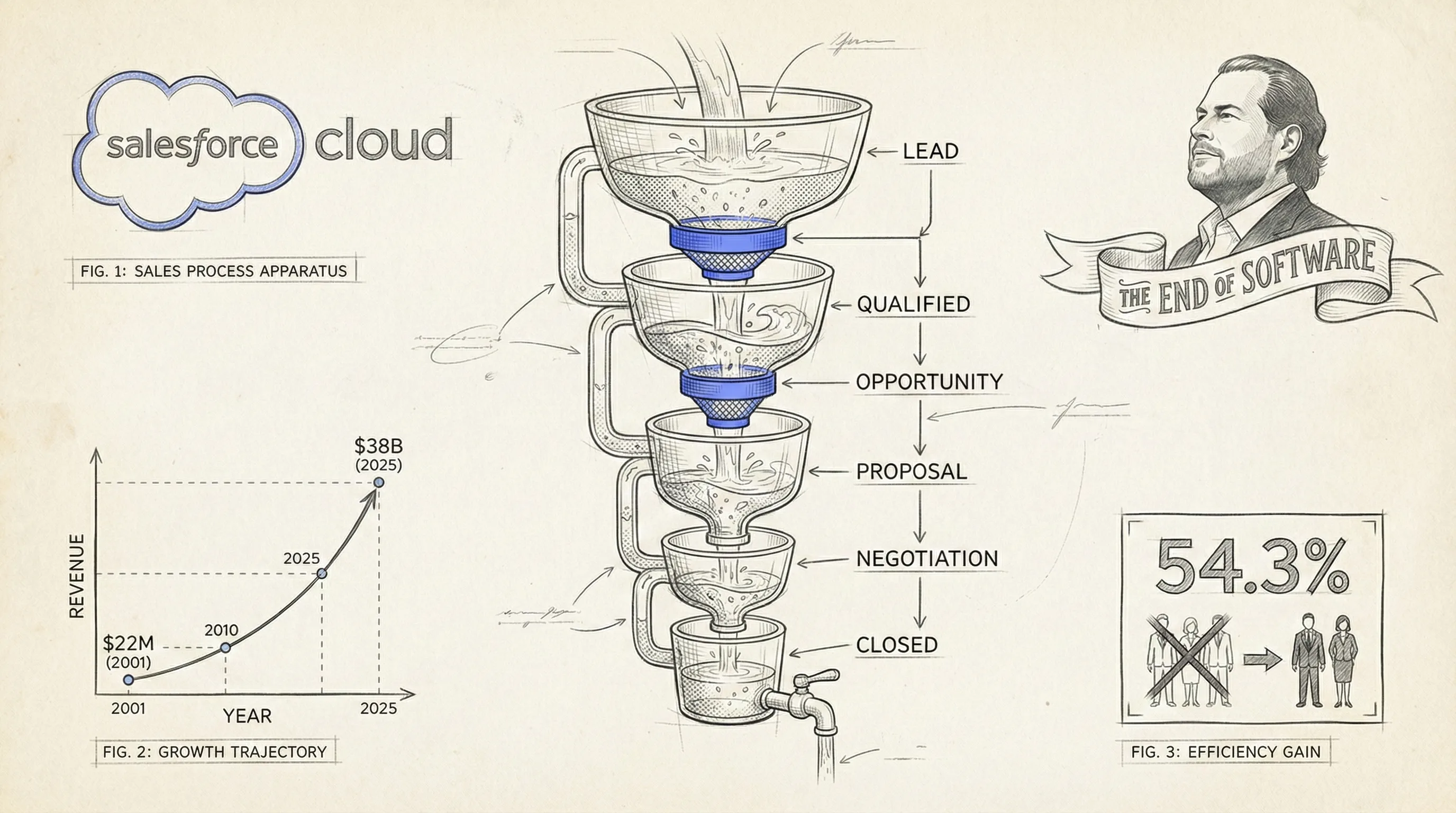
- →Only 54.3% of sales reps hit their quota. Half your team is underperforming.
- →Salesforce uses a 6-stage funnel with entry/exit criteria for each stage.
- →Stars leave. The system stays. That's why training must be documented and replicable.
- →Compare data by stage per rep — don't just look at the final result.
Not who, but how
38 billion dollars in revenue. 76,453 employees. The point isn't what Salesforce sells — it's how it sells.
The number that matters: only 54.3% of sales reps hit their quota (CSO Insights / Korn Ferry, 2023). Half your team is underperforming. It's not a people problem — it's a system problem.
According to Gartner, companies with a formalized sales process close 18% more than those that sell "by feel." McKinsey confirms: B2B organizations that systematize sales grow at twice the industry average. Yet according to HubSpot (State of Sales, 2024), 40% of sales teams don't even have a CRM — and those that do use it as an address book, not a system.
Data
Only 54.3% of sales reps reach their sales quota. — CSO Insights / Korn Ferry
From $22M to $38B: the story
March 1999. Marc Benioff is 34, the youngest VP in Oracle's history, earning millions. And he quits. The idea: sell software as a service, via the internet, no installations, no servers, no consultants at $500/hour. He calls it "The End of Software" — the end of software as a product.
He rents an apartment in Telegraph Hill, San Francisco. First office: a studio with a view of the bay. First marketing campaign: fake protesters outside the Siebel Systems conference with "NO SOFTWARE" signs. Journalists go wild. Benioff immediately understands that the sale starts with the narrative, not the product.
Then comes the dot-com crash of 2001. Tech startups die by the hundreds. Salesforce cuts 20% of staff. Revenue is $22 million — nothing by Silicon Valley standards. But Benioff doesn't change the model. He doubles down. While competitors return to on-premise software "because the cloud doesn't work," Salesforce stays on SaaS.
The numbers tell the rest: $22M in 2001. $176M in 2004 (NYSE IPO year). $1.3B in 2009. $8.4B in 2017. $26.5B in 2022, the year it surpasses SAP as the world's largest enterprise software company. $38B in 2025. A 34% CAGR for 24 consecutive years.
Benioff's key insight — the one most analyses miss — isn't the cloud. It's that selling is a system, not a talent. He learned it from Larry Ellison at Oracle: top performers sell their own way, and when they leave, the team collapses. Salesforce built the opposite: a system where the process produces results, not individual stars. It's the same principle as the Toyota Production System: the thinking system is worth more than the tools.
“The business of business is no longer just about money. It's about the system.”
— Marc Benioff, Behind the Cloud, 2009
6-stage funnel
Salesforce doesn't sell "by feel." Every deal goes through 6 defined stages:
- Lead — first contact, interest expressed
- Qualified — budget, authority, need confirmed
- Opportunity — the problem is real, the solution is clear
- Proposal — offer presented
- Negotiation — terms under discussion
- Closed — signed
Each stage has entry and exit criteria. You don't move to the next stage without meeting them. Everything tracked.
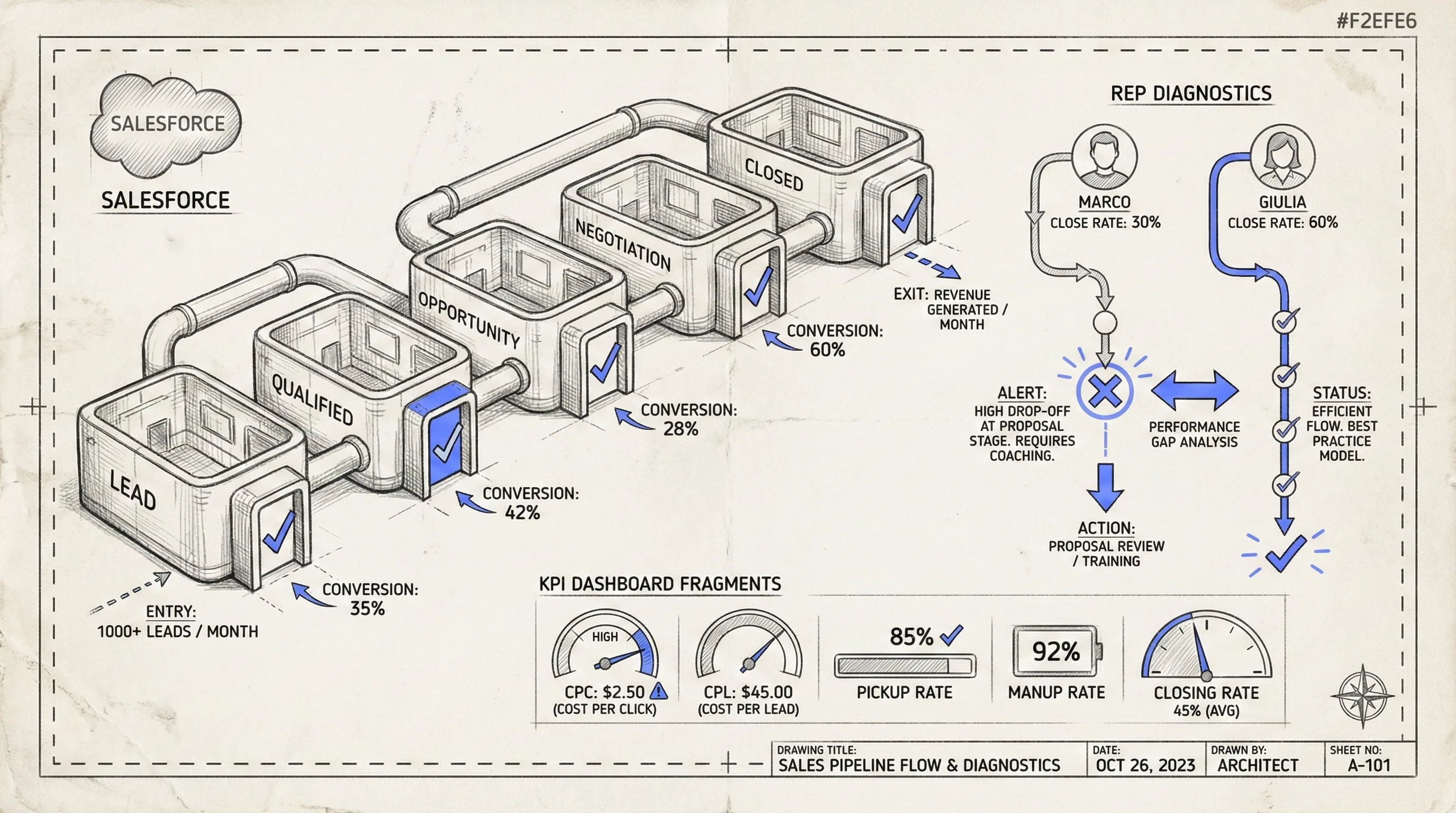
The advantage: you know exactly where you're losing deals. Not "we're not closing enough" — but "we're losing 40% in the transition from Qualified to Opportunity." Precise diagnosis → precise action. The same approach as diagnosing the specific objection with MANUP.
Salesforce has measured that deals following all stages close 28% faster and with deal sizes 33% higher than those that skip stages. It's not bureaucracy — it's the reason Salesforce's average sales cycle dropped from 9 months to 6 months between 2015 and 2023, despite average deal size doubling.
KPIs by department
The funnel isn't enough. You need to know what to measure at each stage. Here's the complete framework by department — the same one we use as a diagnostic framework.
1. Generation (Marketing)
- CPC (Cost Per Click) — how much you pay per click. B2B Italy benchmark: €1.50-€4.00 on Google, €0.80-€2.50 on Meta.
- CPM (Cost Per Mille) — cost per 1,000 impressions. Indicates visibility efficiency.
- CPL (Cost Per Lead) — the real cost to acquire a qualified contact. If CPL rises without quality rate rising, you're buying noise.
2. Setting (Appointment booking)
- Pickup rate — how many answer the phone. Average: 40-60%. Below 30%? Your call timing is wrong.
- Appointment rate — of contacts reached, how many book an appointment. Average: 15-25%.
- Show up rate — how many show up to the booked appointment. Average: 60-80%. Below 50%? Pre-call follow-up is missing or ineffective.
- Quality rate — of appointments held, how many are genuinely qualified. If below 40%, the problem is in targeting or the booking pitch.
3. Diagnosis (First call / Discovery)
- Relationship health score — qualitative assessment of the connection with the prospect (1-10). An RHS below 6 predicts an "I need to think about it" 78% of the time.
- MANUP rate — percentage of calls where Money, Authority, Need, Urgency, and Priority are verified. Target: 80%+. Each missing letter corresponds to a specific objection at closing.
- Second appointment rate — how many prospects agree to a second meeting. Below 50%? The first diagnosis didn't create enough perceived value.
4. Closing (Demo / Presentation)
- PASTA score — framework for evaluating the presentation: Problem, Agitation, Solution, Transformation, Action. Each call is rated on these 5 criteria.
- Objection rate — how many objections arise per call. A low objection rate isn't good — it often means the prospect isn't engaged enough to object.
- Closing rate — the close percentage. B2B average: 20-30%. Top performers: 35-45%.
- Sales cycle — days from first call to signature. The longer it is, the higher the risk of losing the deal.
5. Delivery (Post-sale)
- NPS (Net Promoter Score) — the likelihood the customer will recommend you. An NPS above 50 is excellent. Below 0, you have a serious problem.
- Relationship rate — would the customer maintain the relationship even if the product changed? Measures the strength of the human bond.
The key point: every missing or weak KPI tells you exactly where to intervene. Not "sell more" — but "your pickup rate is at 28%, move calls from 2pm to 10am." Like in the Theory of Constraints: find the specific constraint per stage.
Data
A Relationship Health Score below 6 at first diagnosis predicts an "I need to think about it" 78% of the time. Diagnosis comes before the cure — in sales too.
Replicable training
In 2014 Salesforce launches Trailhead — a free training platform. Talent pipeline + network effect = flywheel.
The principle: document, replicate, certify. Not "shadow the senior for 3 months and see how they do it." But structured modules, practical exercises, certifications.
Stars leave. The system stays.
If your best sales rep walks out tomorrow and the team collapses, you don't have a sales team — you have one person who sells and others who watch. The same logic as the Waterline Principle: the system must work without depending on a single person.
“Don't look for the perfect salesperson. Build the perfect sales system.”
Data, not opinions
Marco closes 30% of his deals. Giulia closes 60%. The instinctive reaction: "Giulia is better."
But if you look at the data by stage, you discover that Marco loses 50% at the Proposal stage. Maybe he's not "less talented" — maybe he presents offers differently. Or maybe he's getting less qualified leads.
Looking at data by stage per person tells you where to intervene. Not "sell more" but "improve your conversion from Qualified to Opportunity using this script."
Here are the KPIs that matter for each department of the sales process:
- Generation: CPC, CPM, CPL — how much it costs to generate attention and leads
- Appointment setting: pickup rate, appointment rate, show up rate, quality rate, call volume
- First diagnosis: relationship health score, second appointment rate, second show up rate, MANUP rate
- Closing/Demo: PASTA score, objection rate, closing rate, sales cycle
- Delivery: relationship rate, product rate
Salesforce introduced Agentforce: $67 billion influenced in one year by data-driven decisions. But the point isn't the technology — it's that data without a framework is just numbers. The framework turns numbers into decisions.
A concrete example: an Italian sales team with 8 reps. Average closing rate was 22%. Looking at data by stage, they discovered that 45% of deals died between Proposal and Negotiation. It wasn't a closing problem — it was a pricing presentation problem. They restructured how they presented the offer (ROI first, then the price — not the other way around) and the closing rate rose to 31% in 3 months. Same people, same product, same prices.
Insight
Don't look at the total closing rate. Look at the conversion rate by stage, by person, by department. That's where you find the constraint.
Agentforce and the AI future
September 2024. Salesforce launches Agentforce — autonomous AI agents that handle lead qualification, follow-up, scheduling, and data entry. Marc Benioff calls it "Salesforce's third act" after the cloud and the platform.
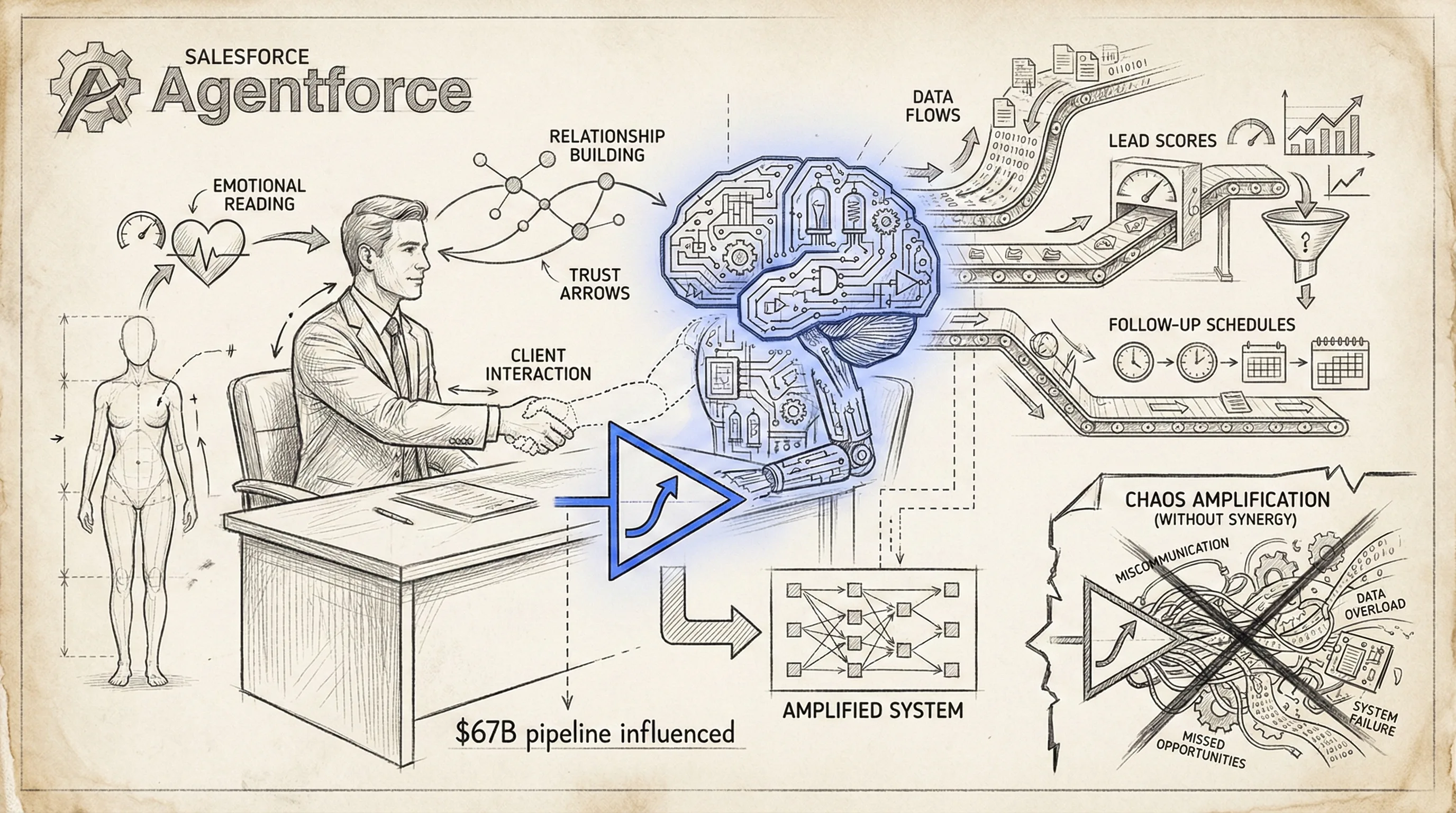
First-year numbers: $67 billion in pipeline influenced by AI-driven decisions. This doesn't mean AI sold $67B — it means AI touched, optimized, or accelerated deals worth that amount. Predictive lead scoring that identifies the most likely prospects with 340% more accuracy than traditional methods (source: Salesforce State of Sales, 2025).
But be careful: AI doesn't replace the system. It amplifies it. If your sales process is chaotic, AI amplifies the chaos. If your CRM is empty, AI has no data to work with. If your reps don't follow the stages, AI can't optimize what doesn't exist.
Here's what concretely changes with AI in the sales process:
- Predictive lead scoring — AI analyzes hundreds of signals (website behavior, opened emails, LinkedIn profile, company size, industry) to assign a closing probability score. The sales team calls the highest-scoring leads first.
- Real-time coaching — During the call, AI analyzes tone, pace, keywords, and suggests questions or responses. Gong.io has shown that reps using AI coaching close 27% more.
- Accurate forecasting — Instead of asking reps "how's the pipeline?" (answer: always "great"), AI predicts closing based on historical patterns. Clari and Salesforce Einstein reach 85-92% accuracy vs 45% for human forecasts.
- Follow-up automation — 80% of deals close between the 5th and 12th touchpoint. AI automates personalized follow-ups, eliminating the biggest problem in sales teams: lack of persistence.
The future isn't AI instead of salespeople. It's AI that makes the system smarter. The salesperson does what AI can't: build relationships, read emotions, handle ambiguity. AI does what the salesperson shouldn't: data entry, mechanical follow-ups, pattern analysis across thousands of deals. Like in the Double Loop: technology is the tool, the thinking system is the advantage.
Data
$67 billion in pipeline influenced by Agentforce in its first year. AI lead scoring: +340% accuracy. But without a structured process, AI amplifies the chaos. — Salesforce State of Sales, 2025
4 steps for SMEs
You don't need Salesforce (the software). You need the principle.
- Define the stages — what are the real steps in your sale? Give them a name and criteria.
- Track in the CRM — any CRM, even an Excel spreadsheet. What matters is that every deal is in a stage.
- Document the training — write down how you sell in your business. Scripts, objections, processes. Make it replicable.
- Review weekly — look at conversion rates by stage, by person. Every week. Data, not opinions.
As we saw with the Theory of Constraints, you need to find the specific constraint — not improve everything. You don't need to do all 4 steps perfectly from day 1. Start with the first: define the stages. Next week, track in the CRM. The week after, document. And every Friday, review the numbers.
The compound effect of this approach is devastating. One of our clients — a B2B agency, 12 reps — implemented these 4 steps in 6 weeks. After 4 months: closing rate from 19% to 34%, sales cycle from 45 to 28 days, average deal size +22%. Zero additional marketing spend. Just system. Find which stage loses the most deals and let's talk about how to systematize it.
Frequently Asked Questions
How many sales reps actually hit their quota?+
According to CSO Insights (now Korn Ferry), only 54.3% of sales reps reach their sales quota. This means nearly half of every sales team is underperforming — a structural problem, not an individual one.
What are the 6 stages of the Salesforce funnel?+
Lead → Qualified → Opportunity → Proposal → Negotiation → Closed. Each stage has specific entry and exit criteria, and everything is tracked in the CRM.
How do you build a replicable sales system?+
Four steps: (1) Define your funnel stages with clear criteria. (2) Track everything in the CRM. (3) Document training to make it replicable. (4) Review data weekly — conversion rate by stage, by person.
What KPIs are needed for each sales stage?+
Generation: CPC, CPM, CPL. Appointment setting: pickup rate, appointment rate, show up rate, quality rate, call volume. First diagnosis: relationship health score, second appointment rate, second show up rate, MANUP rate. Closing/Demo: PASTA score, objection rate, closing rate, sales cycle. Delivery: relationship rate, product rate.
Related Articles
Let's build the system for your business.
Let's discuss how to apply these principles to your specific situation.
Let's talk →