
How to run an organization without bosses ($4.5B in revenue, zero hierarchy)
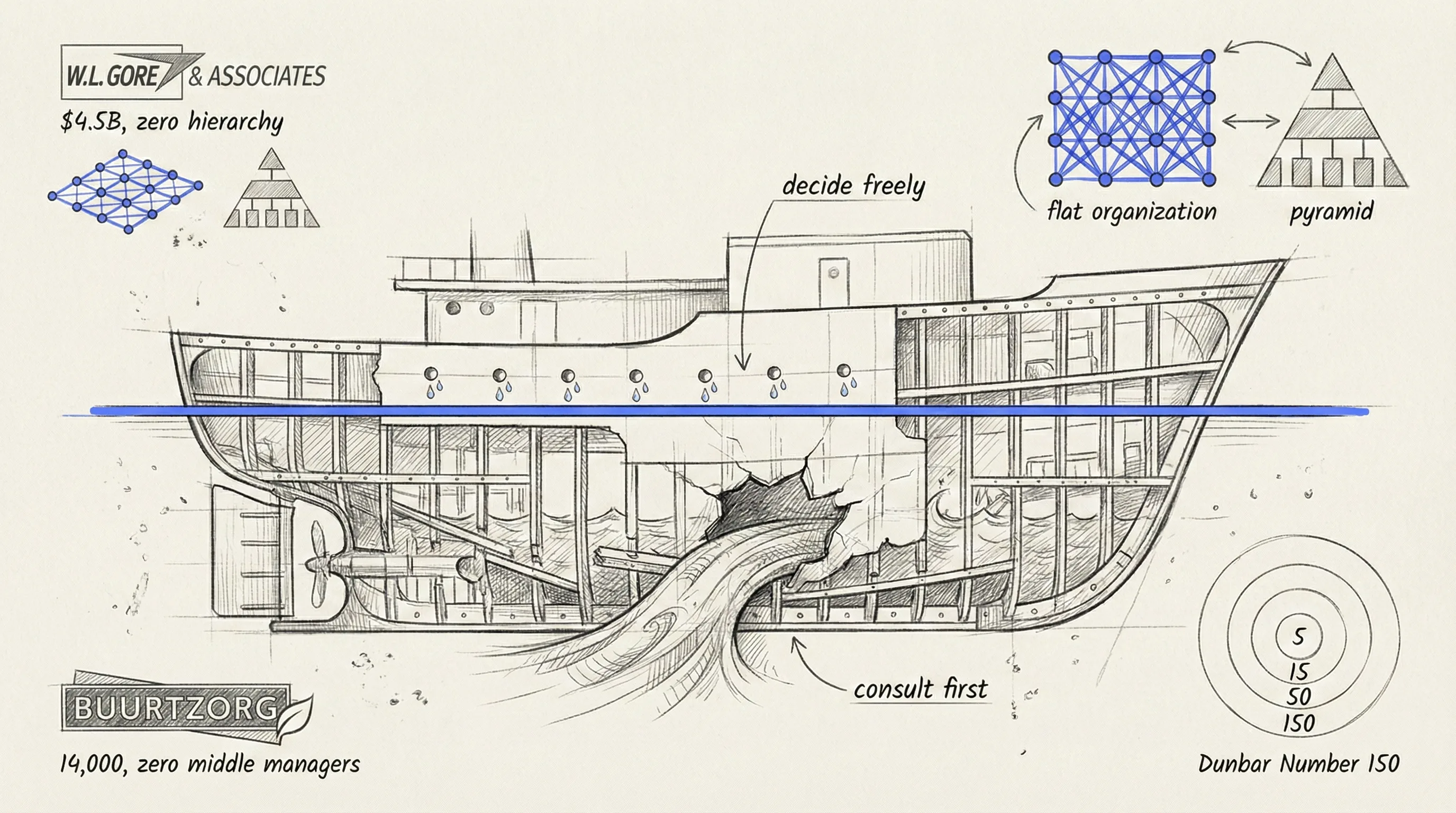
W.L. Gore: $4.5B, 12,000 people, zero hierarchy. Buurtzorg: from 4 to 14,000, zero middle managers. It's not anarchy — it's a system.
Nour Madani
CEO & Founder, Madani
Key Takeaways
- →W.L. Gore generates $4.5B with 12,000 employees and zero hierarchy since 1958.
- →Dunbar's Number (150): beyond 150 people, relationships break down — Gore keeps units below this threshold.
- →Waterline Principle: above the waterline, decide on your own. Below, consult the team.
- →90% of your decisions didn't need your approval.
Gore and Buurtzorg
W.L. Gore: $4.5 billion in revenue. 12,000 employees. Zero hierarchy since 1958. A "lattice" organization — not a pyramid. The CEO is elected by associates (they don't call anyone "employee"). Parking lot rule: if the parking lot is full, the factory is too big.
Buurtzorg: Dutch home care. From 4 nurses to 14,000. Zero middle managers. Costs reduced by 40% compared to competitors. Highest patient satisfaction in the sector.
Two different sectors, same principle: people don't need to be managed. They need a system that makes them autonomous. As in the NUMMI case: it wasn't the people — it was the system.
Gore's model didn't remain an isolated case. Morning Star, the world's largest tomato processor ($700M in revenue), has operated without managers since 1990. Every employee negotiates a "CLOU" — Colleague Letter of Understanding — with colleagues, defining mutual commitments. There's no boss assigning tasks. There are agreements between peers.
And then there's Valve, the software house behind Steam (the $10+ billion gaming platform). Valve's famous "Handbook for New Employees" reads: "There are no managers. There are no promotions. There are no titles. If you want to work on something, move your desk (literally, they have wheels) next to the team working on it." Valve created Half-Life, Portal, and the platform that controls 75% of the PC gaming market — without anyone telling anyone what to do.
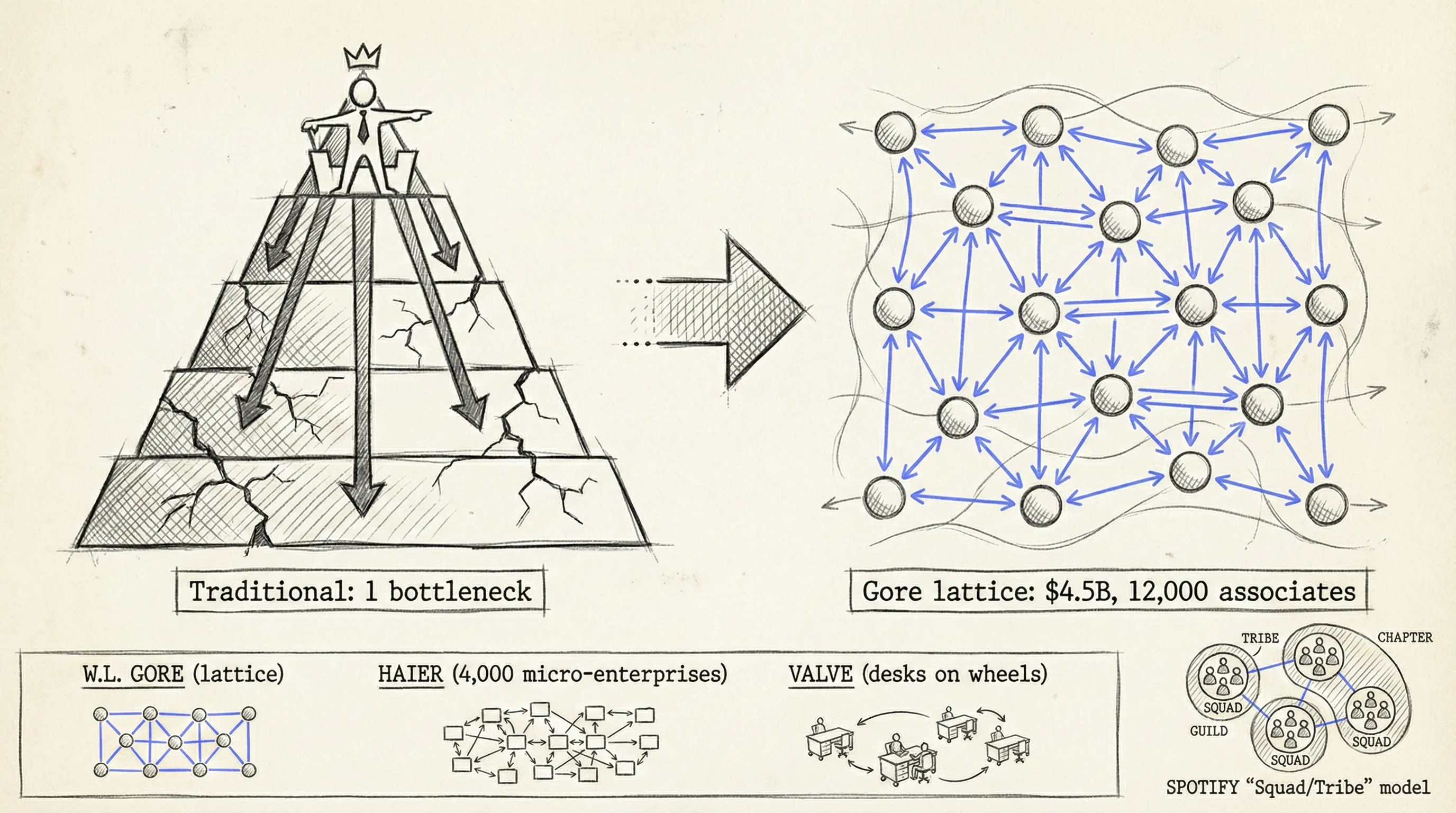
Haier: 4,000 micro-enterprises, zero middle management
If Gore and Buurtzorg are the classic cases, Haier is proof that the model works even at Chinese scale.
Haier is the world's largest home appliance manufacturer. $32 billion in revenue. 80,000 employees. And since 2005, zero middle management.
Zhang Ruimin, Haier's CEO since 1984, took a company on the brink of bankruptcy and transformed it into the global sector leader. In 2005 he made a move that the corporate world called "insane": he eliminated the entire middle management layer — roughly 12,000 positions — and reorganized the company into over 4,000 micro-enterprises (called "zi zhu jing ying ti" — autonomous management units).
Each micro-enterprise operates as an independent startup:
- Own P&L: each unit has its own income statement. It knows exactly how much it earns and spends.
- Hiring freedom: each unit can hire and fire without central approval.
- Direct customer contact: each unit has a direct relationship with the end user — not with the "internal client."
- Internal competition: micro-enterprises compete against each other for resources. Those who perform, grow. Those who don't, get absorbed or shut down.
The model is called RenDanHeYi — literally "integration between person, order, and value." The principle: every employee is an entrepreneur. Every team is a company.
The results speak for themselves. Haier went from near-bankruptcy in the '80s to global leader. Revenue grew from $600 million in 2005 (the year of reorganization) to $32 billion today. The company acquired GE Appliances in 2016 for $5.6 billion — and applied the same model to a century-old American company.
Gary Hamel, one of the world's most influential management thinkers (Harvard Business Review, London Business School), called Haier "the most radical and successful management experiment underway on the planet."
The lesson for Italian SMEs: you don't need to eliminate all managers tomorrow. But you can start by giving every team visibility into their own P&L and direct responsibility for results. When people see the impact of their decisions on real numbers, behavior changes. You don't need alignment meetings. You need transparent numbers.
Data
Haier: from near-bankruptcy to $32B in revenue by eliminating 12,000 middle management positions and creating 4,000+ autonomous micro-enterprises. — Gary Hamel, Harvard Business Review
Dunbar's Number
Robin Dunbar, anthropologist, 1993. The Social Brain Hypothesis: the human brain can maintain stable relationships with roughly 150 people. Beyond that threshold, relationships become superficial and formal rules are needed to compensate.
That's why Gore keeps every facility under 150 people. When the parking lot is full, they build a new facility.
The problem isn't the number of people — it's the number of decisions per person.
Dunbar also identified sub-levels: 5 (inner circle), 15 (close friends), 50 (friends), 150 (meaningful relationships). These numbers appear everywhere in military organizations: the squad (5-8), the platoon (15-30), the company (50-80), the battalion (150). It's not coincidence — it's biology.
For Italian SMEs, Dunbar's Number is crucial: most Italian companies have fewer than 50 employees. That means you're already in the zone where informal relationships work. The problem arises when you grow beyond 15-20 without creating explicit structures. From 5 to 15 people, everyone knows what everyone else is doing. From 15 to 50, gray areas emerge. From 50 onward, without a system, it's chaos. Gore solved the problem by never growing beyond 150 per unit. You can solve it by creating autonomous teams of 5-8 people — the size of Dunbar's inner circle.
Data
Dunbar's Number (150) explains why agile startups become bureaucratic as they grow: beyond 150 people, informal relationships are no longer enough.
The Spotify model: autonomy at 8,000 people
In 2012, Henrik Kniberg and Anders Ivarsson published a paper that changed how thousands of companies think about organization: "Scaling Agile @ Spotify". The document described how Spotify maintained speed and autonomy while growing rapidly.
The model is based on four structures:
- Squad (8-12 people): the base unit. Cross-functional, autonomous, with a clear mission. Each squad has a product owner but no traditional manager. It operates like a mini-startup within the company.
- Tribe (40-150 people): a group of squads working on a related area. The maximum number isn't random — it's Dunbar's Number. The Tribe Lead isn't a manager — they're a facilitator who removes obstacles.
- Chapter: a functional grouping that cuts across squads. All backend developers from different squads form a Chapter. They meet regularly to share best practices and standards. It ensures technical quality without sacrificing autonomy.
- Guild: a voluntary community of interest. Anyone in the company can join a Guild — design, machine learning, data. It's a horizontal learning mechanism, not an organizational unit.
Spotify's key principle isn't the structure — it's alignment through mission, not through hierarchy. Every squad knows what it needs to achieve (the "what" and the "why"). How it gets there is its own responsibility (the "how"). Kniberg used a powerful metaphor: "Be autonomous, but don't sub-optimize. The squad mission should be aligned with the overall product strategy and company mission."
Spotify today has over 8,000 employees and continues to operate with variants of this model. It's not perfect — Spotify itself has admitted the original model was an "aspirational snapshot," not a prescription. But the principle holds: autonomy works when it's guided by mission.
For Italian SMEs, the lesson is this: don't copy Squads and Tribes. Copy the principle. Every team in your company should be able to answer two questions: "What is our mission?" and "How do we measure success?" If they can't answer, they're not a team — they're a group of people waiting for instructions. As in the Feature Factory case: without autonomy and clear metrics, people produce output, not results.
“Autonomy works when it's guided by mission. Without mission, autonomy is chaos. Without autonomy, mission is bureaucracy.”
— Henrik Kniberg, Scaling Agile @ Spotify
Above the line you decide, below you consult
Imagine a ship. If you punch a hole above the waterline, water enters but the ship doesn't sink. If you punch a hole below, it sinks.
Gore divides every decision into two types:
- Above the line — low risk, reversible. Decide on your own. Don't ask permission.
- Below the line — high risk, irreversible. Consult the people affected.
90% of your company's decisions are above the line. They didn't need your approval. But your team asks you anyway — because the system hasn't given them permission to decide. This is exactly what separates an operating framework from a simple hierarchical structure.
In practice, the Waterline Principle is implemented with a simple exercise. Take all the decisions your team asked you about last week. For each one, ask yourself: "If this decision were wrong, would the company survive?" If the answer is yes — it's above the line. Your team can make it without you.
In our experience with Italian SMEs, the result is always the same: 90%+ of decisions are above the line. The founder spends the day approving things that didn't need approval. And meanwhile, the decisions that truly matter — strategy, culture, partnerships — don't get the attention they deserve because the founder is bogged down in operations. As with Apple's cash flow: the constraint isn't where you think. The bottleneck is you.
“Don't look for the right people for the wrong system. Build the right system for the people you have.”
One-way doors and two-way doors
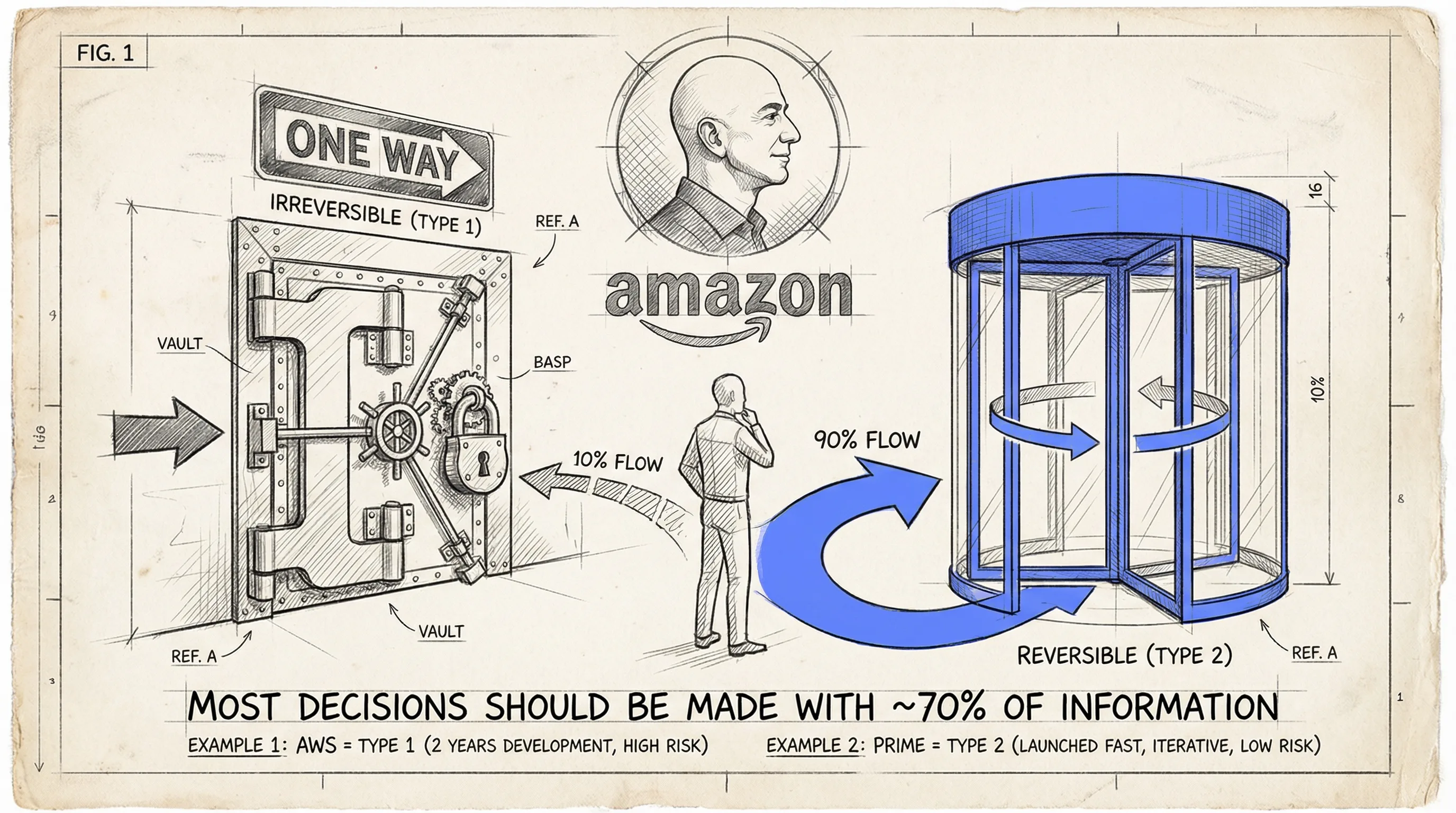
Jeff Bezos, in the 2015 Amazon shareholder letter, introduced a decision framework that has become one of the most influential in modern management: Type 1 and Type 2 decisions.
Type 1 — One-way doors: irreversible decisions or ones that are very costly to reverse. Entering a new market. Hiring 50 people. Signing a multi-year contract. These decisions require caution: data, analysis, consultation, deliberation. Getting them wrong is expensive.
Type 2 — Two-way doors: reversible decisions. Changing a product's price. Testing a new campaign. Modifying an internal process. If it doesn't work, you walk it back. The cost of error is low. The cost of slowness is high.
The problem, Bezos wrote, is that "as organizations grow, there's a tendency to use the heavyweight Type 1 decision-making process for most decisions, including Type 2. The result is slowness, risk aversion, lack of experimentation, and consequently, less innovation."
This is exactly the problem of "permission culture." In many Italian SMEs, every decision goes through the founder. Change the paper supplier for the printer? Ask the boss. Modify an email template? Ask the boss. Reply to a client with a 5% discount? Ask the boss.
The founder becomes the bottleneck of the entire company. Not because the decisions are important, but because the system doesn't distinguish between Type 1 and Type 2. It treats everything as if it were irreversible. It treats every door as if it were one-way.
Gore's Waterline Principle and Bezos's Type 1/Type 2 framework say the same thing with different metaphors: classify decisions by risk, not by perceived importance. 90% of decisions are Type 2 — reversible, low risk, above the waterline. Give your team permission to make them without asking. The alternative isn't "risk" — the alternative is paralysis.
Amazon applies this principle at every level. Teams can launch experiments, change features, modify processes — all without top-down approval, as long as it's a Type 2 decision. The result: Amazon experiments more than any other company in the world. And most experiments fail. But the ones that work — AWS, Prime, Alexa, Marketplace — are worth trillions.
Insight
90% of business decisions are "two-way doors" — reversible and low risk. Treating them as irreversible creates the "permission culture" that kills speed. — Jeff Bezos, 2015 Shareholder Letter
The 30-day test
The most powerful exercise: "If you disappeared for 30 days with no notice, what would happen to your company?"
If the answer is "chaos" — you don't have a company. You have a job.
Start here:
- List last week's decisions. How many were truly necessary? How many could someone else have made?
- Apply the Waterline Test. Divide: above or below the line?
- Create autonomous units — each with its own metrics, emergent leaders, autonomy above the line.
The sales system needs the same principles: document, replicate, certify — so training lives in the system, not in the founder's head.
An entrepreneur we know took the test. He disappeared for 10 days (forced vacation by his wife). On return: 47 emails waiting for his approval. 12 blocked decisions. 3 clients irritated by delays. Monthly revenue had dropped 15%. Not because the team was incompetent — because the system required his approval for everything.
He applied the Waterline Principle. He classified every type of recurring decision. He gave explicit autonomy on everything "above the line." Two months later, he disappeared again — this time for 3 weeks. On return: zero emails waiting for approval. Monthly revenue had grown 8%. The team had made 200+ decisions without him. And none of them had sunk the ship.
Frequently Asked Questions
What is the Waterline Principle?+
If you punch a hole in a ship above the waterline, the ship doesn't sink. Below, it sinks. The Waterline Principle divides decisions into two types: above the line (low risk, decide freely) and below the line (high risk, consult first). W.L. Gore has used this principle since 1958.
What is Dunbar's Number?+
Dunbar's Number (150) is the cognitive limit of stable social relationships a human can maintain. Beyond 150 people, relationships become superficial and formal rules are needed to compensate. W.L. Gore keeps every facility under 150 people.
Is an organization without bosses anarchy?+
No. It's a system with different rules. There are no managers approving things, but there are clear principles (Waterline), autonomous units with their own metrics, and emergent leaders chosen by colleagues — not appointed from above.
Related Articles
Let's build the system for your business.
Let's discuss how to apply these principles to your specific situation.
Let's talk →