
How to apply Toyota's Double Loop to your business (and why copying isn't enough)
Toyota produces a car every 40 seconds. Competitors copy everything. Nothing changes. The secret isn't in the system — it's in the way of thinking.
Nour Madani
CEO & Founder, Madani
Key Takeaways
- →Single Loop corrects the error. Double Loop questions the rule that generated the error.
- →Toyota reopened the worst GM factory in America with the same people — it became one of the most efficient.
- →Toyota's "5 Whys" works because it forces you to look for the cause, not the blame.
- →3 questions to apply the Double Loop: Why does this rule exist? Is the original assumption still true? If I started from scratch, would I make this choice?
The Toyota paradox
Toyota produces a car every 40 seconds. 30,000 parts perfectly synchronized. The system is completely public — Kanban, Just-in-Time, Kaizen are documented in hundreds of books.
Competitors visited the factories. They wrote 200-page reports. Monday: nothing changed.
Why? Because they copied the tools, not the thinking system. The same applies to your business: the principle comes before the tool.
Insight
Toyota doesn't have a competitive advantage in tools. It has a competitive advantage in how it thinks about problems.
NUMMI: opposite results
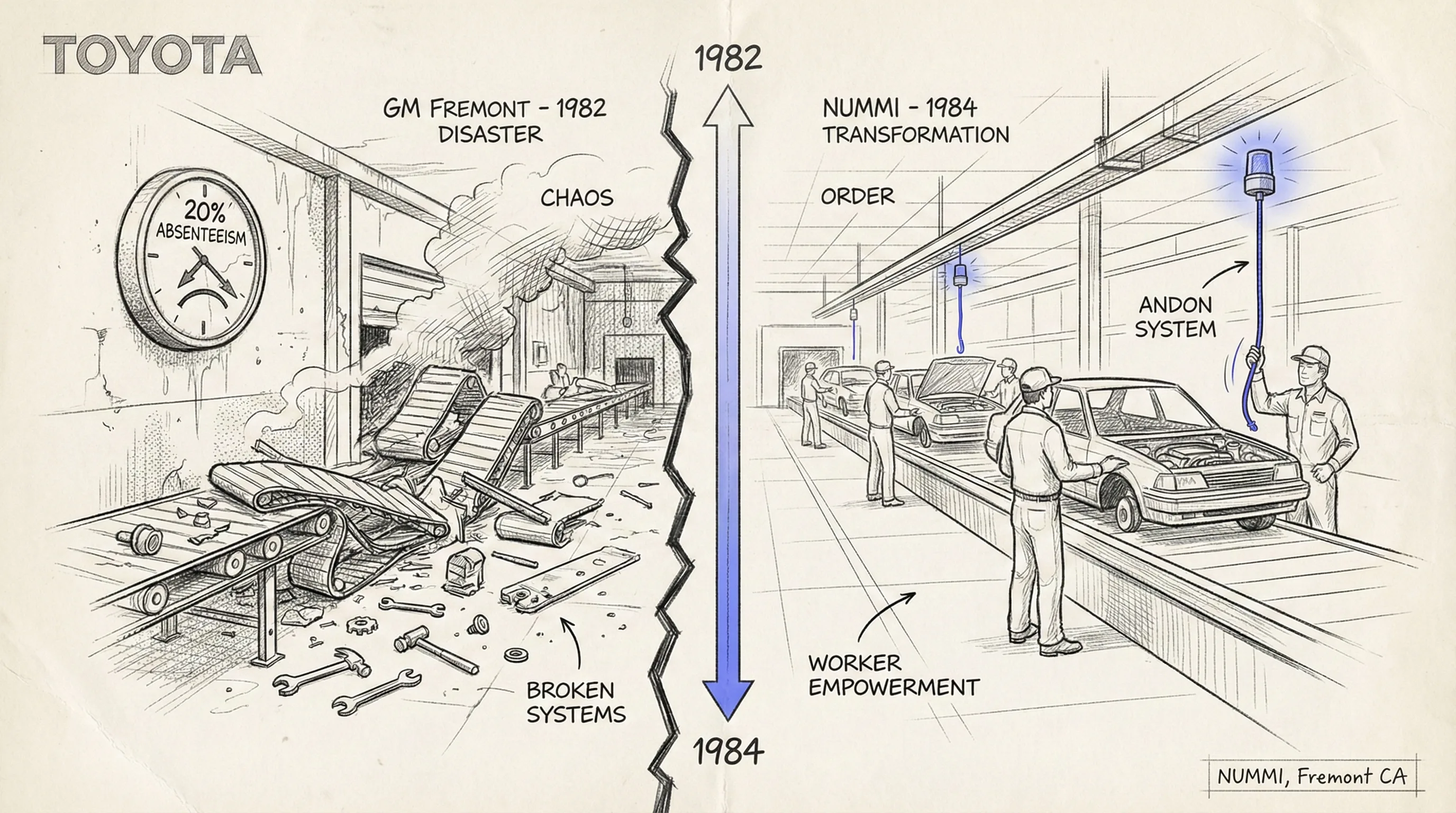
1982. GM closes the worst factory in America in Fremont, California. Workers drink alcohol on the line. Smoke marijuana. Sabotage cars. Record absenteeism. The unions had filed over 5,000 pending grievances. Quality was so low that dealers refused cars produced in Fremont.
1984. Toyota reopens it as a joint venture. Rehires 85% of the same workers — including the toughest union members. Sends them to Japan for two weeks. Not to take a course. To work side by side with Toyota workers at the Takaoka plant.
NUMMI becomes one of the most efficient factories in America. Absenteeism drops from 20% to 2%. Union grievances go from 5,000 to fewer than 100. Quality reaches levels comparable to Japanese factories — in less than a year.
Same people. Opposite results.
What changed? Not the people. Not the machines. The thinking system. At Fremont, before Toyota, a worker who reported a problem was ignored — or worse, punished. With Toyota, every worker had the power to stop the entire production line by pulling the Andon cord. The message was radical: "Your voice matters more than production."
“It wasn't the people who were broken. It was the system that had broken them.”
— NPR, Episode 561 — NUMMI
GM copies everything, learns nothing
Here's the paradox that John Shook — the first American hired by Toyota in Japan — documented in his paper "How to Change a Culture — Lessons from NUMMI" (MIT Sloan Management Review, 2010): GM sent over 3,000 managers and workers to Fremont to study the NUMMI system. They wrote detailed reports. Photographed every process. Returned to their factories.
Nothing changed.
The most ambitious project was the Model J, GM's attempt to create a "Toyota-style" factory from scratch in Van Nuys, California. They copied everything: the layout, the Kanban stations, the Andon boards, the quality circles. They invested hundreds of millions. The result? Quality remained mediocre. Costs stayed high. Van Nuys closed in 1992.
The problem, as Shook explains, was that GM had copied the artifacts of the system — the visible tools — without understanding the invisible assumptions. Toyota didn't use the Andon cord because it was a good tool. They used it because they believed — truly, not just in words — that the worker closest to the problem was the best person to solve it. Without this deep conviction, the Andon cord is just a wire hanging from the ceiling.
Shook summarizes it this way: "The usual way to change a culture is: first change the beliefs, then behaviors will follow. Toyota does the opposite: change the behaviors and the beliefs will follow." That's why they sent workers to Japan to do, not to watch. The Double Loop isn't taught with a PowerPoint presentation. It's lived.
Insight
GM copied Toyota's tools — Andon, Kanban, Kaizen — without the thinking system. The Model J is the proof: you can replicate every artifact and achieve nothing. — John Shook, MIT Sloan Management Review, 2010
Change the rules
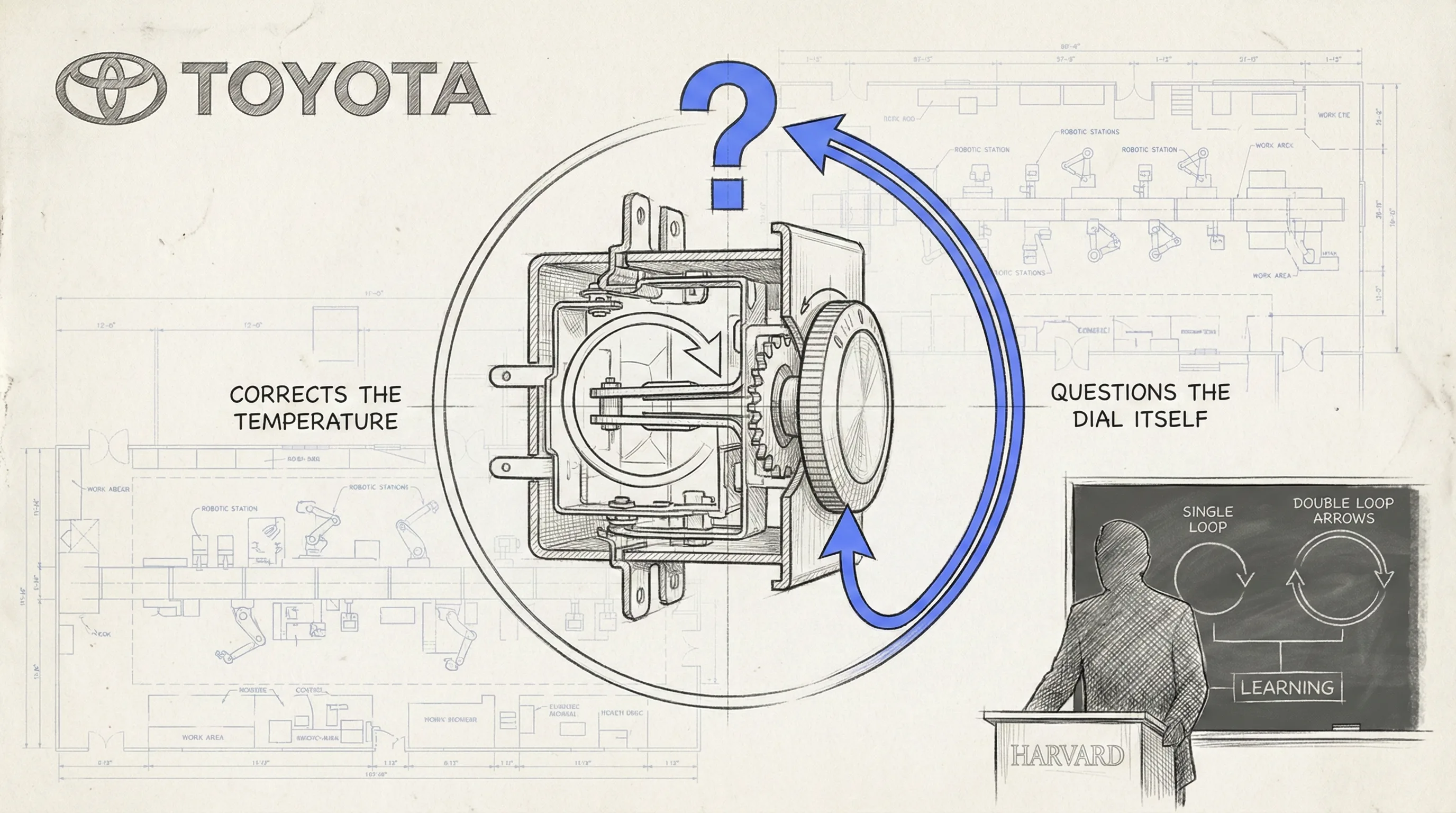
Chris Argyris, Harvard, 1970s. The idea is simple.
Imagine a thermostat. It's cold → turns on the heating. It's hot → turns it off. This is Single Loop: detects an error, corrects it.
Now imagine a thermostat that asks itself: "Is 20°C the right target temperature?". This is Double Loop: it questions the rule itself.
Argyris published the theory in 1977 in Harvard Business Review together with Donald Schön. The original paper — "Organizational Learning: A Theory of Action Perspective" — describes how organizations develop "defensive routines" that protect them from the discomfort of questioning their own assumptions. In practice: companies build invisible walls around their rules to avoid ever having to reexamine them.
Most companies live in Single Loop. Something doesn't work → we fix it. But we never ask whether the rule that generated the problem is still valid. Argyris called it "skilled incompetence": the ability to avoid real learning while appearing perfectly competent. Managers who produce flawless reports on processes that don't work. Teams that optimize KPIs that measure nothing important.
Toyota does it with two tools: the Andon button (any worker can stop the entire production line) and the 5 Whys. But what makes these tools effective isn't the mechanism — it's the culture of psychological safety that surrounds them. Harvard's Amy Edmondson documented this in "The Fearless Organization" (2018): without psychological safety, no worker pulls the Andon cord, even if it's hanging right there from the ceiling.
The 5 Whys
The first "why" gives you the obvious answer. The fifth gives you the real cause.
Real example: B2B company, €4M in revenue. They thought they had a lead generation problem.
- Why are sales declining? We're not closing enough deals.
- Why? Leads don't respond after the first contact.
- Why? We contact them too late.
- Why? The sales team calls leads after 72 hours.
- Why? No rapid response process. 68% of leads were already cold.
The solution: respond within 30 minutes. Same leads, same ad budget, 3x appointments. The same principle behind finding the constraint that unlocks everything.
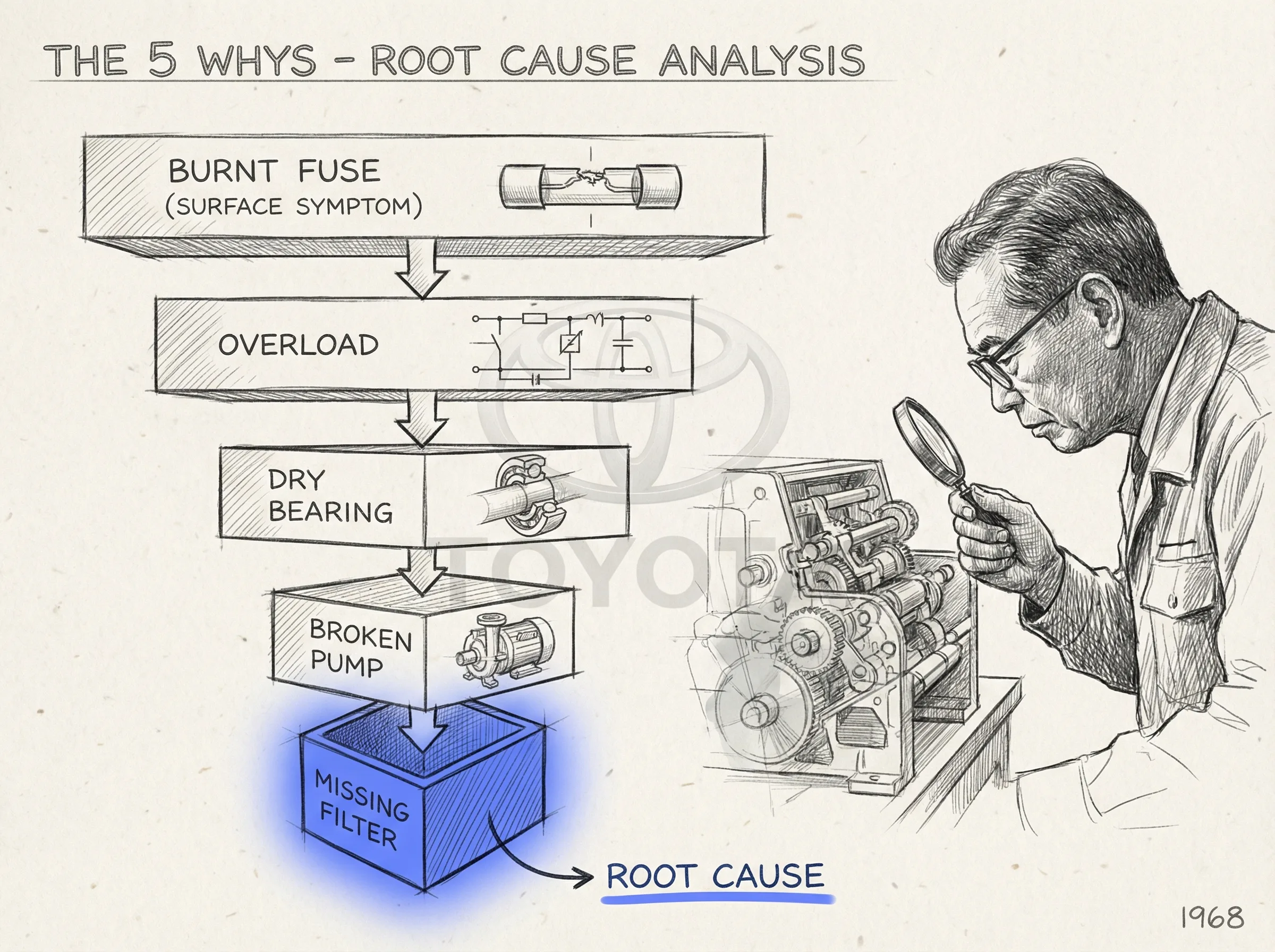
Taiichi Ohno, the father of the Toyota Production System, was obsessive about the 5 Whys. He tells the story of finding a machine stopped in the factory. First why: burnt fuse. Second: overload. Third: unlubricated bearing. Fourth: the lubrication pump wasn't working. Fifth: there was no filter on the pump, and debris had blocked it. A 50-cent fuse was hiding a design problem worth thousands of euros.
The trick of the 5 Whys is that it forces you to look for the cause, not the blame. In a traditional culture, at the first why you find a person ("Marco forgot to lubricate"). At Toyota, at the fifth why you find a system that allowed the error to occur. The difference is enormous: punishing Marco solves nothing. Adding a filter to the pump eliminates the problem forever.
Data
68% of leads contacted after 72 hours were already cold. Reducing response time to 30 minutes tripled appointments — without spending a single extra euro on ads.
The digital Single Loop
Digital companies think they're doing Double Loop because they use data. It's an illusion.
A/B testing is the perfect example of Single Loop disguised as innovation. You test the red button against the blue button. You optimize the landing page copy. You try a new headline. But you never ask: "Should we have this landing page?" or "Are we solving the right problem?"
A/B testing operates within existing assumptions. It changes the variables, not the rules. It's the thermostat adjusting the temperature without asking whether 20°C is the right target.
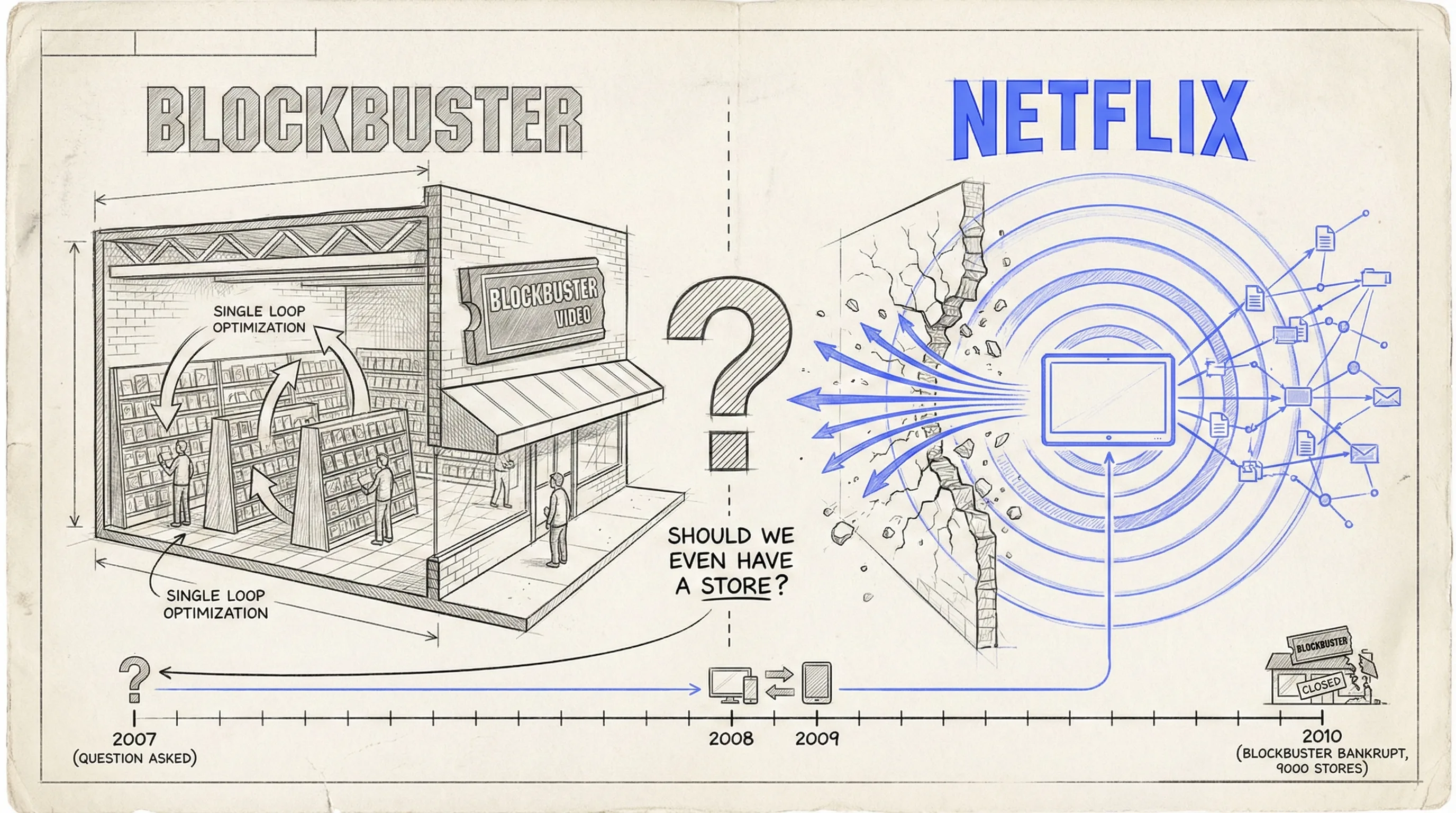
Netflix understood this in 2007. While everyone in the industry was optimizing DVD delivery speed — more efficient envelopes, closer distribution centers, better shipping algorithms — Reed Hastings asked the Double Loop question: "Should we be delivering DVDs?" The answer was no. Streaming was the future. Netflix had already invested in a delivery system that worked perfectly. Single Loop would have said "optimize the delivery." Double Loop said "eliminate the delivery."
Blockbuster, in the same period, was doing exactly Single Loop. Improving stores. Reducing costs. Optimizing shelf layouts. It never asked whether the physical store model was still valid. In 2010, it filed for bankruptcy with 9,000 stores.
The same applies to Italian SMEs that are "going digital." If you're optimizing Facebook Ads without asking whether Facebook is the right channel, you're doing Single Loop. If you're improving your website without asking whether the website is the touchpoint that matters, you're doing Single Loop. Like Zara testing 12,000 products per year: the point isn't optimizing the single product, it's building the system that learns.
Insight
A/B testing is Single Loop disguised as innovation. It tests variables within existing assumptions. Double Loop asks: are we testing the right thing?
Beyond cars
Toyota donated the TPS to non-profit organizations. SBP (St. Bernard Project) went from 12-18 weeks to 6 weeks to rebuild a house after a disaster. They didn't send Toyota engineers to build houses. They taught volunteers the thinking system: identify waste, standardize processes, improve continuously. The results lasted even after Toyota stopped supporting them.
Virginia Mason Medical Center in Seattle applied TPS to healthcare in 2002, becoming one of the first American hospitals to do so. They reduced wait times by 65%, eliminated 38% of unnecessary inventory, and cut hospital infections in half. The key? Every nurse and doctor had the power to "stop the line" — exactly like a Toyota worker — by flagging a patient risk with the "Patient Safety Alert" system.
Case study — 3 restaurants: Food cost at 38% (industry average is 28-32%). The owner thought he had a waste problem. In reality, he had kept the same suppliers for 8 years. Why? "Because we've always done it this way."
Double Loop: Is this supplier relationship still the best choice?
Result: food cost from 38% to 29%. €180,000/year recovered. No need for a €50,000 software. Just a zero-cost question.
Zero-base thinking
Jeff Bezos calls this approach "zero-base thinking": "If we weren't already doing this, would we start it today?"
It's the most dangerous question you can ask in a company. Because the answer, often, is no. And "no" means you have to stop. And stopping is painful.
Amazon did it with the Fire Phone in 2014. Enormous investment: years of development, hundreds of engineers, partnership with AT&T. The launch was a disaster — 35,000 units sold in the first quarter versus millions expected. Amazon recorded a write-down of $170 million. But Bezos killed the project in less than a year. Single Loop would have said: "Let's improve the phone, lower the price, change the marketing." Double Loop said: "We shouldn't be making phones."
Basecamp — the company of Jason Fried and David Heinemeier Hansson — eliminated features that millions of users were using because they weren't aligned with the product's mission. In 2020, they cancelled 6 products to focus on 2. Fried calls it "less is more, but really" — not as a slogan, but as an operational decision.
In Italian SMEs, the problem is even more insidious. It's the sunk cost trap — the sunk cost fallacy applied to processes. "We've invested 3 years in this software, we can't switch." "Our long-time sales rep doesn't sell much, but he's been here 15 years." "This supplier costs more, but we know each other well." Every sentence that starts with "we've always..." is a signal you're operating in Single Loop.
The quarterly zero-base review is a concrete tool: every 3 months, take your 5 main processes and ask "if I started from scratch, would I do them this way?" If the answer is no for more than one, you have a structural problem. And the Double Loop is the cure.
Insight
"If we weren't already doing this, would we start it today?" — Jeff Bezos. Amazon killed the Fire Phone in less than a year. Basecamp eliminated 6 products to focus on 2. The courage to stop is Double Loop.
The 3 questions
Take any process, rule, or habit in your business. Ask these 3 questions:
- Why does this rule exist? — What was the original problem it was supposed to solve?
- Is the original assumption still true? — Has the context changed? Have the people changed?
- If I started from scratch today, would I make this choice? — If yes, keep it. If no, change it.
The third question is the most powerful. It eliminates inertia. It eliminates the "we've always done it this way." It's the same principle we use in our diagnostic method.
Insight
"If I started from scratch today, would I make this choice?" — If the answer is no, you've found a constraint to eliminate.
It was the system
In 1982, the same people sabotaged cars. In 1984, they built the most efficient cars in America.
The staff didn't change. The way the system made them think changed.
If you're copying Toyota's tools without adopting the Double Loop, you're doing what GM did for 20 years: visiting the factory, writing the report, going home, and changing nothing. GM spent billions. Sent thousands of people. Wrote thousands of pages of procedures. Didn't change a single assumption.
The Double Loop isn't a technique. It's a discipline. It requires the courage to say: "This rule that used to work doesn't work anymore." It requires the ability to distinguish between signal and noise — between data that matters and data that only confirms what you want to believe.
Don't look for better tools. Ask yourself whether the rules you have are still the right rules.
“The first why is the answer. The fifth why is the cause.”
— Taiichi Ohno, Toyota
Frequently Asked Questions
What is Double Loop Learning?+
Double Loop Learning is a concept by Chris Argyris (Harvard, 1970s). Unlike Single Loop, which corrects errors within existing rules, Double Loop questions the rules themselves. Like a thermostat that instead of adjusting the temperature, asks itself: "Is 20°C the right target temperature?"
Why doesn't copying the Toyota Production System work?+
Because companies copy the tools (Kanban, JIT, Kaizen) but not the thinking system. Toyota teaches workers to question the rules, not just follow them. Without Double Loop thinking, the same tools produce different results.
What is the NUMMI case?+
NUMMI (New United Motor Manufacturing Inc.) was the worst GM factory in America, closed in 1982 due to absenteeism, sabotage, and alcoholism. In 1984, Toyota reopened it with 85% of the same workers, sent them to Japan for 2 weeks. NUMMI became one of the most efficient factories in America. Same people, opposite results.
How do you apply Double Loop in Italian SMEs?+
With 3 questions about every process: (1) Why does this rule exist? (2) Is the original assumption still true? (3) If I started from scratch, would I make this choice? Example: a restaurant owner with food cost at 38% discovered he had kept the same suppliers for 8 years "because we've always done it this way." By renegotiating, he recovered 180K/year.
Related Articles
Let's build the system for your business.
Let's discuss how to apply these principles to your specific situation.
Let's talk →