
How Zara launches 12,000 products per year (and why H&M can't)
H&M launches 4,000 and copies trends. Zara launches 12,000 and creates them. It's not speed — it's a learning system.
Nour Madani
CEO & Founder, Madani
Key Takeaways
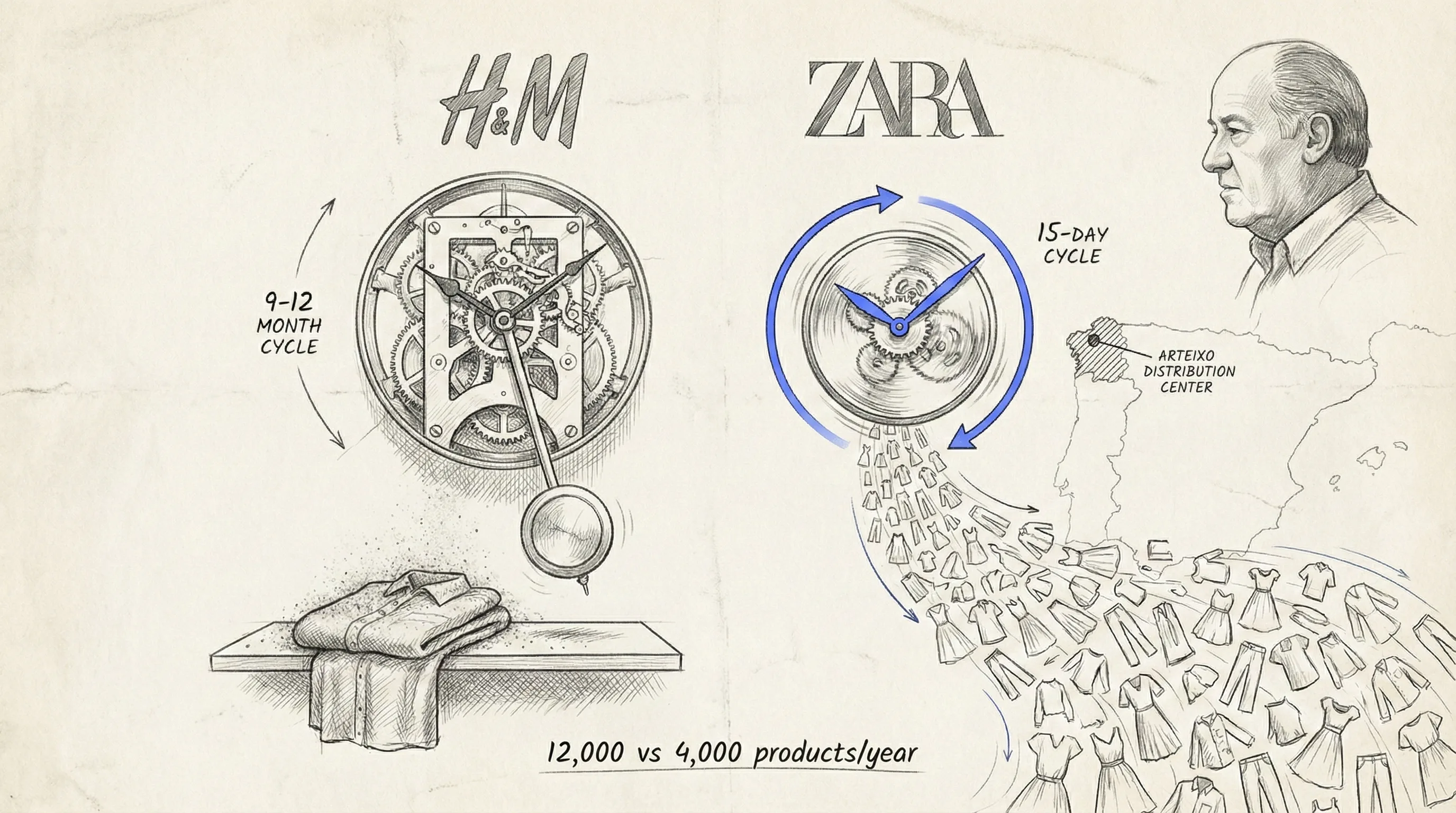
- →Zara isn't faster — it learns faster. 15 days from idea to shelf vs 9-12 months industry standard.
- →H&M bets big on few ideas. Zara bets small on many and doubles down on winners.
- →The principle: reduce the cost of failure, shorten the cycle, build the feedback system.
- →Whoever learns fastest wins — in every industry.
12,000 versus 4,000
H&M launches 4,000 products per year and copies trends. Zara launches 12,000 and creates them. H&M invests more in marketing — about 3-4% of revenue. Zara spends 0.3%. H&M has 4,700 stores. Zara has 1,900. Yet Zara wins. Why?
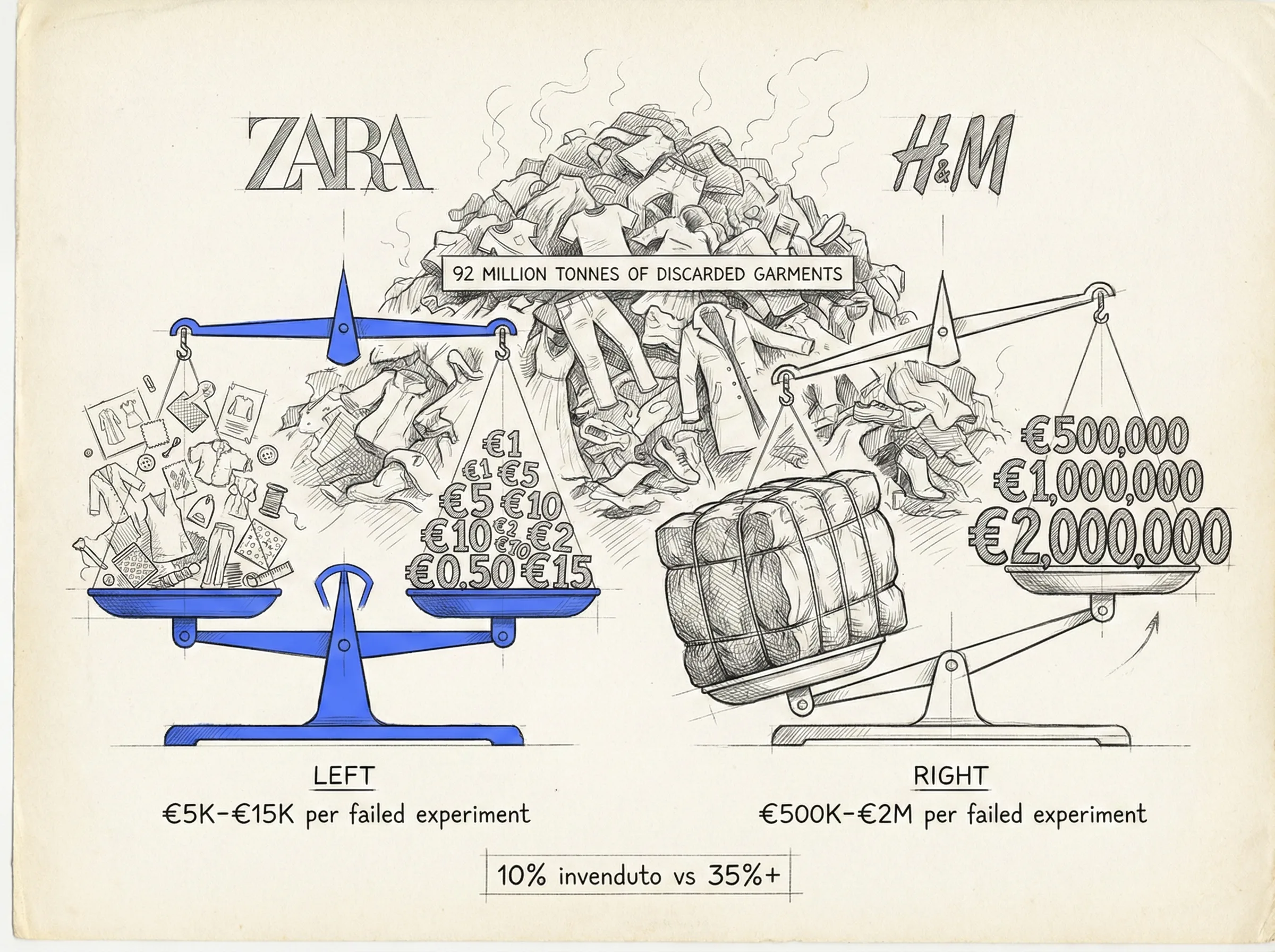
The traditional fashion model: you plan 6-12 months in advance. 9-12 months from idea to shelf. If the trend changes, you're stuck. Unsold inventory becomes discounts → discounts become margin compression. In 2023, the fashion industry sent approximately 92 million tonnes of unsold clothing to landfills or incineration (Ellen MacArthur Foundation).
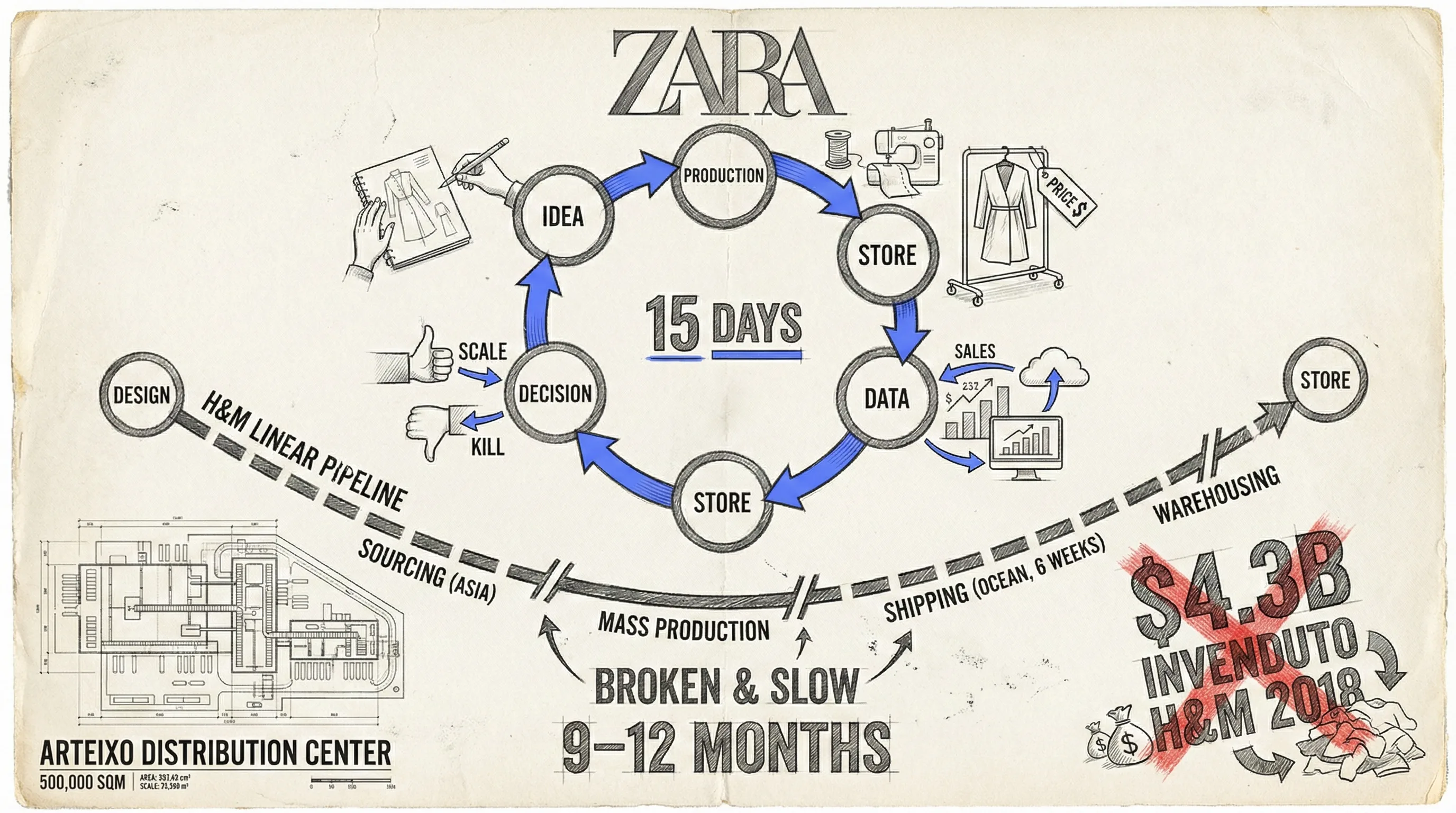
Zara flipped everything: 15 days from idea to shelf. While Gucci plans its Fall-Winter collection in January, Zara is already testing garments that will be in stores in two weeks. They don't predict trends. They discover them in real time.
Amancio Ortega: the system, not the brand
Amancio Ortega Gaona was born in 1936 in Busdongo de Arbas, a village of 100 people in the mountains of León, Spain. His father was a railway worker. At 14 he left school and started working as an errand boy in a shirt shop in La Coruña. At 27 he founded a small bathrobe factory.
In 1975, at 39, he opened the first Zara store in La Coruña. The idea wasn't to sell luxury fashion. It was to sell accessible fashion with a production cycle nobody had ever attempted. While competitors planned 12 months ahead, Ortega wanted to produce in weeks.
Today Inditex — the group he founded — owns 8 brands: Zara, Massimo Dutti, Pull&Bear, Bershka, Stradivarius, Oysho, Zara Home, and Uterqüe. 2024 revenue: €36.5 billion. Ortega is the sixth richest person in the world with a net worth of $165 billion (Bloomberg Billionaires Index, January 2026).
But the point isn't the wealth. The point is how he got there. Ortega never built a brand. He never ran TV advertising. He never had a celebrity endorser. He built a system. The brand is a byproduct of the system, not the other way around.
Ortega's fundamental insight — which most business owners ignore — is that speed beats marketing. If you can test an idea in 15 days instead of 12 months, you don't need to predict what will sell. You discover it. And discovering is infinitely more reliable than predicting. Like in Toyota's Double Loop: don't optimize forecasts, eliminate the need to forecast.
“Fashion is obsolete the moment it leaves the factory. Speed is the only advantage that matters.”
— Amancio Ortega
Small batches, real feedback
Three elements:
- Vertical production — Spain and Portugal, not Asia. Costs more per piece, but speed pays for everything.
- Small quantities — Every design is produced in minimal batches. If it works, they double down. If not, it's killed in days, not months.
- Daily feedback from stores — Sales data returns to headquarters every day. Not monthly reports — real-time data.
The same principle as Toyota's Double Loop: the system learns in real time, not once a year.
There's a fourth element often overlooked: the centralized logistics system. Zara has the largest fashion distribution center in the world in Arteixo, near La Coruña — 500,000 square meters, fully automated. Every garment produced in Spain, Portugal, Morocco, or Turkey passes through there before reaching any store in the world. Two shipments per week to every store — not one per month like competitors.
Zara's store managers aren't just salespeople — they're sensors of the system. Every day they send headquarters data on what sells, what customers try on but don't buy, what they ask for but can't find. This data reaches the 200+ designers working at Arteixo headquarters and becomes new garments in production within 48 hours. It's not a quarterly focus group — it's a daily feedback cycle with data from 1,900 stores across 96 markets.
Insight
H&M bets big on few ideas. Zara bets small on many and doubles down on winners. The difference isn't speed — it's the learning system.
The cost of failure
2018. H&M announces it has $4.3 billion in unsold inventory in warehouses. Not millions — billions. The stock crashes 44%. CEO Karl-Johan Persson publicly admits the model no longer works. H&M starts burning clothes — literally — to clear the excess. The environmental scandal that follows damages the brand for years.
That same year, Zara has an unsold rate of approximately 10%. The fashion industry average is 25-30%. H&M is at 35%+. The difference? It's not design quality. It's not pricing. It's the production system.
The math of small batches is brutal in its simplicity:
- Cost of 1 failed experiment at Zara: a few weeks of a designer's time + a small production batch. Estimated cost: €5,000-€15,000.
- Cost of 1 failed experiment at H&M: 9-12 months of planning + mass orders from China + storage + discounts to clear. Estimated cost: €500,000-€2,000,000.
Zara can afford 12,000 experiments per year because each experiment costs little. H&M can afford 4,000, but each mistake is catastrophic. The result: H&M must be accurate in predicting trends. Zara doesn't need to predict anything — it discovers in real time.
This is the fundamental principle separating fragile systems from antifragile ones (Nassim Nicholas Taleb, "Antifragile", 2012): systems that benefit from volatility are those with low failure cost and high success potential. Zara is antifragile. H&M is fragile. Like in the Theory of Constraints: H&M's constraint isn't design — it's the length of the production cycle.
Data
H&M: $4.3 billion in unsold inventory (2018). Zara: ~10% unsold vs 25-30% industry average. The difference isn't the design — it's the system.
Whoever learns first, wins
It's not "do more, faster." It's learn faster.
The Fast Feedback Loop: idea → minimal production → market → feedback → decision → scale or kill.
Netflix did the same: in 2006 the problem was DVD retention. They discovered that DVDs added to the queue in the first session predicted retention. They optimized that moment. The same approach as escaping the Feature Factory: find the moment that matters.
Amazon: "Double the number of experiments, double the innovation." (Jeff Bezos). It's not generic advice. Amazon runs thousands of experiments simultaneously — from the color of a button to the structure of an entire service. AWS itself was born as an internal experiment that became a $90 billion business.
The principle is measurable: learning speed = number of experiments x quality of feedback / cost per experiment. Zara maximizes the numerator (12,000 experiments with daily feedback) and minimizes the denominator (small batches at low cost). H&M does the opposite on all three fronts. The result is predictable.
“Double the number of experiments you do per year and you'll double your innovation.”
— Jeff Bezos
Lean Startup before Lean Startup
In 2011 Eric Ries publishes "The Lean Startup" and the tech world goes wild. The concept: Build-Measure-Learn. Build an MVP (Minimum Viable Product), measure the market response, learn, repeat. Don't plan for 18 months — launch in 2 weeks and discover what works.
The point nobody ever makes: Zara was doing Lean Startup 30 years before the term existed. Zara's "MVP" is a small batch of garments. The "measure" is the daily sales data from stores. The "learn" is the decision to double down or kill the design. The cycle is 15 days, not biweekly sprints — it's literally the same rhythm software teams try to replicate with Agile.
Amazon applies the same principle with "two pizza teams" — teams small enough to be fed with two pizzas (6-10 people). Each team has a single-threaded leader: one person focused solely on that project, with no distractions. Jeff Bezos wrote in his 2015 shareholder letter: "If the size of your failures isn't growing, you're not inventing at a size that can actually move the needle."
The connection between Zara, Lean Startup, and Amazon is the cost of the experiment. If an experiment costs little and fails fast, you can run thousands. If it costs a lot and fails slowly, you run few — and when you're wrong, the damage is catastrophic. H&M runs few expensive experiments. Zara runs thousands of cheap experiments. The math is on Zara's side.
For Italian SMEs the principle is identical: you don't need Zara's budget. You need Zara's mindset. If you're developing a new service for 6 months before offering it to the market, you're doing H&M. If you launch a basic version in 2 weeks and measure the response, you're doing Zara. Like in escaping the Feature Factory: produce knowing, not hoping.
Insight
Zara was doing Lean Startup 30 years before the term existed. MVP = small batch. Measure = daily store data. Learn = double down or kill in 15 days.
Apply it to services
Three principles:
- Reduce the cost of failure. Don't launch the "perfect" service after 3 months. Launch the minimum version in 2 weeks. If it doesn't work, you've lost 2 weeks, not 3 months.
- Shorten the cycle. From quarterly development to biweekly launches. More cycles = more learning = more competitive advantage.
- Build the feedback system. Market data systematically. Not "how did it go?" by feel — real numbers, every week.
Case study: A client switched from 3-month development cycles to biweekly launches. 6x more services tested at 1/10 the cost. Revenue grew 40% in 8 months.
Example
A Madani client switched from quarterly development to biweekly launches: 6x more services tested, 1/10 the cost per test. +40% revenue in 8 months.
The right question
The right question is: "How do I learn faster?"
Zara doesn't make fewer mistakes than H&M. It makes more. But it discovers them in 15 days instead of 12 months. And when it finds a winner, it scales in days.
Your competitive advantage isn't the best product. It's the fastest learning cycle. Amancio Ortega knew it in 1975. Eric Ries codified it in 2011. Jeff Bezos applies it every day. The principle doesn't change: whoever learns first, wins.
Next time you're planning a 6-month project, ask yourself: "Can I launch a minimum version in 2 weeks?" If the answer is yes — and it almost always is — you're choosing between the Zara model and the H&M model. Like in the Double Loop: don't ask how to make the plan better. Ask whether you need the plan.
Frequently Asked Questions
How many products does Zara launch per year?+
Zara launches approximately 12,000 new designs per year, compared to H&M's 4,000 and the industry average of 2,000-3,000. But the volume isn't the point — it's the speed of learning.
What is the Fast Feedback Loop?+
It's an accelerated production cycle where the time between the idea and market feedback is minimized. Zara takes 15 days from idea to shelf, compared to 9-12 months for the traditional industry. This allows testing many ideas, rapidly eliminating failures, and doubling down on successes.
How do you apply the Fast Feedback Loop to services?+
Three principles: (1) Reduce the cost of failure — launch minimum versions of the service. (2) Shorten the cycle — from quarterly development to biweekly launches. (3) Build the feedback system — collect market data systematically, not by intuition.
Related Articles
Let's build the system for your business.
Let's discuss how to apply these principles to your specific situation.
Let's talk →