
How to find the constraint that unlocks growth (the Facebook and Goldratt method)
Facebook in 2007 was losing to MySpace. Then it found a single number — 7 friends in 10 days — and won. Your business has the same number. Here's how to find it.
Nour Madani
CEO & Founder, Madani
Key Takeaways
- →When you measure everything, you're measuring nothing. Signal vs noise.
- →Facebook beat MySpace with a single number: "7 friends in 10 days."
- →The "Magic Moment" is the point in the first days where the customer decides — often unconsciously — to stay.
- →A leading indicator is a fork in the road: choose A, you arrive at X. A lagging indicator is the destination — you can't change it directly.
- →Slack (2,000 messages), Spotify (6 saved artists), Dropbox (1 file on 2 devices) — the principle is universal.
- →Call your 5 best customers and ask: "When was the moment you thought: ok, this works?"
Where you look, you go
There's a rule in motorcycling: where you look, the bike goes. Stare at the obstacle? You hit it. Look at the trajectory? You follow it.
In business it works the same way. If you're looking at 47 different metrics, you're not going anywhere. You're staring at noise.
Facebook in 2007 was losing to MySpace. MySpace had twice the users. But Facebook already knew it had won. Because it had found one number.
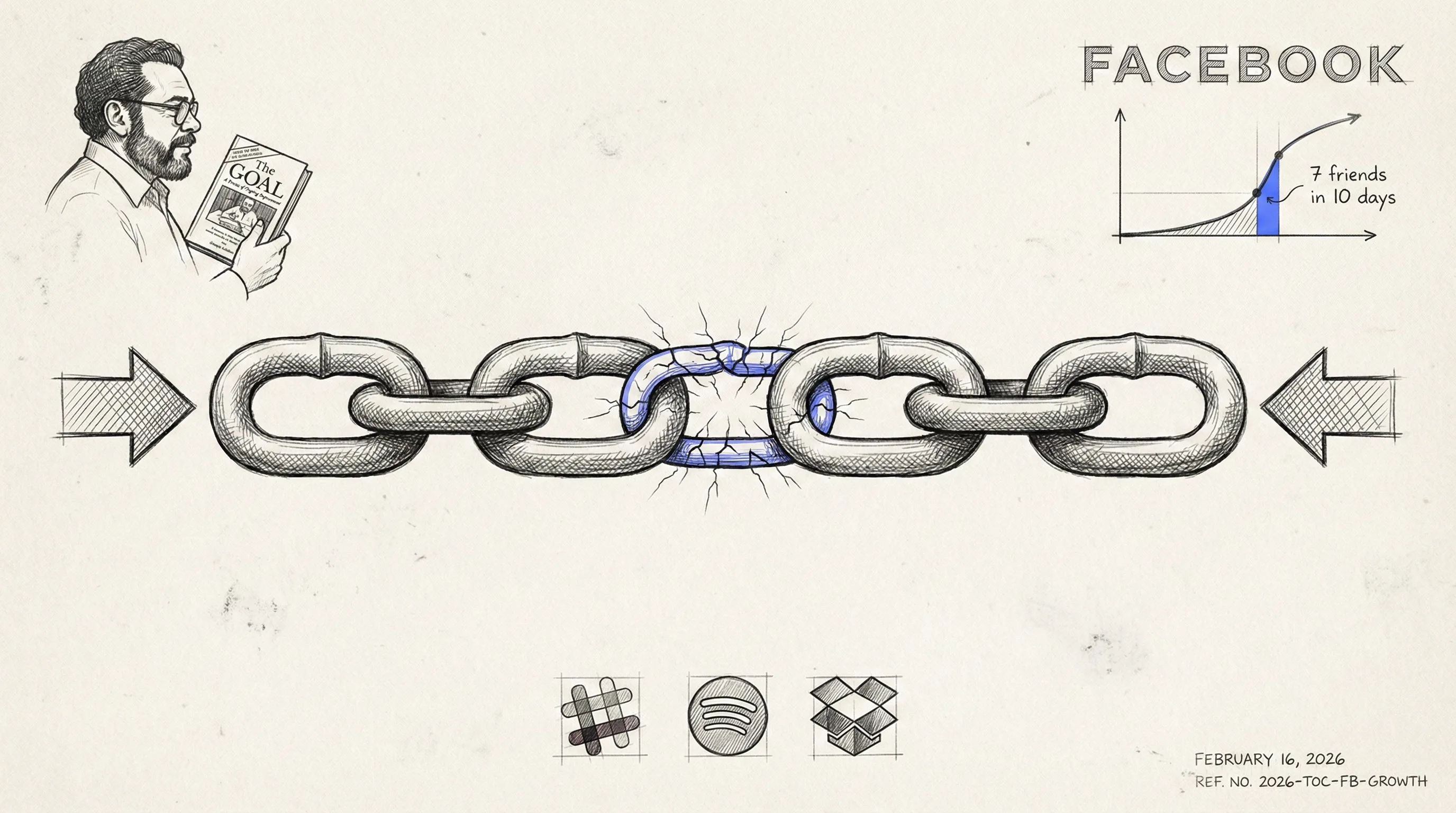
7 friends in 10 days
Chamath Palihapitiya, Facebook's Head of Growth. Problem: people signed up, then vanished.
He dug into the data. Who stays? Who leaves? The answer was surprising — it wasn't time on site, it wasn't posts published. It was the number of friends.
If a user added at least 7 friends in the first 10 days, they stayed forever. Fewer than 7? They vanished.
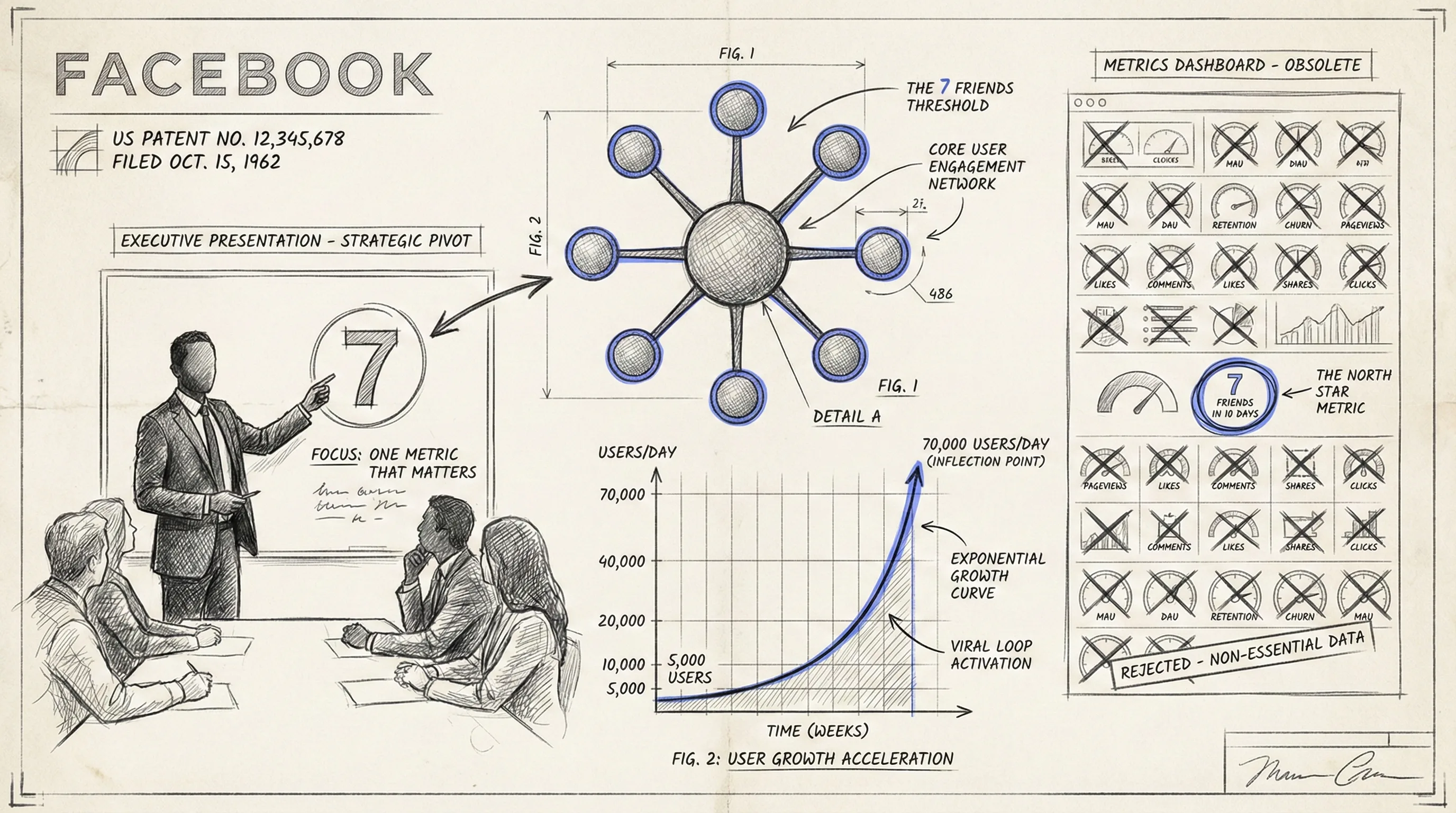
Chamath did something radical: he told the team "I don't care about anything else. Only this number." Every feature, email, pixel of the onboarding — optimized for one thing.
Result: from 5,000 to 70,000 new users per day.
Data
Facebook went from 5,000 to 70,000 new users per day by optimizing for a single metric: 7 friends in 10 days. — Chamath Palihapitiya, Growth Hackers Conference 2012
The Magic Moment
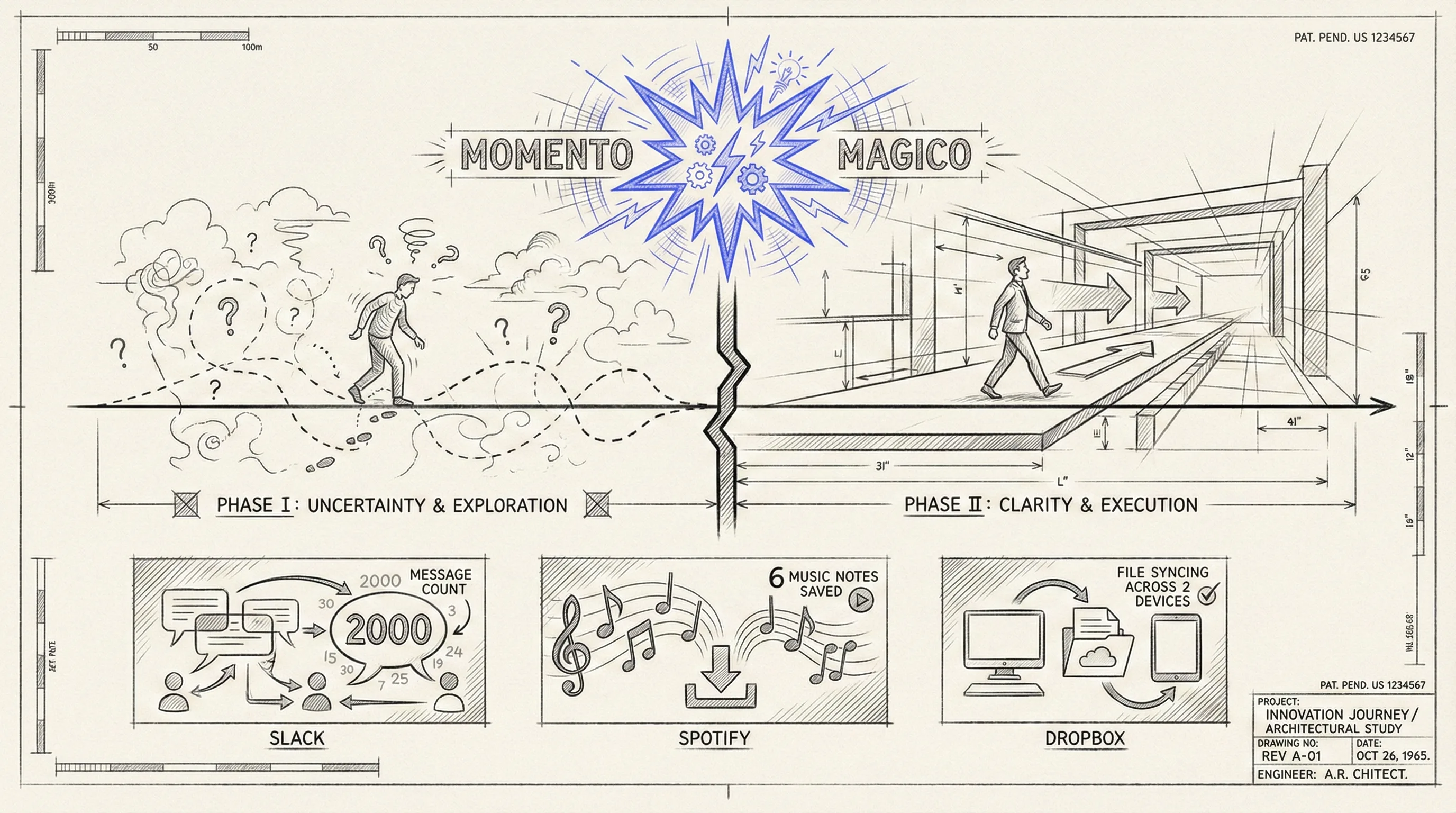
In the growth world it's called "the magic moment." It's the point in the first days where the customer does something — a specific action — and their brain decides, without them realizing it: "Ok, I'm staying."
For Facebook, that action was adding 7 friends. For your business, it's something else. But the principle is identical.
And it makes sense, if you think about it. With 3 friends, Facebook is boring. The feed is empty. There's nothing to see. But with 7 or more friends? Facebook becomes your social life. You come back every day, because every day there's something new.
Robert Cialdini calls it "commitment and consistency": when you invest time and energy in something — in this case, building your social network — your brain decides it's worth staying. The more friends you add, the more invested you are. The more invested you are, the more you stay.
The magic moment isn't a trick. It's the point where the real value of the product becomes visible to the customer. Before that moment, the customer is hoping. After, they're experiencing.
Insight
The Magic Moment isn't a growth hacking trick. It's the point where the real value of the product becomes tangible. Before, the customer hopes. After, they experience.
The principle is universal
It's not just Facebook. Every company that found its magic moment stopped looking at everything else — and started winning.
- Slack: 2,000 messages sent within the team. When a team passes that threshold, they become dependent on the tool. Adoption becomes irreversible.
- Spotify: 6 artists saved in the first week. Those who personalize playlists stay. Those who listen passively vanish.
- Dropbox: one file saved on two different devices. Drew Houston understood that cross-device syncing was the moment the user "got" the product.
Completely different numbers. Completely different businesses. Completely different industries. But the principle is identical: there is a single data point that predicts who stays and who leaves.
Signal vs noise
Claude Shannon, 1948. The paper that invented information theory. Key concept: in every system, there's the signal (useful information) and the noise (everything else).
The metrics you usually look at — churn, NPS, revenue — are like looking in the rearview mirror. They tell you what already happened. By the time you read them, it's already too late.
The magic moment is the windshield. It tells you what's about to happen. It's a leading indicator: it lets you act before the customer leaves, not after.
Applied to business:
- Signal: if you move this number, other things move.
- Noise: if you move this number, nothing changes.
Leads, conversions, churn, CAC, LTV, MRR, NPS... I've seen entrepreneurs with dashboards that look like an airplane cockpit. 37 numbers. And when you ask "which is the most important?" — silence.
Are you measuring everything? You're measuring noise. Every department has its own specific indicators — but you need one constraint per department, not 47 metrics for everyone.
One constraint at a time
Eliyahu Goldratt, The Goal, 1984. The idea: every system has a single constraint that limits total output. No matter how much you improve the other parts — as long as the constraint exists, the system doesn't accelerate.
Revenue is a lagging indicator — a result. Like the destination on Google Maps. You can't change it directly.
What you need is the leading indicator — a fork in the road. Choose A, you arrive at X. Choose B, you arrive at Y. You can control it.
Revenue is rational. But rational doesn't mean right. Optimizing for revenue is like driving while looking in the rearview mirror. The same principle applies when you build a sales system: look at data by stage, not the final result.
“When you measure everything, you're measuring nothing.”
— Nate Silver
Find it in 3 steps
Step 1: Think about your best customer.
Not the biggest. Not the highest-paying. The one who's been with you for years. Who refers people to you without being asked. Who has never hassled you about price.
Got them in mind? Good.
Step 2: Ask yourself what happened in the first 30 days.
What was the moment — the precise moment — when that customer realized it was working?
It depends on what you do. But there's always a moment:
- If you have a marketing agency → when the customer sees the first qualified leads
- If you have a consultancy → when the first change you suggest gets implemented and produces a result
- If you have a SaaS → when the team starts using the tool every day
The moment when the customer thinks — maybe without saying it out loud: "Ok, it works." That's your "7 friends." That's your magic moment.
Step 3: Turn it into a metric and attack only that.
Formula: "How many of my new customers reach [that moment] within [how much time]?"
One metric. With a threshold. And a time window. Like "7 friends in 10 days." But yours. For your business.
Every decision passes through one filter: "Does this move the constraint? Yes or no?" If no, don't do it.
Insight
You don't need a database with 47 metrics. You need 5 conversations with your best customers to find the moment that matters.
The concrete example
A lead generation agency. SME clients. Monthly subscription service. They were losing clients. Didn't understand why. Measured everything — and understood nothing.
Then they asked themselves the question: what's our magic moment?
They looked at their best clients — the ones who had been with them for years — and found a pattern. All of them, without exception, had received at least 5 qualified leads in the first month.
When they measured: only 45% of new clients were getting there. More than half were destined to leave. And they didn't know it.
They did what Chamath did. They accelerated onboarding — the client no longer waited two weeks to see the first lead. They improved initial targeting — the first leads needed to be good, not many. They added a check-in at day 7.
In four months, that number went from 45% to 78%.
Churn collapsed. Referrals exploded — clients who reached the magic moment didn't just stay, they brought other clients.
Same agency. Same service. Same prices. But with a different focus.
Data
An agency went from 45% to 78% of clients reaching the "magic moment" in the first 30 days. Churn collapsed, referrals exploded — same service, different focus.
Your number
Facebook didn't beat MySpace because it had more money. Not because it had more engineers. Not because it had a more beautiful product.
It beat it because it found the one number that mattered. And stopped looking at everything else.
Chamath didn't invent a 47-step framework. Didn't build a dashboard with 200 metrics. He found one number. One. And built everything around it.
Your business works the same way. Somewhere, in the first days of your customer's journey, there's a moment that decides everything.
Where you look, the bike goes.
What's your "7 friends in 10 days"? Find it.
“It's not about how many customers you have. It's about how many customers stay.”
Frequently Asked Questions
What is the Theory of Constraints?+
Developed by Eliyahu Goldratt, it states that every system has a single constraint (bottleneck) that limits total output. Instead of improving everything, you focus resources on the constraint. When you solve it, a new one emerges.
What is a North Star Metric?+
It's the single metric that predicts long-term success. For Facebook it was "7 friends in 10 days" (retention). For Airbnb "nights booked." For Spotify "listening hours." It's the metric that, if you move it, moves everything else.
What's the difference between leading and lagging indicators?+
A lagging indicator (like revenue) is a result — you can't change it directly. A leading indicator (like lead response speed) is an action within your control that influences the result. Optimizing for leading indicators is more effective.
How do I find the constraint in my business?+
Three steps: (1) Call your 5 best customers, ask when they thought "ok, this works." (2) Turn that moment into a metric: "% of new customers who reach [X] within [Y days]." (3) Optimize for that metric only.
Related Articles
Let's build the system for your business.
Let's discuss how to apply these principles to your specific situation.
Let's talk →