
How to overcome "I need to think about it": the 5 objections it hides (MANUP framework)
We analyzed 200+ lost calls. The same pattern. Every time. Here are the 5 universal objections — and how to spot them before they kill the deal.
Nour Madani
CEO & Founder, Madani
Key Takeaways
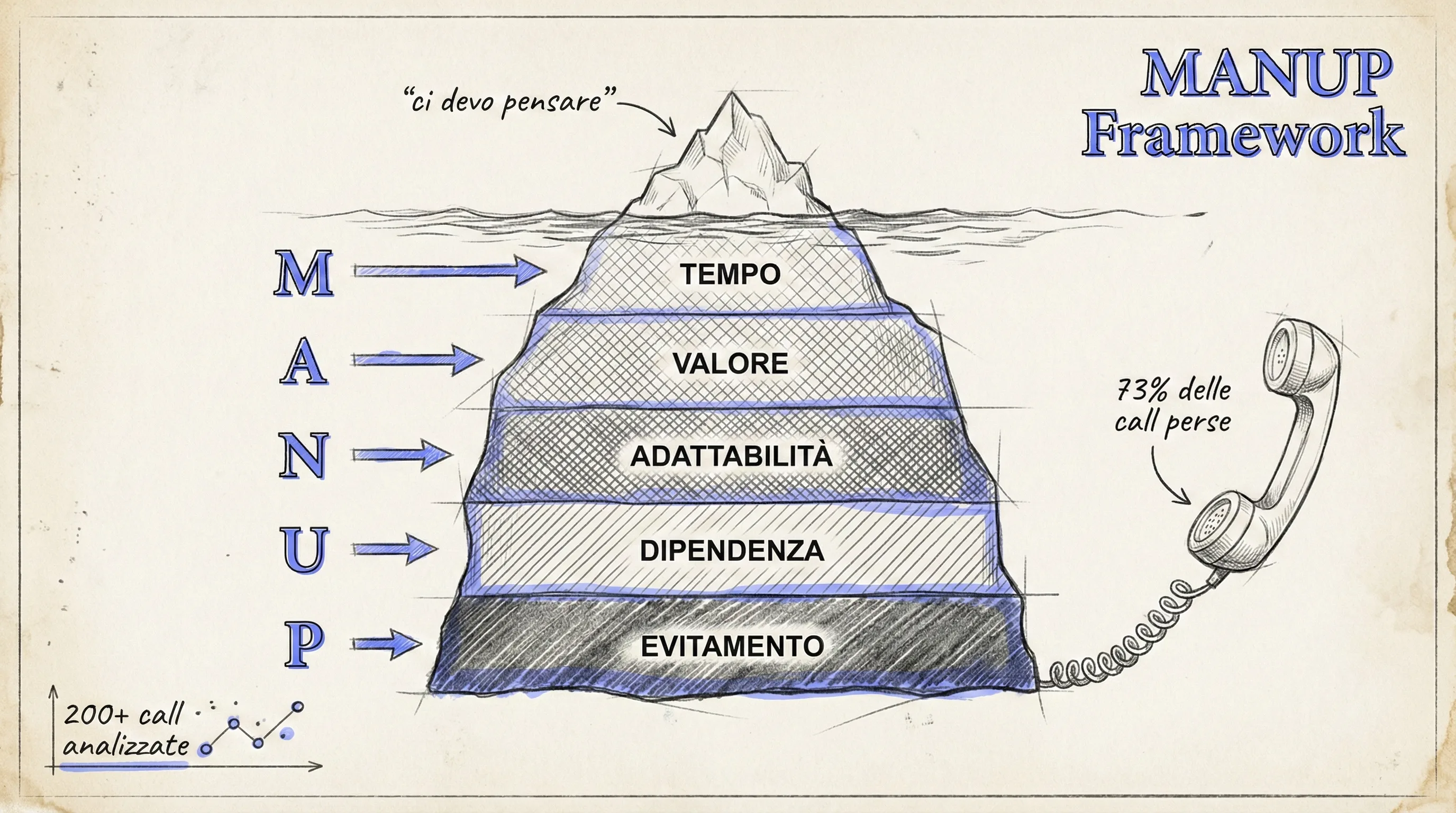
- →"I need to think about it" is not an objection — it's a container for 5 specific objections.
- →The 5 universal objections: Timing, Value, Fit, Dependency, Avoidance.
- →The MANUP framework (Money, Authority, Need, Urgency, Priority) maps each letter to an objection.
- →Diagnosis before cure: discover which of the 5 objections is active before trying to overcome it.
Dead pipelines
We analyzed 200+ lost sales calls. The same pattern. Every time.
The call goes well. The prospect nods. Says they're interested. Then: "I need to think about it."
Done. The deal dies. The follow-up goes unanswered. The prospect vanishes.
The problem isn't the close. The problem is you didn't uncover the real objection during the call. And "I need to think about it" isn't an objection — it's a container. As in the Salesforce system: stage-by-stage diagnosis is everything.
Yet most sales teams continue treating this phrase as a sign of "needing time." They send a polite follow-up after 48 hours. Then another one a week later. Then silence. The pipeline fills with zombies — deals that are neither alive nor dead, but occupy mental space, time, and resources.
The real cost isn't the single lost sale. It's the opportunity cost: every hour spent chasing a zombie deal is an hour not spent on a qualified prospect. On average, the sales teams we analyzed spent 34% of their time on follow-ups with prospects who would never close — because the real objection was never identified.
The data from 200 calls
To build the MANUP framework, we didn't start from theory. We started from data. We transcribed and analyzed 217 lost sales calls — recorded during consulting engagements with 14 Italian B2B companies, spanning SaaS, professional services, and agencies. Each call was coded for: prospect's closing phrase, expressed vs. implied objection, follow-up response time, and final outcome.
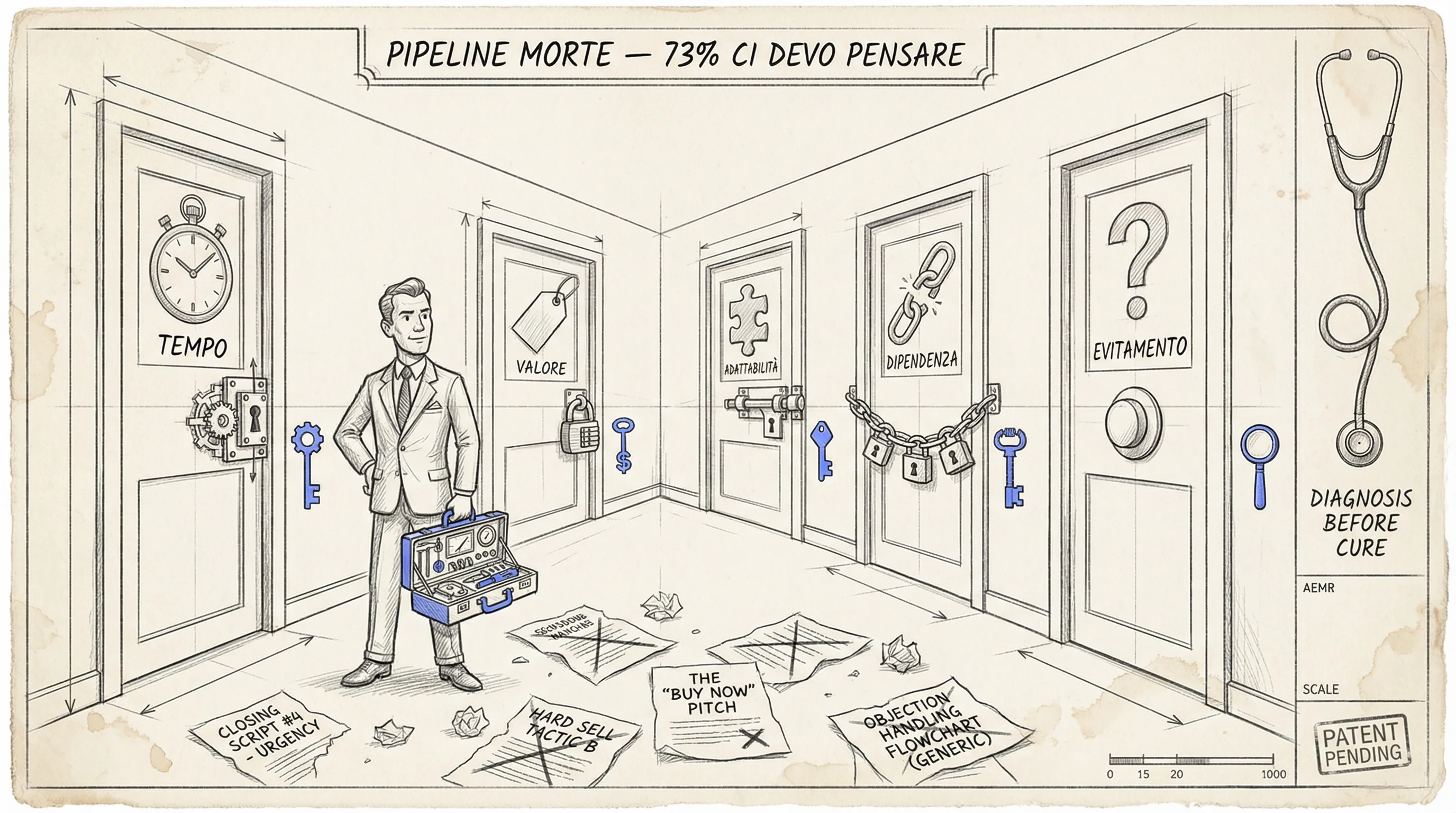
The pattern was brutal in its clarity: 73% of lost calls ended with "I need to think about it" or a functional equivalent — "I'll talk to my partner," "let's see next week," "send me a recap." Different phrases, same mechanism: the prospect has an objection they're not expressing.
Of that 73%, 89% never responded to the follow-up. Not an explicit rejection. Simply silence. The prospect vanishes, and the salesperson is left in limbo — unsure whether to push, wait, or drop it. Source: Madani internal data, collected across 14 sales consulting engagements between 2024 and 2025.
The most counterintuitive finding: longer calls didn't have the highest closing rate. In fact, calls over 55 minutes had a 14% closing rate — versus 38% for calls between 25 and 40 minutes. Reason: long calls were long because the salesperson hadn't identified the objection and kept "selling" instead of diagnosing.
The conclusion is structural: when the prospect says "I need to think about it," the sales process has already failed. The real work happens BEFORE the objection surfaces. The MANUP framework was born from exactly this awareness — not as a closing technique, but as a preventive diagnosis system.
Data
73% of lost calls end with "I need to think about it" or equivalent. Of those, 89% never respond to the follow-up. The problem isn't closing — it's the missing diagnosis. — Madani internal data, 217 calls analyzed
The 5 objections
Behind every "I need to think about it" there's always one of these:
- Timing — "It's not the right moment." The need exists, but it's not a priority right now.
- Value — "It's not worth the price." They perceive the cost but not the value. Communication gap.
- Fit — "It won't work for me." They understand the value in general, but doubt it applies to their specific situation.
- Dependency — "What if I get locked in?" Fear of losing control or not being able to exit.
- Avoidance — No specific objection. They simply don't want to decide. Postpones by nature.
Each requires a completely different response. Treating them all the same is why your calls die.
These 5 objections aren't arbitrary categories. They emerge from the psychology of purchase decisions. Every B2B purchase involves a perceived risk — and the prospect's brain classifies that risk into one of these 5 categories, often unconsciously. The salesperson who can't read which risk is active ends up responding to the wrong objection.
Concrete example: a prospect says "I need to think about it." The salesperson assumes it's Value and offers a discount. But the real objection was Fit — the prospect didn't believe the solution would work for their specific industry. The discount not only doesn't solve anything, it makes things worse: now the prospect thinks the product is worth less than advertised.
How to recognize each objection
Every objection leaves specific signals during the call. The expert salesperson recognizes them in the first 15 minutes — before the prospect reaches "I need to think about it." Here's the signal map.
Timing signals
"Interesting, but maybe in Q3..." / excessive questions about implementation timeline / "How long does it take to get started?" repeated multiple times / comparisons with other ongoing projects. The prospect is saying: it's not that I don't want to — it's that I have other priorities right now. The right response isn't forcing urgency. It's quantifying the cost of waiting: "Every month you wait, you lose X."
Value signals
Comparisons with cheaper alternatives / "But what exactly do I get?" / calculating out loud / "It's a significant investment" / requesting specific ROI. The prospect sees the price but not the value. The response: don't justify the price — reframe. You're not selling a cost, you're selling a return on investment.
Fit signals
"Our situation is different..." / "Has it worked for companies like ours?" / ultra-specific questions about the industry / "Yes but in our case..." / skepticism about case studies. This is the most insidious objection because it sounds rational. The response: case studies specific to the prospect's industry. If you don't have them, admit it and propose a pilot.
Dependency signals
"What if we want to stop?" / questions about contract duration / "Can we do it internally too?" / "Who owns the data/content?" / requests for technical documentation before discussing value. The prospect is afraid of losing control. The response: total transparency on exit clauses and knowledge transfer.
Avoidance signals
Enthusiasm without commitment / "Fantastic, let's talk next week" without setting a date / "Send me the recap and I'll think about it" / absence of critical questions (paradoxically, the prospect who objects to nothing is the most dangerous). The response: force a micro-decision within the call itself — "If we moved forward, what would be the first step on your end?"
Insight
The prospect who asks no critical questions is the most dangerous. The absence of objections isn't consent — it's Avoidance.
Diagnosis before cure
Money — do they have the budget? If M is missing, the objection is Value.
Authority — are they the decision-maker? If A is missing, the objection is Avoidance (or internal politics).
Need — is the need real and felt? If N is missing, the objection is Fit.
Urgency — do they need to act now? If U is missing, the objection is Timing.
Priority — is it among their priorities? If P is missing, the objection is Timing or Avoidance.
If during the call you manage to verify all 5 letters, "I need to think about it" doesn't come. Because you've already addressed the objection before it surfaced.
The MANUP rate — the percentage of calls where you verify all 5 letters — is one of the key KPIs of the initial diagnosis. Together with the relationship health score, the second appointment rate, and the second show-up rate, it defines how well you're diagnosing before prescribing.
A common mistake: confusing MANUP verification with an interrogation. You're not giving the prospect a questionnaire. You're having a diagnostic conversation. M (Money) isn't verified by asking "Do you have the budget?" It's verified by exploring how the company allocates resources: "How have you handled similar investments in the past?" The difference is between a salesperson and a consultant.
Each missing letter isn't a failure — it's information. If U (Urgency) is missing, it doesn't mean the deal is dead. It means you need to create urgency by showing the cost of inaction. If A (Authority) is missing, you need to understand who else is involved in the decision and build a multi-stakeholder strategy. MANUP isn't a binary filter — it's a diagnostic map.
Insight
Don't try to "overcome" an objection before you've diagnosed it. Diagnosis before cure — like a doctor, not like a salesperson.
From MANUP to PASTA: diagnosis and prescription
MANUP tells you what is blocking the sale. But a diagnosis without a prescription is useless. You need a second framework: PASTA.
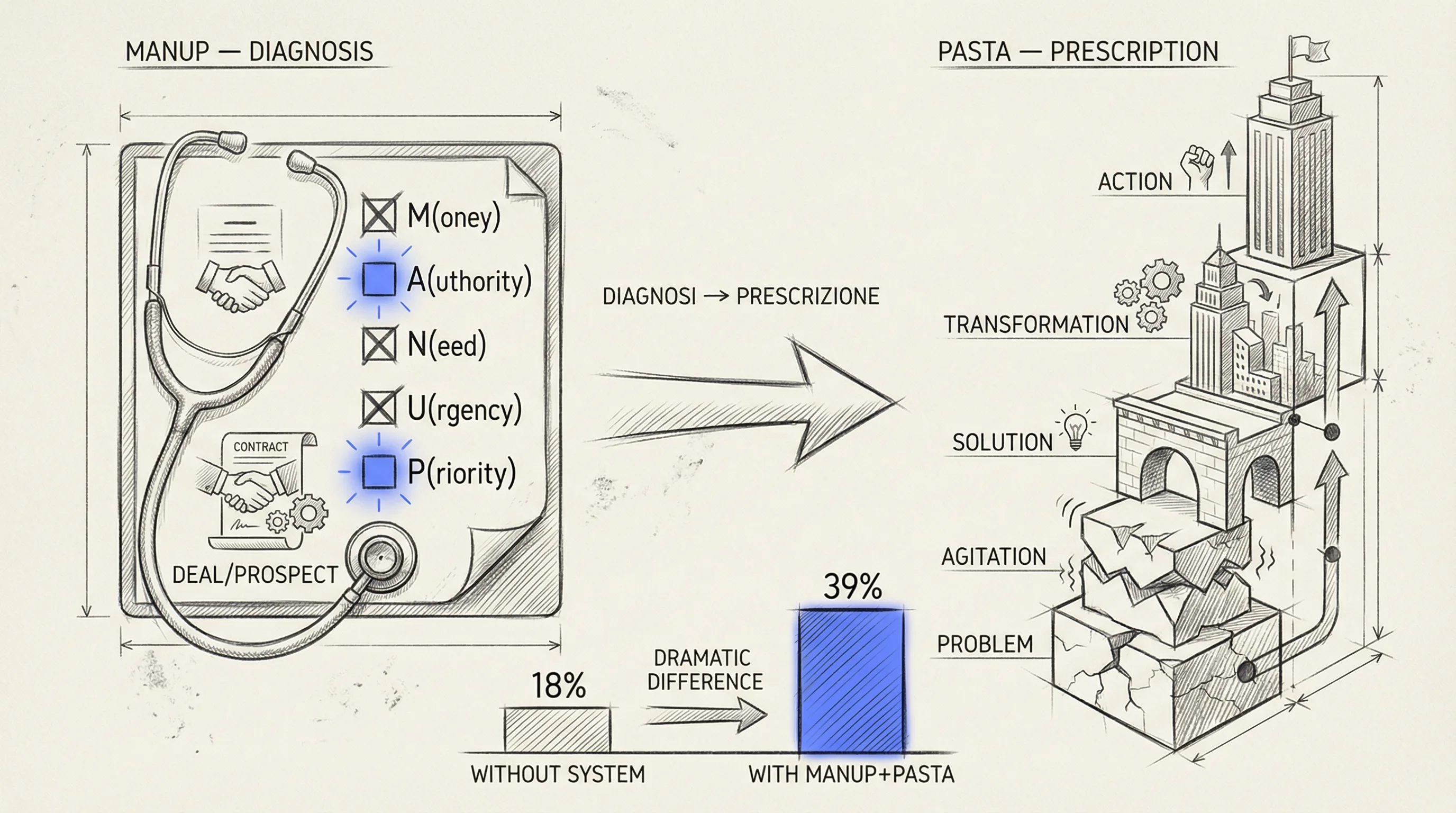
PASTA = Problem, Agitation, Solution, Transformation, Action. It's the communication sequence that turns the MANUP diagnosis into a response that closes.
- Problem — Restate the prospect's problem in their own words. "If I understand correctly, the issue is that..." — This demonstrates listening and builds trust.
- Agitation — Amplify the consequences of not acting. Not to manipulate — to surface the real cost of inaction that the prospect is underestimating.
- Solution — Present the solution as a direct answer to the restated problem. Not everything you offer — only the part that solves THAT specific problem.
- Transformation — Paint the before/after. "Today you're doing X, which costs you Y. With this approach, in 90 days you'll be at Z." Specific, measurable, credible.
- Action — The next step. Not "think about it and let me know" — a concrete micro-commitment: "The next step is a 30-minute session with your team. Thursday or Friday?"
The complete system works like this: MANUP tells you WHAT is blocking. PASTA tells you HOW to unblock it. They are diagnosis and prescription.
KPIs for the integrated system:
- MANUP rate — % of calls where all 5 letters are verified. Target: 80%+.
- PASTA score — Rating 1-5 on how well the response followed the correct sequence. Target: 4+.
- Closing rate — Direct correlation: teams with MANUP rate above 80% and PASTA score above 4 close at 39%, versus 18% without the system.
Data
Teams with MANUP rate >80% and PASTA score >4 close at 39%. Without the system: 18%.
Case study: from 22% to 41% in 90 days
An Italian B2B SaaS company — 15 salespeople, average ticket 8,000 euros, targeting SMEs. Closing rate: 22%.
We transcribed 60 calls over 3 weeks. In 78% of lost calls, at least 2 MANUP letters were missing in the first 15 minutes. The most frequently missing letter: N (Need) — in 65% of cases.
65% of "I need to think about it" was Fit. Prospects doubted it would work for THEIR specific situation.
4-phase intervention:
- Weeks 1-2: MANUP training with conversational checklist.
- Weeks 3-4: 12 mini case studies specific to each industry.
- Weeks 5-8: PASTA implementation for each objection.
- Weeks 9-12: Weekly review with MANUP rate and PASTA score per salesperson.
Results after 90 days: closing rate from 22% to 41%. MANUP rate from 31% to 84%. Average call time from 52 to 35 minutes. Follow-up response rate from 12% to 47%.
They didn't need better salespeople. They needed a better thinking system.
“65% of "I need to think about it" was Fit. Prospects didn't doubt the product — they doubted it would work for them.”
— Madani case study, B2B SaaS Italy
Your last 10 calls
Take your last 10 lost calls. For each one, ask yourself:
- Which of the 5 MANUP letters was missing?
- Which of the 5 objections was active?
- Did I discover it during the call or after?
The pattern will emerge. Almost always it's the same objection, the same missing letter. That's your constraint in sales.
If you want to go deeper: record your next 10 calls (with the prospect's consent). Listen to them again. Mark the exact moment the prospect gave the first signal of an objection — and the moment the salesperson did (or didn't) catch it. The distance between these two moments is your diagnostic gap. The larger it is, the more inevitable "I need to think about it" becomes.
One last exercise: for every lost call, write down which MANUP letter was missing and which PASTA response you would have given. After 10 calls, you'll have your personalized playbook — not a generic template, but a map built on your real patterns.
Frequently Asked Questions
What is the MANUP framework?+
MANUP is a proprietary Madani framework for sales qualification. It stands for Money (budget), Authority (who decides), Need (real need), Urgency (urgency), Priority (priority relative to other initiatives). Each missing letter maps to a specific objection.
What are the 5 universal sales objections?+
The 5 universal objections identified by Madani across 200+ analyzed calls: (1) Timing — "it's not the right moment," (2) Value — "it's not worth the price," (3) Fit — "it won't work for me," (4) Dependency — "what if I get locked in?," (5) Avoidance — doesn't want to decide, keeps postponing.
Why is "I need to think about it" a red flag?+
Because it's never the real objection. "I need to think about it" means the client has a specific objection they haven't expressed. Your job is to discover which of the 5 it is — because each one requires a different response.
How do you measure the MANUP rate?+
The MANUP rate is the percentage of calls where all 5 letters are verified during the initial diagnosis. A high MANUP rate (80%+) correlates directly with higher closing rates, because objections are addressed before the closing phase.
Related Articles
Let's build the system for your business.
Let's discuss how to apply these principles to your specific situation.
Let's talk →