
How satire controls the narrative (the only weapon without a defense)
Force can be counter-attacked. Morality can be counter-argued. Ridicule? Has no defense. From DARPA to White House memes — the science behind laughter as a weapon.
Nour Madani
CEO & Founder, Madani
Key Takeaways
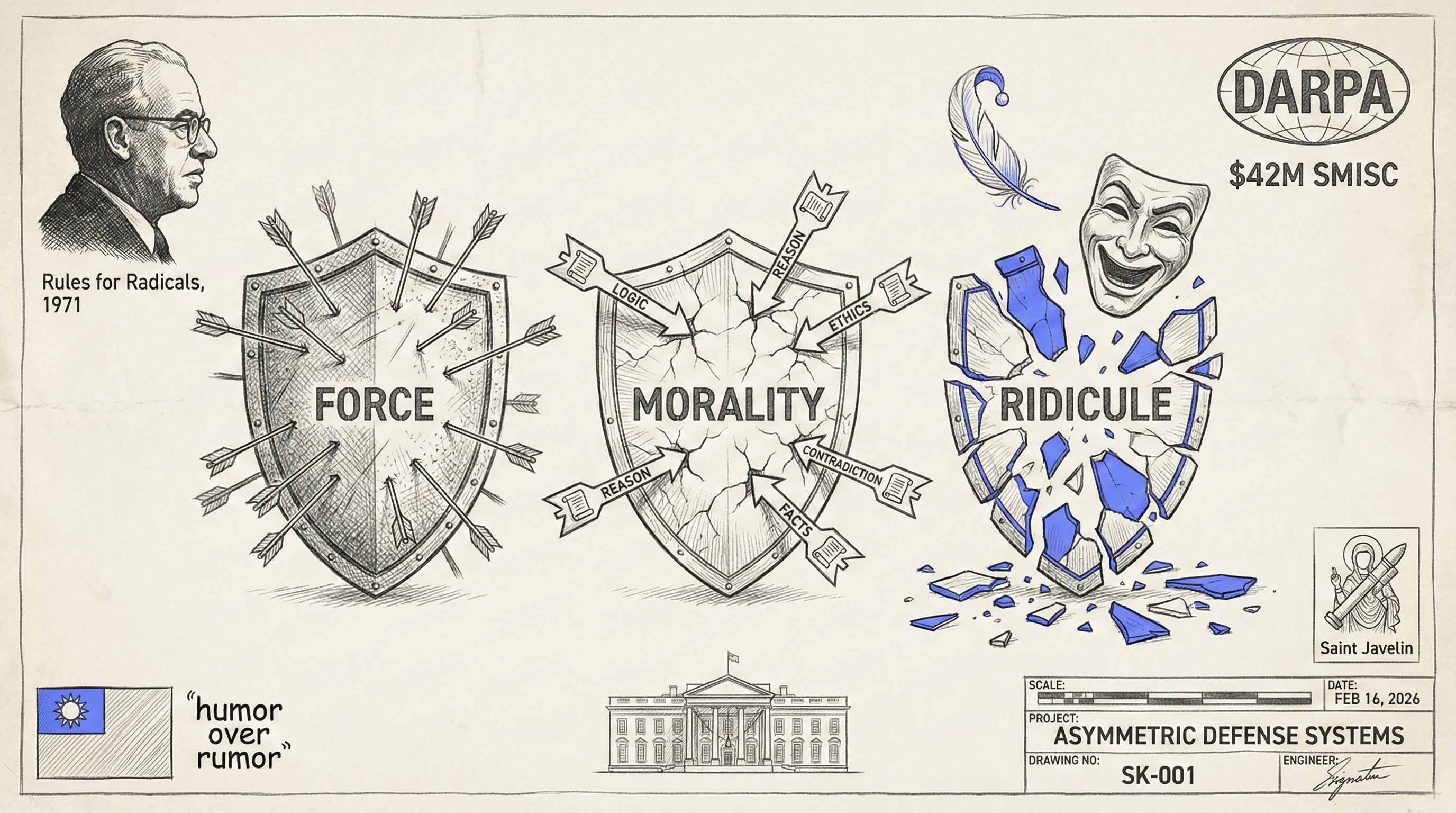
- →Three levels of influence: Force (can be counter-attacked), Morality (can be counter-argued), Ridicule (no defense).
- →The paper "Those Who Laugh Are Defenseless" demonstrates that humor bypasses cognitive defenses.
- →DARPA invested $42M in the SMISC program for "memetic warfare."
- →Taiwan uses the "humor over rumor" strategy successfully against disinformation.
Three levels
Saul Alinsky, Rules for Radicals, 1971. Rule number 5: "Ridicule is man's most potent weapon. There is no defense."
Three levels:
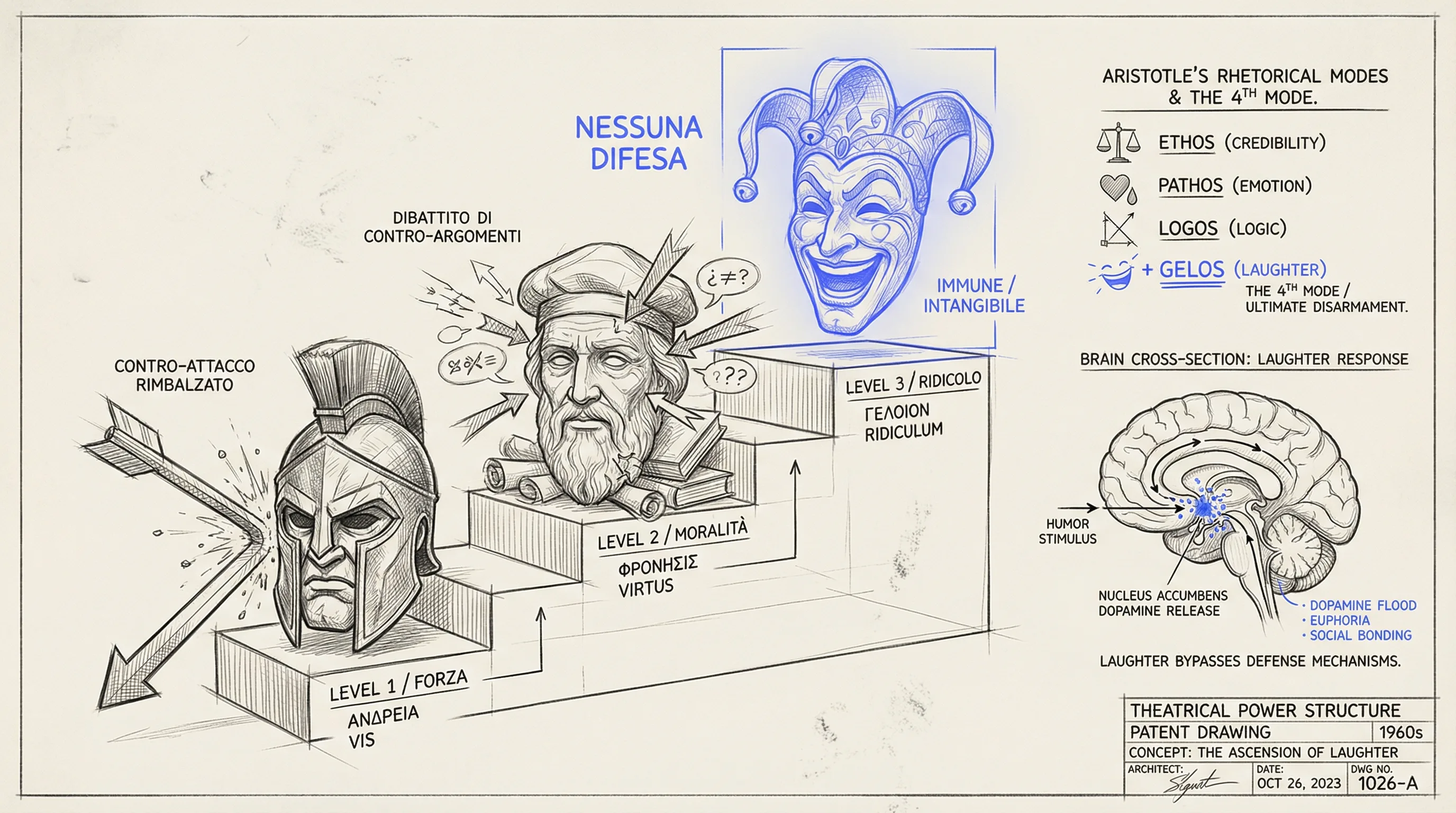
- Level 1 — Force. It can be counter-attacked with greater force.
- Level 2 — Morality/Arguments. It can be counter-argued with better arguments.
- Level 3 — Ridicule. It has no defense. You can't "counter-ridicule." You can't respond to a nickname.
"Low Energy Jeb." "Crooked Hillary." They weren't insults. They were convictions. Because how do you respond to a nickname? You can't.
Alinsky was no armchair theorist. He was a community organizer who worked in the streets of Chicago for 30 years. His 13 rules for radicals — published in 1971, one year before his death — became the unofficial manual for every social movement, political campaign, and communication strategy of the last 50 years. Obama studied them. The Tea Party studied them. Trump applied them better than anyone.
Rule number 5 is the most powerful because it exploits a fundamental asymmetry: force is balanced, arguments are debated, but ridicule has no counterweight. If someone attacks you with force, you can respond with greater force. If someone attacks you with an argument, you can respond with a better argument. But if someone makes you ridiculous? Any response — serious, angry, rational — makes things worse. Reacting to ridicule confirms the ridicule.
“Ridicule is man's most potent weapon. There is no defense.”
— Saul Alinsky, Rules for Radicals, 1971
Yu Sze and the jester's privilege
Around 300 BC. The First Emperor of China, Qin Shi Huang — the same one who built the Great Wall and the terracotta army — announces a plan: he wants to lacquer the entire Great Wall. Thousands of kilometers of wall, coated in lacquer. A mad, impossibly expensive, logistically unfeasible project.
No one dares to object. In the Qin empire, contradicting the emperor means death. The advisors stay silent. The generals nod. The only one who speaks is Yu Sze, the court jester.
Yu Sze doesn't say "Your Majesty, that's a stupid idea." He says: "Brilliant idea! And while the lacquer dries, we'll need to build a drying hall bigger than the Wall itself. And then guards to protect the hall. And then cooks to feed the guards..."
The emperor laughs. And abandons the project.
This episode, documented by Beatrice K. Otto in "Fools Are Everywhere: The Court Jester Around the World" (University of Chicago Press, 2001), illustrates what Otto calls the "jester's privilege". The jester is the only person in the court who can tell the king he's wrong. But he can only do it through humor. If he speaks seriously, he gets beheaded. If he gets a laugh, he gets heard.
The mechanism is the same one identified by Alinsky two thousand years later: ridicule bypasses defenses. The emperor would never have accepted a rational argument against his plan — because a rational argument implies the emperor is wrong, and the emperor is never wrong. But laughter isn't an accusation. It's a game. And in a game, even the emperor can lose without losing face.
The tradition is universal. In medieval Europe, the fou du roi had absolute right of speech. In West Africa, griots used satirical songs to criticize leaders. In Ottoman courts, the maskhara could insult the sultan in public — something that cost anyone else their life. The pattern is identical in every culture: whoever makes power laugh is the only one who can challenge it.
“The jester is the only person in the court who can tell the king he's wrong. But he can only do it through humor.”
— Beatrice K. Otto, Fools Are Everywhere, 2001
Those who laugh are defenseless
Academic paper, 2012: "Those Who Laugh Are Defenseless: How Humor Breaks Resistance to Influence."
Cognitive resistance is your mental shield against persuasion. You know someone is trying to convince you, so you raise your guard.
Humor bypasses that shield. When you laugh, the brain releases dopamine. Defenses drop. The information that follows the laughter enters without filters.
The researchers propose "Gelos" as a fourth mode of persuasion — alongside Aristotle's Ethos, Pathos, and Logos. The same principle applies in sales: it's the reason why emotional objections are more powerful than rational ones.
The mechanism is biological, not cultural. Neuroscientist Robert Provine (University of Maryland) documented in "Laughter: A Scientific Investigation" (2000) that laughter is 30 times more likely in social contexts than in solitude. It's not a response to humor — it's a social signal of belonging. When a group laughs together, it's communicating: "We're on the same side." That's why memes work: they're not jokes — they're group identity markers.
Jonathan Haidt, in "The Righteous Mind" (2012), extends the concept: people don't change their minds through rational arguments. They change their minds when they feel part of a group that thinks differently. And shared humor is the fastest way to create that sense of belonging. It's the reason why political movements that use satire grow faster than those that use only arguments — humor creates the tribe before a platform even exists.
Data
Laughter lowers cognitive defenses. Information following humor is processed with less resistance. — ResearchGate, "Those Who Laugh Are Defenseless," 2007
The neuroscience of laughter
The Gelos paper isn't isolated. Research on the relationship between humor and memory is extensive — and the results are consistent.
In 1994, Stephen Schmidt published in Memory & Cognition the study that defines the "Humor Superiority Effect": information presented in humorous form is remembered 2-3 times better than the same information presented neutrally. Not a bit better — much better. Schmidt tested the phenomenon with word lists, sentences, and concepts: in every condition, the humorous version was recalled with significantly greater accuracy at 24 hours, one week, and one month.
Neuroimaging confirms the mechanism. fMRI studies (Mobbs et al., 2003, published in Neuron) show that humor activates the mesolimbic reward circuit — the same one activated by food, sex, and drugs. Specifically, the nucleus accumbens and the ventral tegmental area release dopamine when something makes us laugh. This dopamine doesn't just produce pleasure — it signals to the brain that the associated information is relevant and worth remembering.
In practical terms: when you laugh, your brain is doing "priority filing" — it's storing that information with a "important, remember" tag. It's the same mechanism that makes emotional memories (fear, joy, surprise) more vivid than neutral ones. But with an advantage: laughter is pleasant, so it doesn't produce the trauma associated with fear.
The implications for sales communication are enormous. If your message makes someone laugh — even slightly — it gets remembered better, processed with less resistance, and associated with a positive emotion. It's not manipulation. It's neurobiology.
Data
Humor Superiority Effect: humorous information is remembered 2-3x better than neutral information. Laughter activates the same reward circuit as food and sex. — Schmidt (1994), Mobbs et al. (2003)
Who uses it today
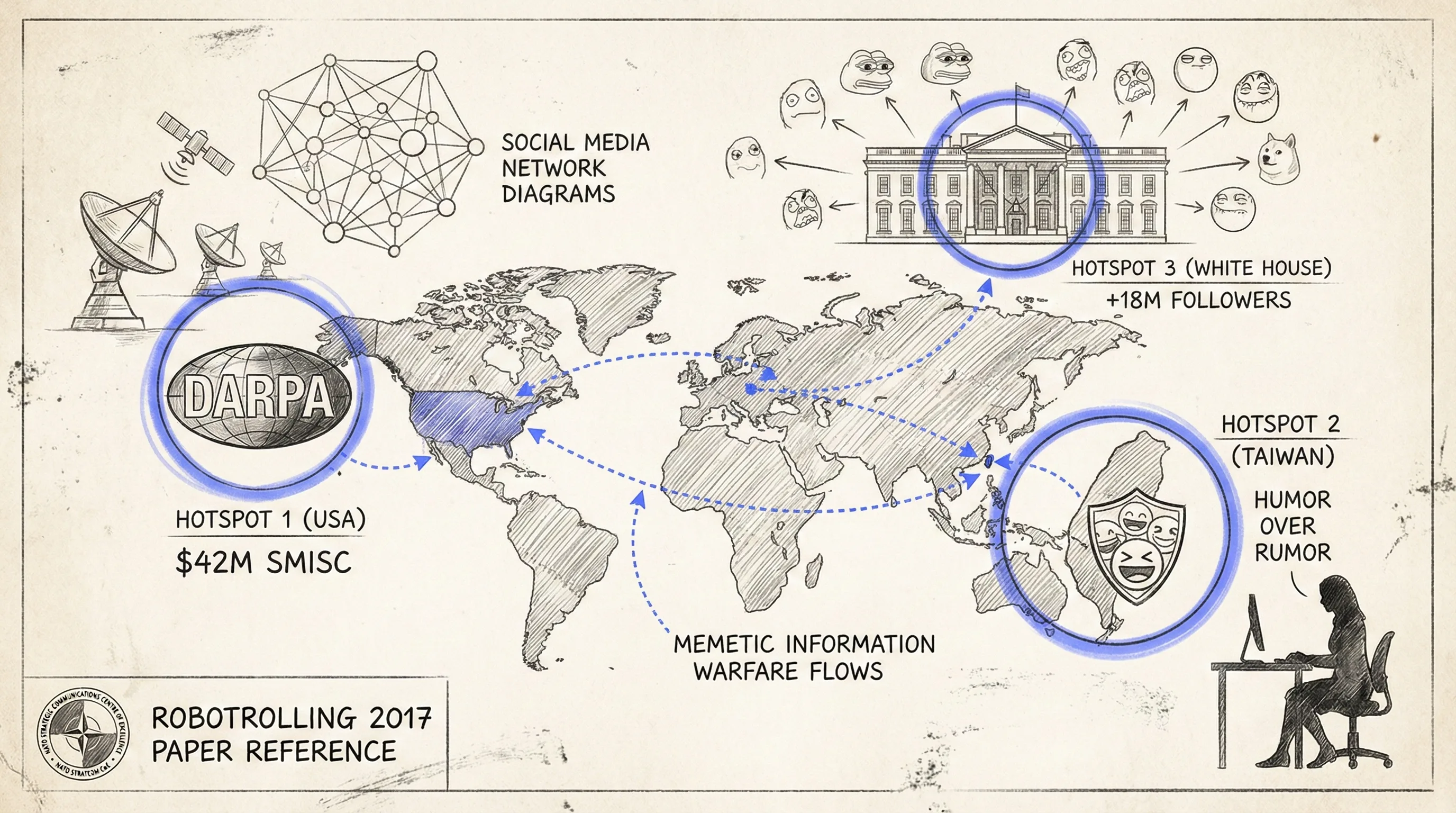
DARPA: $42 million invested in the SMISC program (Social Media in Strategic Communication). NATO StratCom has published academic papers on "memetic warfare."
Taiwan: "Humor over rumor" strategy led by Audrey Tang. Instead of censoring disinformation, they make it ridiculous. It works better than censorship.
White House: Official memes during military operations. Trump dressed as Superman, as the Pope, as Star Wars. +18 million followers in 6 months. It's not casual communication — it's Level 3 strategy.
The Taiwan case deserves deeper analysis. Audrey Tang — Taiwan's Minister of Digital Affairs, one of the most brilliant programmers in the world — built a system that responds to Chinese disinformation not with censorship or denials, but with parodies that arrive before the fake news. The Taiwanese government produces anti-disinformation memes within 60 minutes of a fake news story appearing. The result: Taiwan is consistently ranked among the countries with the best disinformation resilience (V-Dem Institute, University of Gothenburg).
The DARPA SMISC program (launched in 2011, $42M budget) is even more unsettling in its implications. The stated objective: "Develop tools for automated propaganda and counter-propaganda in social media." NATO StratCom published the paper "Robotrolling" in 2017 — analyzing how memes are weaponized by state actors to influence Western elections. The conclusion: memes are more effective than traditional fake news because they spread organically, are difficult to trace, and impossible to censor without appearing authoritarian.
The meme as a modern weapon
If DARPA and Taiwan use satire at the state level, recent history shows it works from the bottom up too — and that memes have become a real geopolitical tool.
Ukraine: Saint Javelin
February 2022. Russia invades Ukraine. Within hours, a Canadian designer of Ukrainian descent creates the image of "Saint Javelin" — the Virgin Mary cradling an FGM-148 Javelin anti-tank missile instead of the Child. The image goes viral within hours. The Saint Javelin website sells merchandise and raises over $1.5 million in humanitarian aid within weeks.
The point isn't the fundraising. It's the mechanism: a meme turned a military weapon into a pop symbol. It made Ukrainian resistance cool, shareable, viral. Ukrainian memes — the tractor towing a Russian tank, "Russian warship, go f**k yourself" — did more for Western public opinion than any diplomatic press conference. NATO has published academic papers on this phenomenon.
Italy: from Beppe Grillo to M5S
The Italian case is unique in the world. Beppe Grillo — a comedian, not a politician — founded a party that in 2018 received 32.7% of the vote in national elections, becoming Italy's largest party. The Five Star Movement was born literally from a blog and political satire shows.
The pattern is Alinsky taken to the extreme: humor builds community, community builds movement, movement builds power. Grillo didn't win with better political arguments. He won by ridiculing the existing political class — and ridicule has no defense.
The universal pattern
Yu Sze in 300 BC, medieval jesters, Alinsky in 1971, the memes of 2022. The mechanism is identical: humor lowers defenses, creates group identity, and mobilizes action. Those who laugh together, fight together. Those who share a meme, share an identity. And a shared identity is the foundation of any movement — political, social, or commercial.
Insight
Saint Javelin raised $1.5M in weeks. Beppe Grillo went from comedian to leader of Italy's largest party. The pattern: humor builds community, community builds movement, movement builds power.
4 rules
Rule 1: Never attack head-on. If someone attacks you, don't defend yourself with arguments. Find the absurd in their position. Laughter does more damage than any counter-argument.
Rule 2: Strategic self-deprecation. When you make fun of yourself, you disarm anyone who wanted to attack you. You have nothing to hide. You're invulnerable.
Rule 3: Make them laugh before making them think. The order matters. First laughter (lowers defenses), then information (enters without filters). Reverse the order and you lose the effect.
Rule 4: Turn enemies into comic figures. Not dangerous monsters. Fools. Monsters frighten. Fools get ignored.
How to apply it to business
Satire isn't just for politics and war. It's a business communication tool — if you know where to position yourself on the spectrum.
The business communication spectrum runs from corporate boring (press releases nobody reads) to authentic humor (which generates engagement and memory) to cringe (the company that tries to be funny and fails miserably). The sweet spot is in the middle — and it requires precise rules.
Rule 1: Punch up, never down
Effective satire attacks those with more power, not less. A brand that makes fun of bigger competitors is David vs. Goliath — likable, brave. A brand that makes fun of customers or employees is a bully — and bullies lose.
Rule 2: Self-deprecation is the safest weapon
When you make fun of yourself, you're unbeatable. No one can attack you on something you've already admitted. RyanAir figured this out perfectly: their TikTok account (7.5 million followers) is built entirely on self-deprecation. "Yes, our seats don't recline. But they cost 9.99." Brutal honesty, presented with humor, has become their brand. Engagement rate 5x above the industry average.
Rule 3: Timing matters more than the joke
The right joke at the wrong time is worse than no joke at all. Wendy's on Twitter is the perfect case study: sarcastic real-time responses to customer and competitor tweets. "Hey McDonald's, we heard you're testing fresh beef. Good for you. We've been using it since 1969." The tweet generated 3.5 million impressions. But it works because it's timely — a spontaneous response, not a scheduled post.
Rule 4: The competitor as comic character, not villain
The most extreme case: Old Spice — "The Man Your Man Could Smell Like" (2010). An absurdist campaign with Isaiah Mustafa speaking directly to camera, going from a shower to a horse in a single take. Result: sales up 107% in the first month. 1.8 billion media impressions. The product was the same deodorant as before — but the communication transformed it from "grandpa stuff" to cultural phenomenon.
The spectrum is clear: if your business communication is so serious nobody remembers it, you're losing. If it's so forced it's embarrassing, you're losing worse. The sweet spot is authenticity with a smile — the same thing that worked for Yu Sze in 300 BC and works for RyanAir in 2026.
Insight
Old Spice: +107% sales with an absurdist campaign. RyanAir: 7.5M TikTok followers with self-deprecation. The product was the same — the communication changed.
The age of ridicule
For millennia, power was based on force. Then on ideas. Now it's based on ridicule.
Whoever controls the laughter controls the narrative. Whoever controls the narrative controls the power.
Yu Sze knew it in 300 BC. The Duke's jester knew it in 1386. Alinsky codified it in 1971. DARPA invested 42 million in it in 2011. Taiwan uses it every day.
Next time you see a meme from the White House — don't think: "It's just a meme."
Think: "It's a weapon." The only weapon without a defense.
And if you're an entrepreneur, a marketer, or a communicator, ask yourself: does your communication make anyone laugh? Not to be clownish — but because information that makes people laugh is remembered 3 times better, shared 5 times more, and processed without resistance. In a world where every person is exposed to 6,000-10,000 advertising messages per day (Red Crow Marketing, 2024), the only weapon that cuts through the noise is the one nobody wants to block: a laugh.
Force can be counter-attacked. Morality can be counter-argued. Ridicule conquers.
Frequently Asked Questions
Why is satire effective in communication?+
According to neuroscience research ("Those Who Laugh Are Defenseless," 2007), laughter lowers cognitive defenses. When you laugh, the brain releases dopamine and drops its guard — the information that follows enters without filters. This makes ridicule more powerful than logical arguments.
What is memetic warfare?+
The term "memetic warfare" describes the strategic use of memes and humorous content to influence public opinion. DARPA invested $42 million in the SMISC program (Social Media in Strategic Communication). NATO StratCom has published academic papers on the subject.
How do you use satire in business communication?+
Four rules: (1) Never attack head-on — find the absurd. (2) Strategic self-deprecation — disarms anyone wanting to attack you. (3) Make them laugh before making them think — the order matters. (4) Turn competitors into comic figures, not monsters — monsters frighten, fools get ignored.
Related Articles
Let's build the system for your business.
Let's discuss how to apply these principles to your specific situation.
Let's talk →