
Why every decision you make takes three times longer than it should (the Bezos framework)
40% of your time goes to decisions. 60% of that time is wasted. Amazon has a framework to fix this — and you can install it in your team in 30 minutes.
Nour Madani
CEO & Founder, Madani
Key Takeaways
- →The problem isn't how many decisions you make, but that you use the same process for all of them. 60% of decision time is wasted (McKinsey 2019).
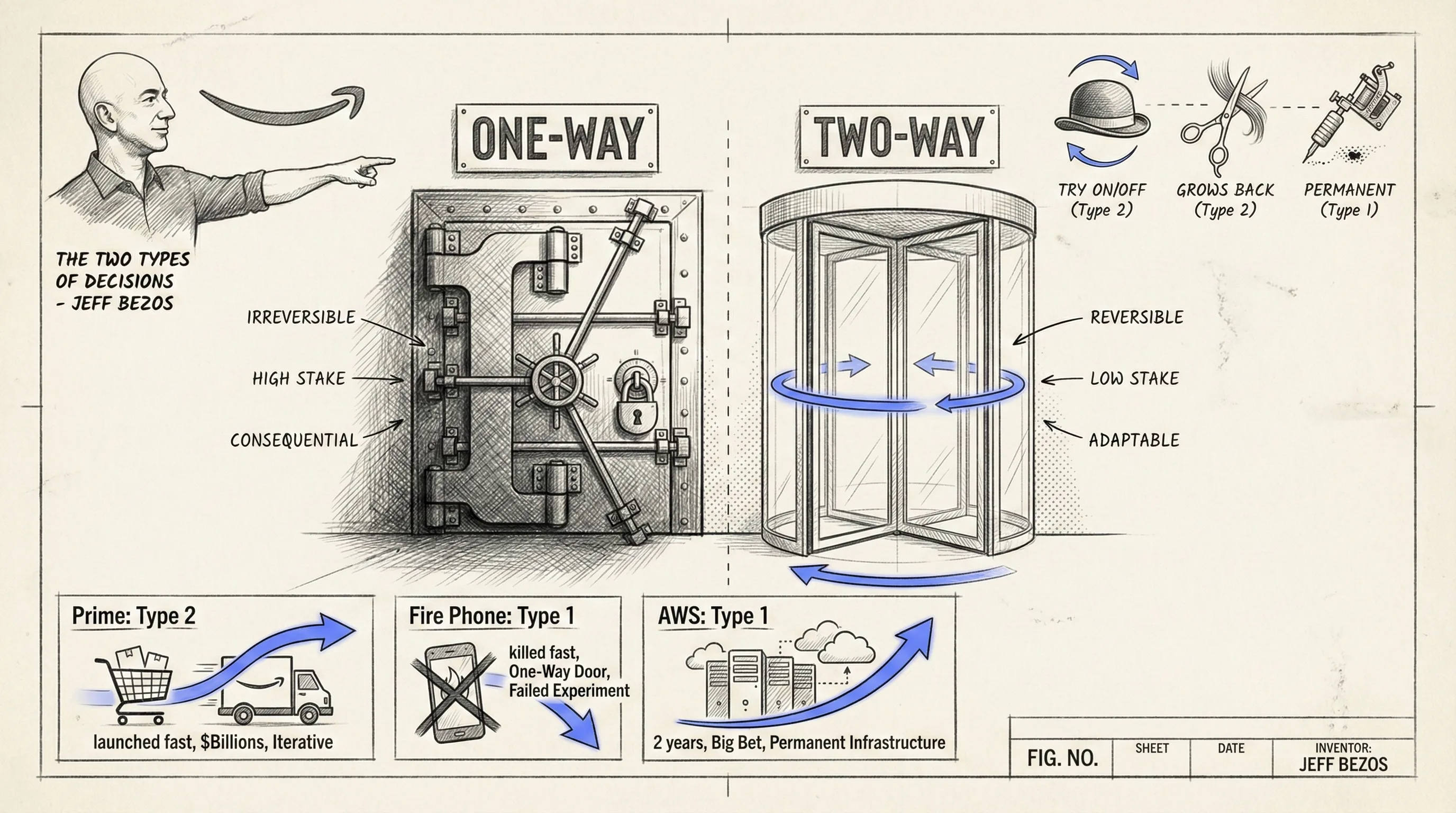
- →Type 1 (one-way door): irreversible, deserves analysis. Type 2 (two-way door): reversible, deserves speed. 90% of business decisions are Type 2.
- →Amazon Prime — now worth tens of billions in revenue — was a Type 2 decision at launch, completely reversible. AWS instead required 2 years of analysis.
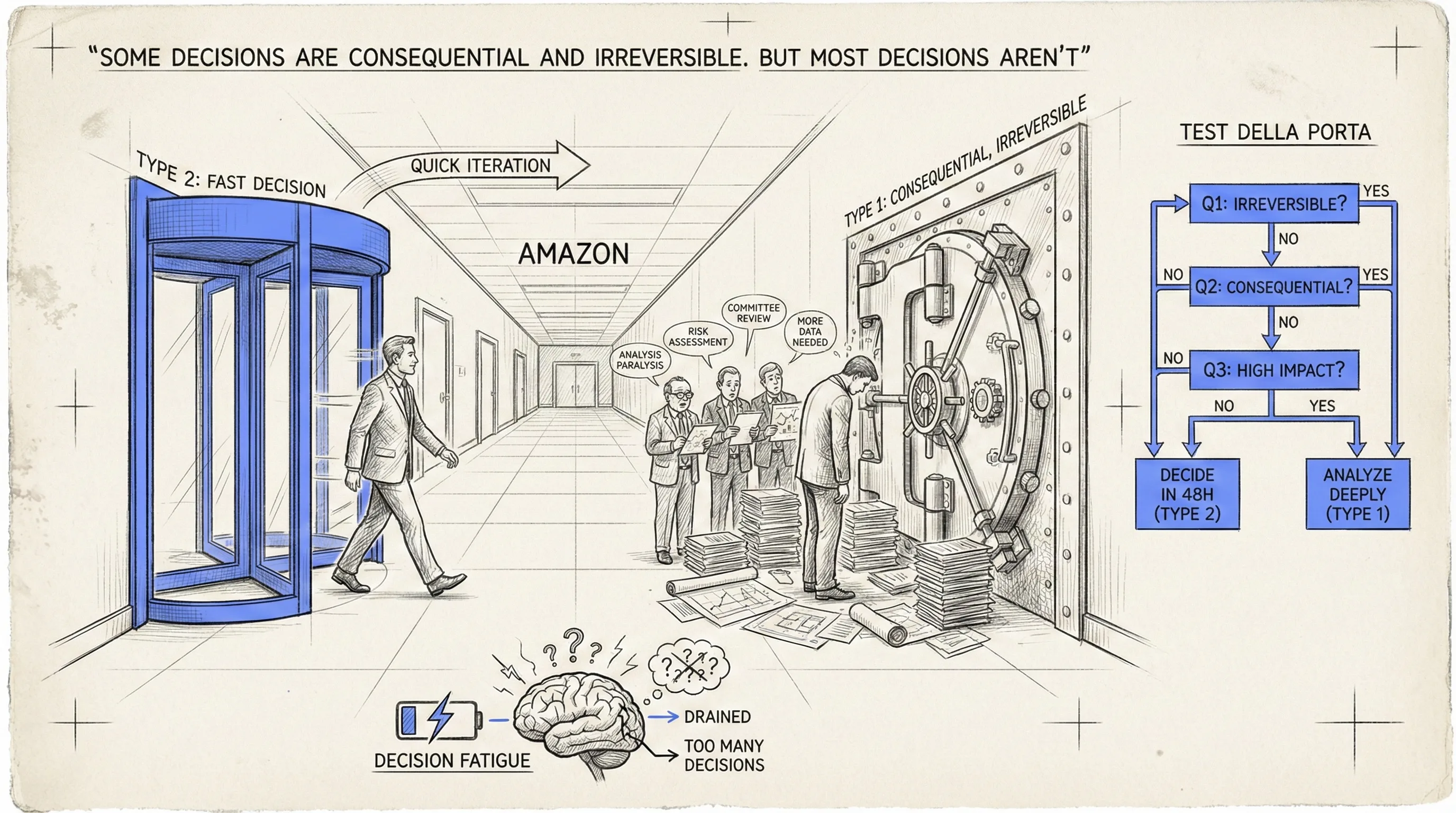
- →The Door Test: 3 questions, 30 seconds, any decision. If it's Type 2, you have 48 hours to decide or delegate.
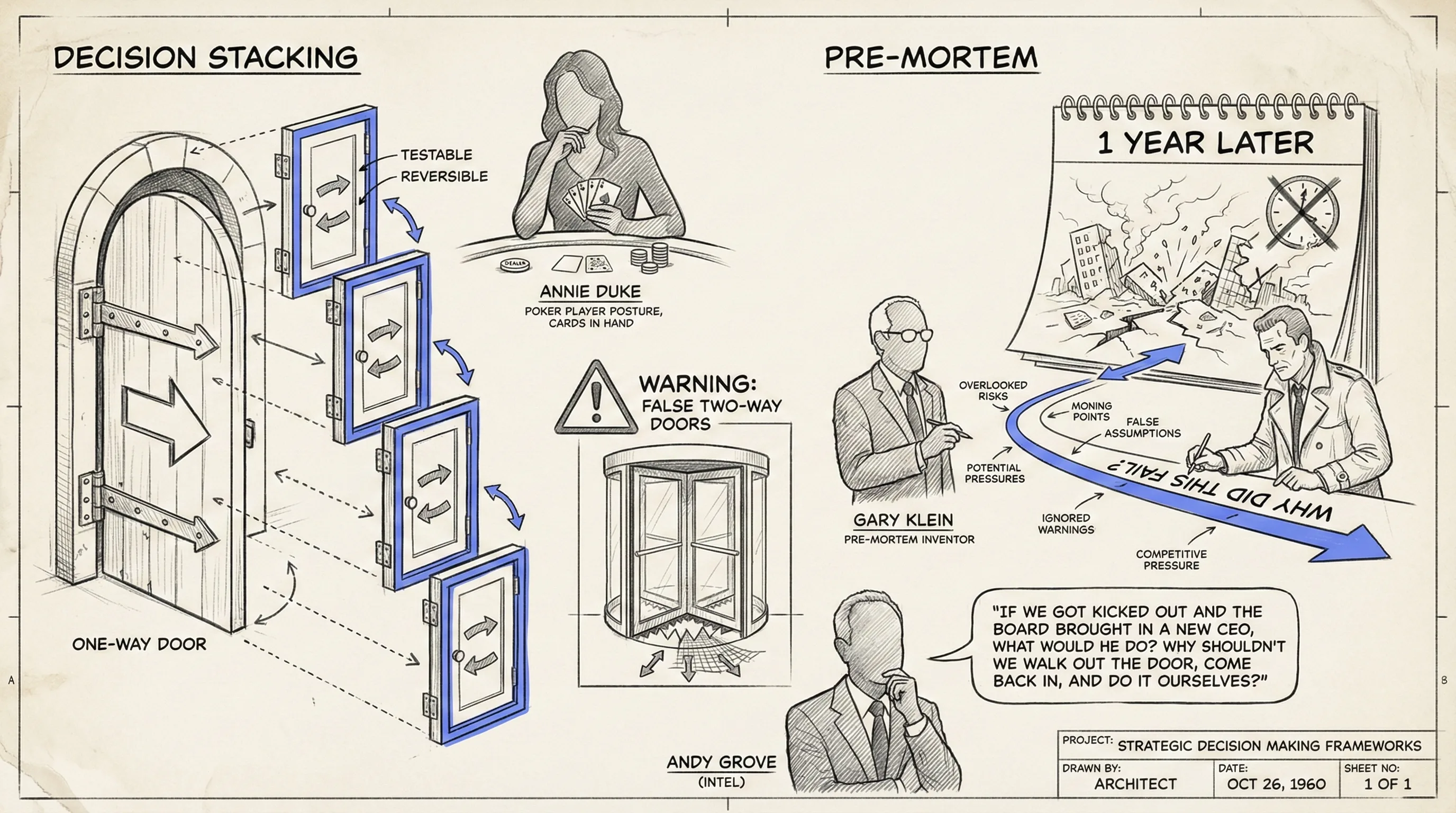
- →Decision stacking (Annie Duke): break one-way doors into a series of smaller, testable two-way doors.
The problem that costs you triple
If every decision in your company goes through you, the problem isn't your team. The problem is you're using the same hammer for nails and for screws.
Do you know how much time you spend deciding? 40% of your working time. Four hours out of ten. And of that 40%, how much is time well spent?
According to McKinsey — which interviewed 1,200 global managers — 60% of that time is wasted. Sixty percent. That means every week you throw away nearly three entire days on decisions that didn't require that level of attention.
Every decision costs you something. Not money — mental energy. Deciding what to eat for lunch and deciding whether to fire the sales director draw from the same reserve. It's called decision fatigue. The more decisions you make, the worse you make them. Not because you're less sharp — because the tank empties.
The point isn't HOW MANY decisions you make. The point is you use the same process, the same attention, and the same time for decisions that don't deserve it. Warren Buffett closes billion-dollar acquisitions in forty-eight hours. How long does it take you to choose business software?
Buffett isn't smarter. He uses different criteria for different decisions. This distinction — the difference between decisions that deserve your time and decisions that don't — is something we see missing in nearly every company we work with. A problem similar to the hidden constraint blocking growth.
“The point isn't how many decisions you make. The point is you're using the same hammer for nails and for screws.”
Data
McKinsey Global Survey 2019: 40% of working time goes to decisions. 60% of that time is wasted. Nearly 3 days per week thrown away.
The door metaphor: Type 1 and Type 2
In 2015, Jeff Bezos wrote a letter to Amazon shareholders. Hidden among the numbers and projections, he included a sentence that changed how Amazon makes decisions:
"Some decisions are consequential and irreversible. But most decisions aren't like that."
Bezos introduced a framework. He called it: Type 1 and Type 2 decisions. And he used a metaphor: a door.
One-way door (Type 1): you walk through it and can't go back. The lock clicks shut. These decisions deserve caution, analysis, time.
Two-way door (Type 2): you walk through, see what's on the other side, and if you don't like it you walk back. The cost? Minimal. The time lost? Recoverable. The damage? Reversible.
James Clear explains it with another analogy: hats, haircuts, and tattoos. Hats you try on and take off. Haircuts grow back. Tattoos are forever. Most of your business decisions? They're hats. And you're treating them like tattoos.
When companies grow, something specific happens: every door gets locked. Every decision gets treated as irreversible. Bezos says it clearly: "As organizations get larger, there seems to be a tendency to use the heavy-weight Type 1 decision-making process on most decisions." Result? Slowness. Micromanagement. Decisions that should take thirty minutes end up taking three weeks.
“Some decisions are consequential and irreversible. But most decisions aren't like that.”
— Jeff Bezos, Shareholder Letter, 2015
Amazon Prime, AWS, and Kodak: three lessons
Here's the twist. You know what was a Type 2 decision for Amazon? Amazon Prime. The service that today is worth tens of billions of dollars per year. At launch in 2005, it was a two-way door. Bezos could have shut it down the next day — he would have lost a few million, nothing for Amazon.
And Type 1? AWS — Amazon Web Services. Entering cloud computing, an entirely new market with billions in infrastructure investment, that YES was irreversible. It took two years of analysis. Today AWS generates more than $100 billion per year — roughly 60% of all Amazon operating income.
But there's also the opposite mistake. Treating irreversible decisions as reversible. This kills companies.
Kodak and Fujifilm. In the '90s, both face the same problem: the shift from film to digital. A one-way door. Fujifilm treats it as such — analyzes, invests, diversifies. Kodak treats it as two-way: "We can always go back to film. Digital is a fad." In 2012, Fujifilm thrives. Kodak declares bankruptcy.
On the other side, Google changed the shade of blue on search result links. A one hundred percent two-way door — reversible in a second, tested with A/B testing. Result: $200 million more per year. And how much time did you spend choosing the color of your logo?
Example
Amazon Prime (tens of billions/year) was Type 2 at launch. AWS ($100B+/year) was Type 1 and required 2 years. Google earned $200M/year by changing a shade of blue — a decision reversible in a second.
Bezos's 70% rule
In 2016, Bezos returned to the topic in the shareholder letter:
"Most decisions should probably be made with somewhere around 70% of the information you wish you had."
Seventy percent. If you wait for ninety, you're too slow. Because — and this is the sentence you need to remember — the cost of waiting is almost always higher than the cost of being wrong. For Type 2 decisions.
This principle connects directly to what we analyzed in the Gore Waterline Principle: decisions "above the waterline" — reversible, low impact — should be made quickly by whoever is closest to the problem. Decisions "below the line" deserve consultation.
The point is that most entrepreneurs treat EVERY decision as if it were below the line. And this creates the bottleneck that slows everything down.
“Most decisions should probably be made with somewhere around 70% of the information you wish you had.”
— Jeff Bezos, Shareholder Letter, 2016
The Door Test: 3 questions, 30 seconds
Knowing that two types of doors exist is useless if you don't know HOW to classify yours. Here's the Door Test — it works for any decision in thirty seconds.
Question 1: "If I'm wrong, can I reverse it in less than 4-8 weeks?"
The range depends on your business. An agency is different from a manufacturing company. But the principle is the same. If the answer is YES — it's Type 2. Decide fast. If the answer is NO — move to question two.
Question 2: "How much does being wrong cost compared to how much waiting costs?"
The client you lose while "thinking about it." The opportunity that slips away while you "analyze a bit more." The competitor who acts while you hold meetings. In most cases, waiting costs more.
Question 3: "Who on my team can make this decision without me?"
If someone can, and the decision is Type 2 — delegate it. Don't supervise it. Don't approve it after. Delegate it, period. Your job isn't to make Type 2 decisions. Your job is to create the conditions for your team to make them without you.
For Type 2 decisions, two precise rules: 48 hours — if you haven't delegated it, you have forty-eight hours to decide. And if someone on your team can make it, it's not your decision.
Insight
The Door Test: (1) Can I reverse it in 4-8 weeks? (2) Does waiting cost more than being wrong? (3) Who can decide without me? If it's Type 2: 48 hours or delegate it.
Case study: the 2.8M agency that recovered 15 hours per week
Filippo, CEO of a marketing agency in Milan. Revenue 2.8 million euros. Fourteen people. The first thing he told me: "Nour, my team doesn't decide anything without me."
Every contract, every quote, every hire, every campaign — everything went through his desk. He worked twelve hours a day. The team sat there waiting for his OK. He was the bottleneck slowing everything down.
I taught him the two-door framework in a thirty-minute call. Then we organized a meeting with his team. Thirty minutes. I explained the metaphor. Gave a couple of examples. And we established one rule — just one:
"If it's Type 2, you decide. If you're wrong, we'll fix it."
Meetings to choose a tool — which previously took three days of emails and calls — were resolved in thirty minutes. The team classified the decision, saw it was Type 2, and acted.
Filippo recovered 15 hours per week. And he told me something that stuck with me: "I no longer feel indispensable. I finally feel like an entrepreneur."
This is the same principle that Toyota applies with the Andon cord: giving decision-making power to whoever is closest to the problem. The framework is different, the result is the same — speed without losing control.
“I no longer feel indispensable. I finally feel like an entrepreneur.”
— Filippo, CEO — marketing agency, 2.8M
Decision stacking and pre-mortem: tools for Type 1
And truly irreversible decisions? Those deserve different tools.
Decision stacking (Annie Duke, former poker champion): many decisions that SEEM like one-way doors can be broken into smaller ones. Instead of "let's change our entire business model" — irreversible — you try: "let's test a new service for three months" — reversible. Then measure. Then decide the next step.
But be careful: there are "false two-way doors". Decisions that SEEM reversible but have hidden costs. Firing someone — technically you can rehire them, but the relational damage is permanent. Announcing a strategy you then abandon — you can change direction, but lost credibility doesn't come back. If in doubt, treat the decision as Type 1.
For true Type 1 decisions there's the pre-mortem by Gary Klein (HBR, 2007). Instead of asking "what could go wrong?", change the question: "It's been one year. This decision was a complete disaster. Tell me why." The brain shifts from predicting to explaining — and finds risks everywhere. The original study (Mitchell, Russo, Pennington 1989) shows this technique increases risk identification by 30%.
Andy Grove, former CEO of Intel, added the "outside view": "If we got kicked out and they brought in a new CEO, what would they do?" It forces you to look at the situation without your biases.
Warning
False two-way doors: decisions that SEEM reversible but have hidden costs (relationships, credibility, trust). If in doubt, treat the decision as Type 1.
Disagree and commit: the 5 words that break deadlock
In 2016, Bezos introduced a concept that unblocked hundreds of decisions at Amazon: "Disagree and Commit."
When there's no consensus on a Type 2 and time is running out, someone says five words: "I disagree. But I commit."
Bezos himself did it. There was a project for an Amazon Original — a show — that his team was pushing for. Bezos wasn't convinced. You know what he said? "I disagree and commit. And I hope it becomes the most watched thing we've ever made."
Five words that unblock weeks of deadlock. Because total consensus is a luxury that fast companies can't afford. For two-way doors, a committed disagreement is worth more than an infinite agreement.
You don't need to decide better. You need to decide differently. Fast where the cost is low. Slow where it truly matters.
As Bezos says: "Being wrong might cost less than you think. Being slow will certainly cost more than you think."
Homework: every Friday for the next 4 weeks, take the last 10 decisions of the week. For each one: one-way door or two-way door? I'll bet at least 7 out of 10 are Type 2. And at least 3 you could have delegated.
“Being wrong might cost less than you think. Being slow will certainly cost more than you think.”
— Jeff Bezos
Frequently Asked Questions
What are Bezos's Type 1 and Type 2 decisions?+
Jeff Bezos introduced this distinction in the 2015 Amazon shareholder letter. Type 1 decisions are "one-way doors" — irreversible, with heavy consequences. Type 2 are "two-way doors" — reversible, low cost. Most business decisions are Type 2, but companies treat them all as Type 1, causing slowness and micromanagement.
What is the Door Test and how do you apply it?+
The Door Test is a 3-question framework to classify any decision in 30 seconds: (1) If I'm wrong, can I reverse it in 4-8 weeks? (2) Does waiting cost more than being wrong? (3) Who on my team can make it without me? If the answer to the first is yes, it's Type 2: decide in 48 hours or delegate it.
What is decision stacking?+
A concept from Annie Duke (former poker champion, author of "Thinking in Bets"): many decisions that seem irreversible can be broken into smaller, reversible ones. Instead of "let's change our entire business model" (irreversible), you test "let's try a new service for 3 months" (reversible). Then measure and decide the next step.
What is Gary Klein's pre-mortem?+
A technique published in the Harvard Business Review in 2007. Instead of asking "what could go wrong?", you ask: "It's been one year. This decision was a complete disaster. Tell me why." The brain shifts from predicting to explaining — and finds risks it would otherwise have minimized. According to the original study (Mitchell, Russo, Pennington 1989), it increases risk identification ability by 30%.
What is Amazon's "disagree and commit"?+
Introduced by Bezos in the 2016 letter: when there's no consensus on a Type 2 decision, someone says "I disagree, but I commit." Bezos himself did this for an Amazon Original he didn't believe in. It unblocks weeks of deadlock because total consensus is a luxury fast companies can't afford.
Related Articles
Let's build the system for your business.
Let's discuss how to apply these principles to your specific situation.
Let's talk →