
How to scale without destroying what you bought (the wrong PE playbook in Italy)
The Vista Equity playbook works for American software companies. Applying it to Italian SMEs destroys exactly what makes them valuable. There is an alternative framework.
Nour Madani
CEO & Founder, Madani
Key Takeaways
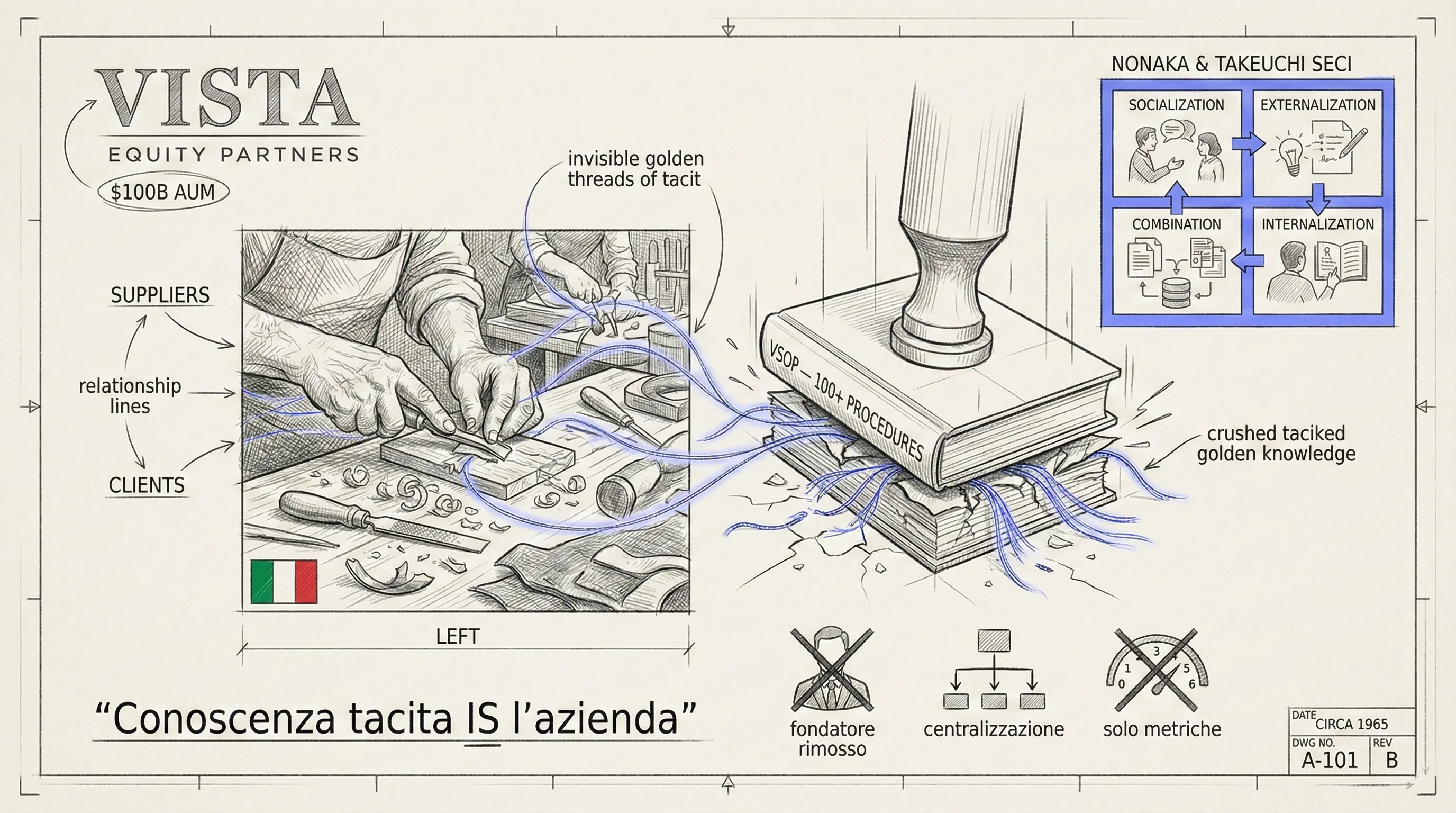
- →The Vista Equity playbook (VSOP, 100+ procedures) was designed for American software companies — explicit-knowledge businesses. Italian SMEs are containers of tacit knowledge.
- →The 3 errors that kill value: (1) Replace the founder too soon, (2) Centralize everything, (3) Measure only what's measurable. Each one removes the tacit knowledge that IS the company.
- →The alternative framework: "Scale the uniqueness, don't standardize it." 4 principles: identify before integrating, amplify instead of replacing, transfer through osmosis, create synergies from the bottom up.
- →The 3 immediate steps: tacit knowledge audit (who are the 5 key people?), preservation indicators in monthly reporting, slow down integration to understand before changing.
The hidden problem: you're using the wrong playbook
If you've bought an Italian family business and the synergies aren't materializing — if you have a group of companies that on paper should be worth more than the sum of its parts but in reality isn't — the problem is probably not where you think it is.
Most operators buying Italian companies are using the wrong playbook. Not because they're stupid, but because the playbook everyone copies was designed for a different market.
Vista Equity Partners. 100 billion under management. The gold standard of private equity. They have a playbook — VSOP — with more than 100 standardized procedures. Their philosophy: "The more standardized the input, the more standardized the output."
It works. For American software companies. But Italian SMEs are not American software companies. And when you apply the wrong playbook, you don't get efficiency — you get value destruction.
Warning
Vista Equity VSOP: 100+ standardized procedures. Philosophy: "The more standardized the input, the more standardized the output." Works for US software. Destroys Italian SMEs.
Tacit vs explicit knowledge: the heart of the problem
There's a concept from the philosophy of knowledge. Two types of knowing.
Explicit knowledge: what you can write in a manual. Measure. Standardize. Transfer. An American software company is primarily explicit knowledge — code, processes, metrics. Everything can be written and replicated.
Tacit knowledge: what lives in relationships. In intuition. In experience. What you can't codify.
A third-generation Italian family business? It's a container of tacit knowledge. The relationship with that supplier built over 30 years. The intuition about materials inherited from the grandfather. The way of treating clients that's written nowhere. The sensitivity about when an employee is going through a difficult time.
None of this is in a balance sheet. None of this is in a playbook. None of this can be measured. But it IS the company.
When you apply a playbook that "standardizes the input," you're removing the tacit knowledge. You're removing the company. You're left with the shell. The brand. The clients — for a while. But the substance is gone. This is the same mistake that Toyota resolved with Double Loop thinking: looking beyond the visible process to understand the underlying thinking system.
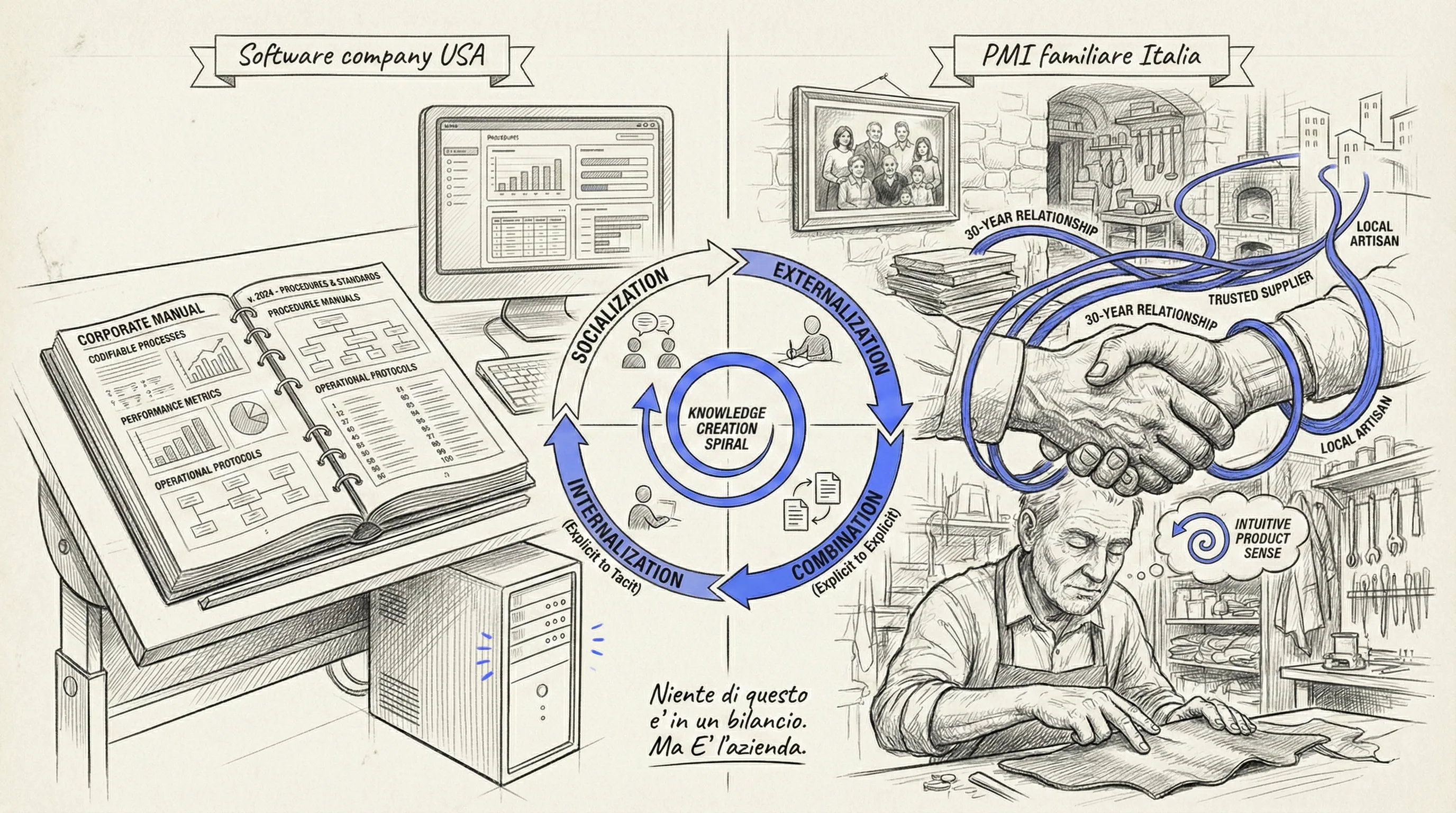
“The Italian family business is a container of tacit knowledge. None of this is in a balance sheet. But it IS the company.”
Error 1: Replacing the founder too soon
The founder sells. Wants to exit. The instinct is: "OK, let's put in a new manager and implement our processes."
Problem: the founder is the container of tacit knowledge. When they leave too early, that knowledge leaves with them. Supplier relationships? Compromised. Client intuition? Lost. Employee trust? Reset to zero.
What to do instead: gradual transition. Minimum 12-18 months of structured shadowing. Not to "hand over" — that doesn't work. But to allow the new management to ABSORB the tacit knowledge. Through direct experience. As in the Waterline Principle: "below the waterline" decisions require consultation — and replacing the person who holds the knowledge is definitely below the line.
Example
The gradual transition isn't "handing over" — it's allowing the new management to absorb tacit knowledge. Minimum 12-18 months of structured shadowing.
Error 2: Centralizing everything
You buy 5 companies. You want synergies. "Let's centralize procurement. Centralize finance. Centralize HR." On paper it makes sense.
Problem: you're removing the touchpoints where tacit knowledge lives. The relationship with that local supplier? Now it goes through central procurement that doesn't know the history. Managing that employee who's been there 25 years? Now it's a ticket in an HR system.
What to do instead: centralize visibility, not control. Shared dashboard. Reporting standards. Documented best practices. But leave execution local. Real synergies come from knowledge sharing, not power centralization.
It's the same principle that works in decentralized organizations: sharing information without centralizing decisions. As the Theory of Constraints model demonstrated, the constraint must be managed — not eliminated by forcing uniformity.
Error 3: Measuring only the measurable
KPIs. Dashboards. Metrics. "What gets measured gets managed." True. But there's a corollary: "What doesn't get measured gets ignored."
In Italian companies, the most important things can't be measured: the quality of relationships, the depth of knowledge, trust, culture. If you manage only by numbers, you'll systematically ignore what makes the company valuable. And when you notice something is wrong, it'll be too late.
What to do instead: create qualitative indicators for tacit knowledge. "How many pre-acquisition employees are still here?" "Is the founder still accessible for strategic questions?" "Are historical suppliers maintaining the same terms?" These aren't traditional KPIs. But they tell you if you're preserving or destroying.
Insight
Preservation indicators: pre-acquisition employee retention, founder accessibility, historical supplier stability. If they deteriorate, you're destroying value — even if revenue grows.
The alternative framework: scale the uniqueness
If the Vista playbook doesn't work for Italian SMEs, what does? Cases like Permasteelisa — acquired and employees INCREASED by 26% — show the way. The framework: "Scale the uniqueness. Don't standardize it."
Principle 1: Identify before integrating. Before changing anything, spend 90 days mapping tacit knowledge. Who are the 3-5 people holding the company together? Which relationships are critical? Which processes aren't written down but are essential? Document it — not to standardize it, to protect it.
Principle 2: Amplify instead of replacing. Your goal isn't to replace the Italian way with the American way. It's to take what works and give it more resources. That salesperson with relationships with all key clients? Don't put them in a CRM. Give them a team. That artisanal process that seems inefficient? Before automating it, understand why it exists.
Principle 3: Transfer through osmosis, not manuals. Tacit knowledge doesn't transfer through documentation. It transfers through shadowing, time spent together, shared experience. Have the new management spend 6 months alongside the founder and long-standing employees. It's slow. It's expensive. It's the only way that works.
Principle 4: Create synergies from the bottom up. Real synergies don't come from the top. They come from connections between people in different companies. The sales director from company A spending a week with company B's. Best practices that emerge spontaneously from sharing. Synergies are discovered. Not imposed.
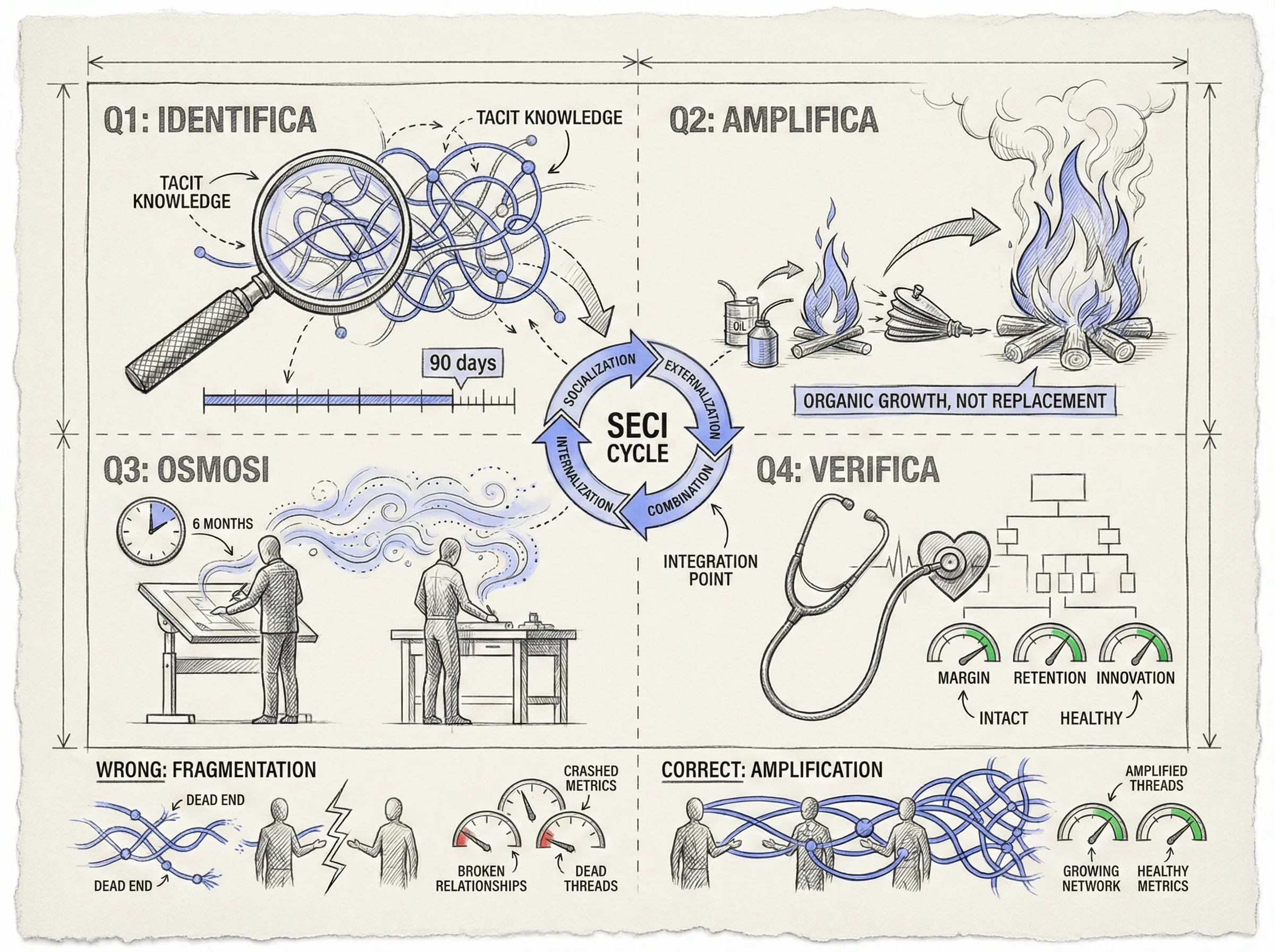
“Synergies are discovered. Not imposed.”
The 3 steps to take tomorrow
What do you do tomorrow? Three things.
1. Tacit knowledge audit. For every company in your group: who are the 5 people who, if they left, the company stops functioning? Write down the names. Those people are your priority.
2. Preservation indicators. Add to your monthly reporting: pre-acquisition employee retention, historical supplier retention, founder accessibility. If these numbers deteriorate, you're destroying value — even if revenue grows.
3. Slow down integration. If you have recent acquisitions and you're pushing to integrate fast: stop. Every month you wait to understand before changing is a month of preserved value.
Insight
Step 1: identify the 5 key people per company. Step 2: monitor retention and relationships in monthly reporting. Step 3: slow down integration — understand before changing.
Two philosophies, one choice
American private equity is built on one philosophy: maximize shareholder returns. Everything else is inefficiency.
Italian companies are built on a different philosophy: the company serves the family, the employees, the community, future generations. Profit is a means, not the end.
These two philosophies aren't compatible. But you don't have to choose the American philosophy just because it has more money behind it. You can build a group that scales uniqueness instead of standardizing it. That preserves tacit knowledge instead of eliminating it. That grows without destroying what it bought.
It's not the fastest way. It's not the way they teach in MBA programs. But it's the way that works for Italian companies. And perhaps it's the way that builds something that lasts.
“The Italian company serves the family, the employees, the community, future generations. Profit is a means. Not the end.”
Frequently Asked Questions
Why doesn't the American PE playbook work on Italian SMEs?+
Because the playbook (like Vista Equity's VSOP, 100+ standardized procedures) is designed for explicit-knowledge companies — code, processes, metrics, everything codifiable and replicable. Italian family SMEs are containers of tacit knowledge: thirty-year supplier relationships, inherited intuitions, ways of handling clients that aren't written anywhere. Standardizing these companies means removing what makes them valuable.
What is the difference between tacit and explicit knowledge?+
A concept from Nonaka and Takeuchi (SECI Model). Explicit knowledge is what you can write in a manual — measure, standardize, transfer. Tacit knowledge lives in relationships, intuition, experience. You can't codify it. In Italian SMEs, tacit knowledge IS the company: the relationship with that supplier built over 30 years, the intuition about materials inherited from grandfather, the way of treating clients.
What is the "Scale the Uniqueness" framework?+
An alternative framework to the American PE playbook, based on 4 principles: (1) Identify before integrating — spend 90 days mapping tacit knowledge. (2) Amplify instead of replacing — give more resources to what works, don't replace it. (3) Transfer through osmosis — 6 months of shadowing, not manuals. (4) Create synergies from the bottom up — exchange between people, not centralization of power.
What are the first steps after acquiring an Italian SME?+
Three steps: (1) Tacit knowledge audit — for each company, identify the 5 people without whom it doesn't function. (2) Preservation indicators — add to reporting: pre-acquisition employee retention, historical supplier retention, founder accessibility. (3) Slow down integration — every month you wait to understand before changing is a month of preserved value.
Related Articles
Let's build the system for your business.
Let's discuss how to apply these principles to your specific situation.
Let's talk →