
Where all the money is going (the Degen Economy explained)
From 2% to 34% of Gen Z gambling — in a single year. It's not madness. It's a calculation. And it has a name: financial nihilism.
Nour Madani
CEO & Founder, Madani
Key Takeaways
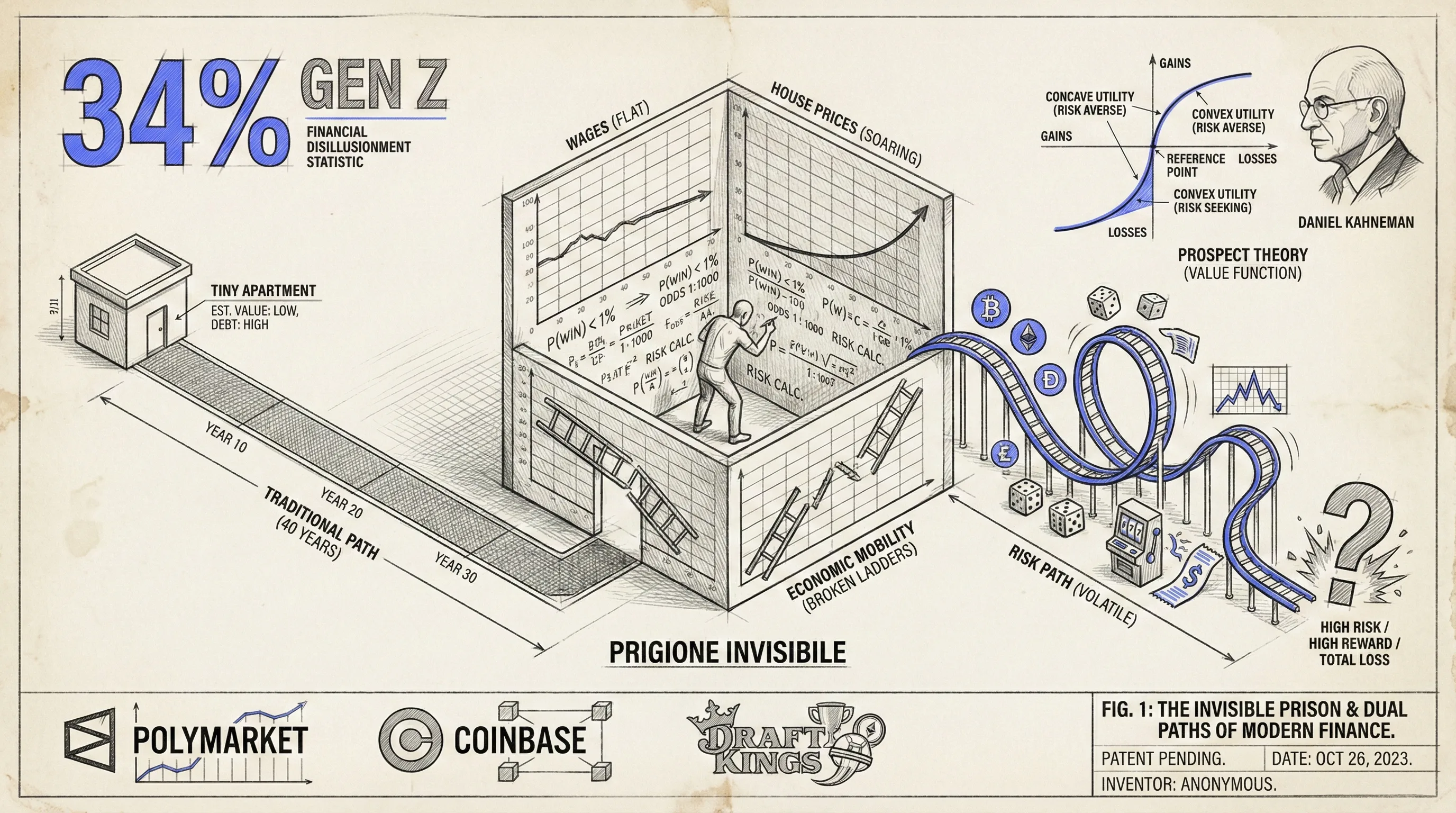
- →34% of Gen Z gambles (it was 2% a year earlier). It's not impulsivity — it's a rational response to a system that stopped keeping its promises (TransUnion Q2 2025).
- →The "Invisible Prison": you can survive, but you can't imagine a realistic path to the life you're supposed to have. The work-reward pact is dead.
- →The "Prisoners' Calculation": a 5% chance of escape is mathematically more attractive than a 100% chance of staying stuck. Prospect Theory (Kahneman & Tversky): those who feel they're losing prefer high risk.
- →Three choices: moralize (useless), be the player (dangerous), be the house (strategic). The difference between betting IN the casino and betting ON the casino.
A number that doesn't add up
34% of Gen Z gambles. A year ago it was 2%. Two percent. In a single year — twelve months — it went to 34.
The first reaction is: they've lost their minds. An entire generation has gone insane. Too much TikTok, too much Instagram, too many influencers with rented Lamborghinis. Young people don't know how to manage money.
We all think it.
What if they're right? Not in the sense that gambling is smart. But in the sense that they've figured something out about the system — something the rest of us don't want to see because admitting it would mean questioning everything we believe in.
This isn't a story about gambling. It's a story about a prison. A prison with no bars. No walls. No guards. And the prisoners have done the math.
Data
TransUnion Q2 2025: the percentage of Gen Z gambling went from 2% to 34% in a single year. 42% of Millennials gamble (was 33%).
The Invisible Prison
You don't have to be locked up to be a prisoner. There's a type of prison where you can walk around, work, go out on Saturday night, post vacation photos — but you're stuck. You can SEE the life you're supposed to have. The house with a garden. The car not on installments. The luxury of saying "I'm not working today" without your stomach clenching.
You simply can't imagine a realistic path to get there.
It's not "hard." Hard implies a road exists and it's tough. Here the road doesn't exist.
I call this The Invisible Prison.
But to understand the prison, you need to understand the pact that built it. Because this prison hasn't always existed. Someone created it — not with a plan, not out of malice. They created it by breaking a promise.
“It's not "hard." Hard implies a road exists and it's tough. Here the road doesn't exist.”
The broken pact
1950. The pact was simple: work hard, do overtime, be loyal to the company — and in return the company is loyal to you. A house. A pension. A better life for your children.
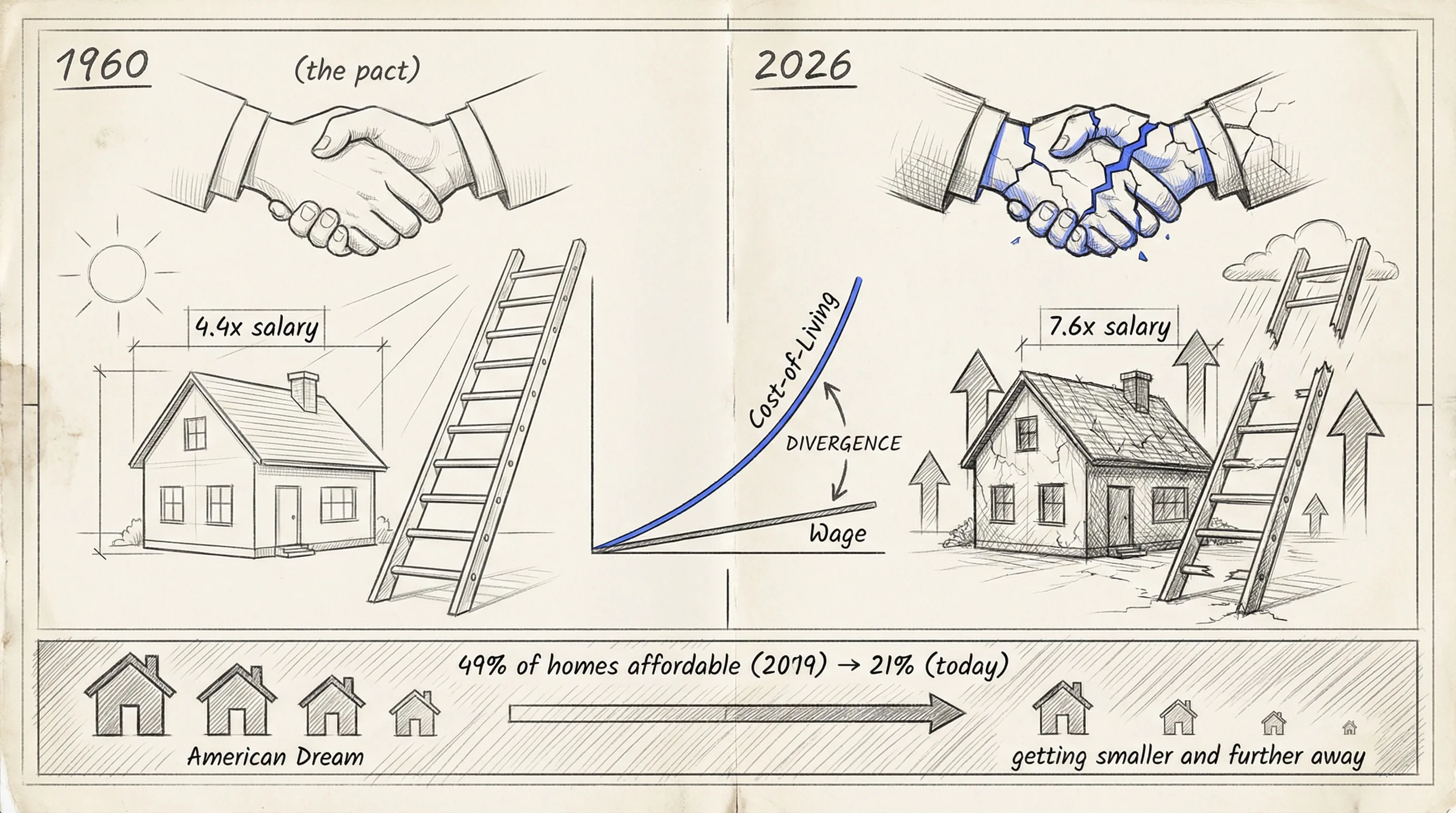
And it worked. The numbers prove it. In 1960, buying a house took 4.4 years of average salary. Four and a half years. You worked, saved, and the roof was yours.
That pact is dead. Today that number is 7.6. Nearly double. But the real numbers are worse than that.
In 2019 — six years ago — if you earned $75,000 a year you could afford 49% of homes on the market. Today? 21%. Less than half of half. On the same salary.
95% of American workers say wages aren't keeping up with the cost of living. Only 9% received a raise to compensate for inflation. Real wages have been flat for 40 years.
Let's recap: work hard, do overtime, be loyal to the company — and in return the company gives you... nothing. The pact was: you give, the system gives back. The system stopped giving. But it keeps asking. The ladder has been pulled up. And those who climbed it look down and preach patience.
Data
Visual Capitalist: in 1960 a house cost 4.4 years of salary. Today 7.6. In 2019 with $75K you could afford 49% of homes — today 21%. EPI: real wages flat for 40 years.
The two forces: pull and push
The force that pulls you (pull). When a society solves survival problems — food, shelter, basic security — it doesn't become happier. It becomes more frustrated. Because the brain is free to worry about everything else: belonging, esteem, self-actualization.
Previous generations had a psychological advantage: when you're worried about hunger, you don't have mental space for existential questions. This generation doesn't have that distraction. They want experiences, meaning, to feel that Monday morning isn't just the price you pay for Friday night. And the traditional paths to these things are exactly the ones blocked by the broken pact.
The force that pushes you away (push). Two components. The first: artificial intelligence is coming for white-collar jobs. ChatGPT writes better than most junior marketers. Midjourney produces images that would have required years of training. Three years ago it was science fiction. Now it's a timeline.
The second: social media. The algorithm always shows you the next step up — the vacation you didn't take, the apartment you can't afford, the lifestyle just above yours. Previous generations compared themselves to their neighbors. Now the comparison group is infinite. The zero point — the one below which you feel you're losing — never stops moving upward.
When pull and push combine with a broken pact, something happens that has a precise name.
The Prisoners' Calculation
When you can survive but can't get anywhere, something breaks inside the way you make decisions. There's a term: financial nihilism, coined in 2021 by Demetri Kofinas, picked up by the Financial Times, CNBC, Bloomberg.
I call it The Prisoners' Calculation. It's not nihilism in the sense of "they don't care." It's the opposite. They care TOO MUCH — and they've done the math.
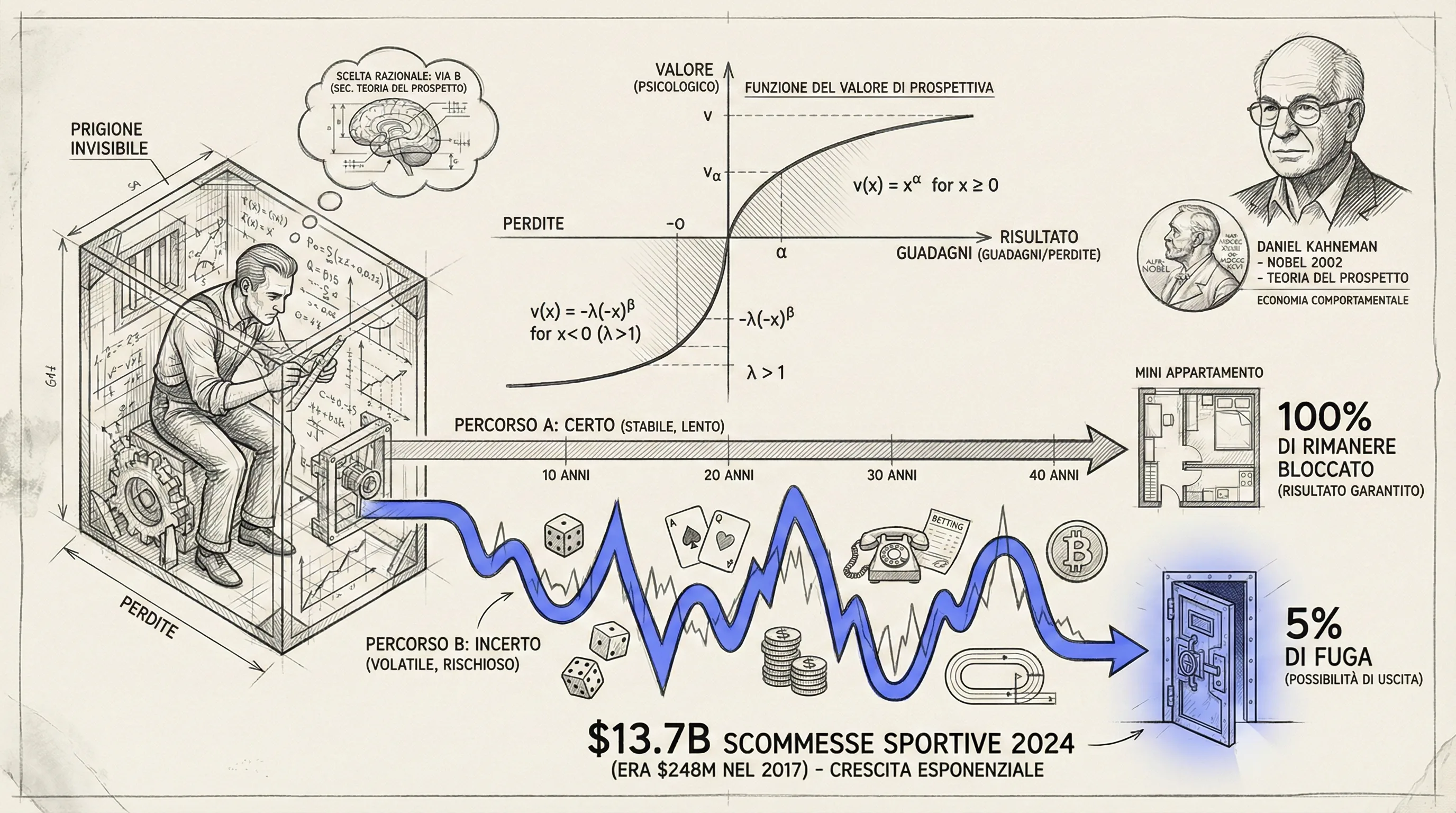
The calculation: if you save 500 euros a month for 40 years, you retire with maybe enough for a studio apartment in the suburbs. BUT if you take those 500 euros and put them on a crypto that does a 100x — you have a chance. Small. But real. To unlock in months what the traditional path promised in decades.
Economists call it "convex utility in losses" — Prospect Theory by Kahneman and Tversky (Nobel 2002). In simple terms: when you're already losing, you prefer a small chance of breaking even over a certain but slow loss. Same reason lottery tickets sell better in poor neighborhoods.
And here's the piece nobody says: social media have conditioned this generation to feel like they're losing EVEN WHEN they're objectively fine. The zero point has been shifted by the algorithm, continuously upward.
A 5% chance of escape is mathematically more attractive than a 100% chance of staying stuck. It's not financial ignorance. It's a rational choice under constraints.
“A 5% chance of escape is mathematically more attractive than a 100% chance of staying stuck.”
Insight
Prospect Theory (Kahneman & Tversky, 1979): those who perceive themselves as losing prefer high risk over a certain and slow loss. Social media have shifted the "zero point" upward for an entire generation.
The hope merchants
Where there's desperation, there are always vultures. The easiest thing to sell to a generation that has done The Prisoners' Calculation is a single word: hope.
Courses on how to make money. That teach you to sell courses on how to make money. To people who want to make money selling courses on how to make money. It's a pyramid. But when you tell someone trapped in the Invisible Prison that the 2,000-euro course is a scam, they're not listening — because the scam still seems better than the nothing they have now.
79% of Millennials and Gen Z seek financial advice on social media. 31% followed advice seen online. 55% of them lost money. More than half.
Legal sports betting went from $248 million in 2017 to $13.7 billion in 2024. But the point isn't whether gambling is right or wrong. The point is that those who say "you should stop" are almost always speaking from a privileged position — they're part of the class that benefited from the pact when it still worked.
For those trapped in the Invisible Prison, the advice "be patient" sounds like: "accept a life without hope." It's not the advice they reject. It's the premise.
Data
Chase UK: 79% of Millennials and Gen Z seek financial advice on social media. 55% lost money. US sports betting: from $248M (2017) to $13.7B (2024).
Three choices (and one is the right one)
There are three positions you can take.
1. Moralize. Preach against gambling. Tell them they should save, be patient. Your advice will be ignored — not because it lacks value, but because it presupposes a pact that no longer exists. You're giving directions for a demolished road.
2. Be the player. You can enter the casino yourself. But one rule: you have to be genuinely good. The casino is designed to take money from people who think they're good. If you're about to gamble with your life on the line, study as if your life depends on it. Because it does.
3. Be the house. The house always wins — not because it's smarter, but because it takes a commission on every transaction. Polymarket is raising investment at 8-10 billion dollars. The global betting market exceeds a trillion. Coinbase, DraftKings, Robinhood are publicly traded.
The bet isn't that some individual speculator wins. The bet is that the phenomenon continues. That the economic conditions pushing millions of young people toward risk won't change. Given the acceleration of AI, housing costs, wealth distribution — does this look temporary to you?
This is the difference between betting IN the casino and betting ON the casino. As Apple built a model where it collects before it pays, whoever builds the infrastructure wins regardless of the players.
Insight
I'm not saying buy stock. I'm saying understand the logic: when a phenomenon is structural, the smart question isn't "how long will it last" but "who inevitably profits from it."
The math doesn't work
There's a guy I know. Smart — the type who, when he talks about something, you can tell he's read everything. Works in tech. Earns well.
Last month he put $100,000 on a crypto trading platform. Not invested. Not allocated in a diversified portfolio. Put there to collect points that might turn into tokens that might have value.
I asked him why. He looked at me as if the question were absurd and said:
"What should I do instead? Save for twenty years and buy an apartment when I'm fifty-five?"
It's not an anecdote. It's a diagnosis. That guy did The Prisoners' Calculation. He looked at the traditional path and measured where it leads. He looked at the alternative path and measured where it leads. And he chose.
The question isn't: why are young people betting everything? The question is: why does a system that doesn't keep its promises expect people to keep believing in it?
Next time you see someone betting everything on a crypto, don't think: they're an idiot. Think: they've done the math.
The prisoners of this prison have done the math. And the math doesn't work.
“What should I do instead? Save for twenty years and buy an apartment when I'm fifty-five?”
Frequently Asked Questions
What is financial nihilism?+
A term coined in 2021 by analyst Demetri Kofinas, picked up by the Financial Times, CNBC, and Bloomberg. It doesn't mean "they don't care" — it's the opposite. They care too much, and they've done the math: the traditional path (save for 40 years) no longer leads anywhere. Extreme risk becomes a rational choice under constraints.
Why does Gen Z gamble more?+
Three forces converge: (1) The broken pact — in 1960 a house cost 4.4 years of salary, today 7.6. (2) Pull of higher needs (Maslow) + push from AI threatening jobs and social media shifting the zero point. (3) Prospect Theory: those who feel they're losing prefer high risk (convex utility in losses). TransUnion Q2 2025 confirms: from 2% to 34% in one year.
What is the Prisoners' Calculation?+
An analysis framework: when the traditional path promises a studio apartment in the suburbs after 40 years of saving, a 5% chance of unlocking everything in months becomes mathematically more attractive than a 100% chance of staying stuck. It's not financial ignorance — it's a rational choice under constraints, supported by Kahneman and Tversky's Prospect Theory (Nobel 2002).
What does "being the house" mean in this context?+
Instead of betting IN the casino (personal risk), you can bet ON the casino — on the structural phenomenon continuing. Polymarket is valued at 8-10 billion. Coinbase, DraftKings, Robinhood are publicly traded. The bet isn't that any single speculator wins, but that the economic conditions pushing millions toward risk won't change.
Related Articles
Let's build the system for your business.
Let's discuss how to apply these principles to your specific situation.
Let's talk →